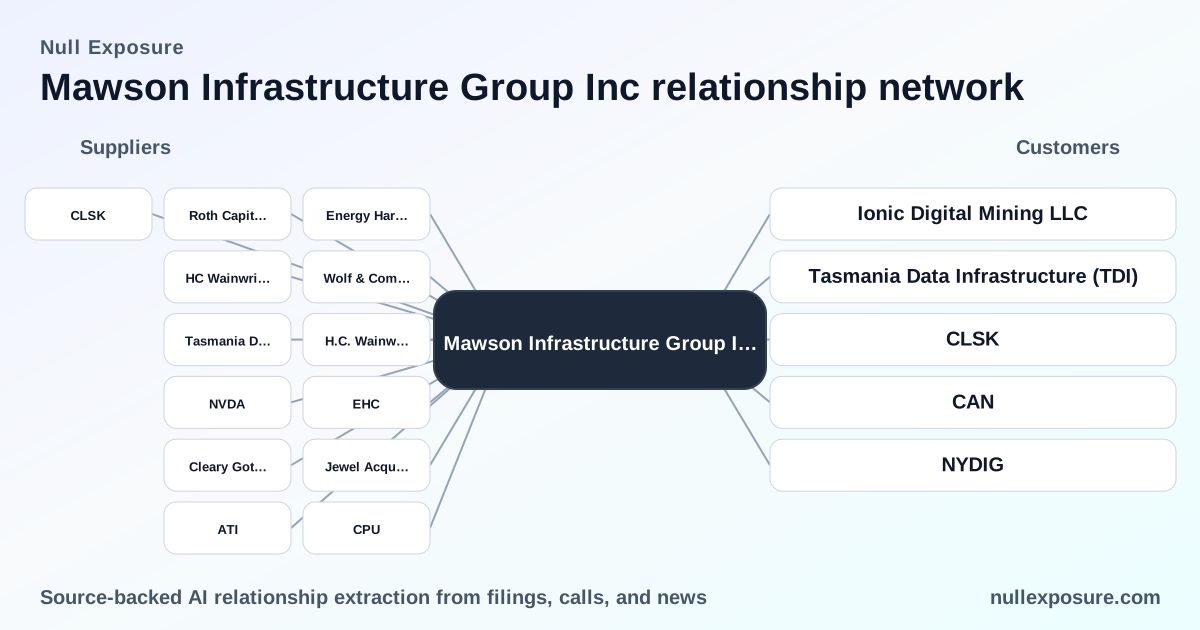
Mawson (MIGI) — who pays, who sues, and what that means for revenue quality
Mawson Infrastructure Group (MIGI) runs and monetizes digital colocation and bitcoin-mining infrastructure: it leases floor space and power to enterprise miners, charges colocation and related fees, often passes energy costs through to customers, and occasionally monetizes assets through facility sales or equity stakes exchanged for hardware. Revenue is a mix of recurring colocation fees and transactional monetizations (facility sales, equity-for-rigs deals), with customer relationships that combine short-duration and multi-year contracts and expose Mawson to operational and legal counterparty risk.
If you evaluate commercial exposure or counterparty credit for Mawson, this brief synthesizes each customer or partner relationship visible in public reporting and the operating constraints that shape them. For a quick corporate data and relationship feed, see https://nullexposure.com/.
What the relationship list tells investors — the headline takeaways
- Customer mix is enterprise-focused and North America–centric. Mawson operates as both a service provider (seller of colocation) and a customer-facing platform (hosting miners that keep mined coins). (Company disclosures and filings underline this NA focus and enterprise orientation.)
- Contracting posture is mixed and flexible. Public excerpts show both multi-year master colocation agreements and one-year starter agreements, implying Mawson balances lock-in with opportunistic short-term capacity deals.
- Operational risk is real and material. Reported litigation and disputes over hosted hardware underscore custody and counterparty enforcement risk — a direct business-critical exposure for a colocation operator.
Customer and partner relationships (every reported item)
Below are the relationships captured in public reporting; each entry includes a concise description and a source reference.
Ionic Digital Mining LLC
Mawson reached a confidential settlement with Ionic Digital Mining LLC to resolve claims arising from a co-location agreement, indicating a legally material dispute tied to hosting arrangements. According to Mawson’s FY2026 press release, the settlement concludes claims Ionic brought against Mawson and two subsidiaries. (The Globe and Mail press release, March 10, 2026.)
Tasmania Data Infrastructure (TDI)
Mawson took a 33% equity stake in Tasmania Data Infrastructure in exchange for roughly 1,975 bitcoin mining rigs, a capex-light growth move that converts hardware assets into an ownership stake in infrastructure. This transaction demonstrates Mawson’s willingness to monetize rigs via equity rather than cash proceeds. (CoinDesk coverage, FY2022.)
CAN (Canaan) — colocation agreement (first capture)
Canaan signed a three-year colocation deal with Mawson for the Midland facility, establishing a medium-term hosting customer relationship and predictable revenue for that site. (The Miner Mag, July 22, 2025; FY2025 reporting.)
CleanSpark, Inc. (CLSK) — Sandersville facility sale (first capture)
CleanSpark entered definitive agreements to acquire Mawson’s turnkey bitcoin mining facility in Sandersville, Georgia, for up to $33 million, representing a discrete, non-recurring monetization of infrastructure assets. This is an example of Mawson converting physical assets into cash to fund operations or reallocate capital. (ESG News/press coverage, FY2022.)
Canaan — corroborating capture (second record)
The Miner Mag entry is recorded again, corroborating the three-year Midland colocation agreement with Canaan and reinforcing that Mawson secures multi-year hosting contracts with OEM/mining clients. (The Miner Mag, July 22, 2025; FY2025.)
CLSK — corroborating capture (second record)
The ESG News item is captured a second time, reaffirming the Sandersville sale to CleanSpark for up to $33 million, which underscores that Mawson’s business includes asset-sale cycles alongside recurring colocation fees. (ESG News coverage, FY2022.)
NYDIG / Stone Ridge (Consensus Colocation)
Public reporting documents that Stone Ridge (parent of NYDIG) and its mining subsidiary sued Mawson, alleging Mawson unlawfully took control of more than 20,000 ASIC miners worth roughly $30 million housed at Mawson’s Midland facility — a high-dollar custody dispute that directly threatens service continuity and reputation with large institutional miners. (The Miner Mag, FY2025.)
How Mawson contracts and operates — constraints that shape revenue quality
Public constraint excerpts paint a coherent picture of Mawson’s operating model and business-model characteristics:
- Contracting posture: a mix of short and long terms. The company discloses both an initial three-year Master Colocation Agreement and a separate one-year Master Colocation Agreement with NASDAQ-listed counterparties, so Mawson runs both multi-year locked-in revenue streams and shorter-term, renewable arrangements. That mix supports liquidity while preserving optionality to reprice or reallocate capacity.
- Pricing structure: energy pass-throughs dominate operational variability. Colocation customers typically pay energy used on a pass-through basis, either fixed or variable, so Mawson’s gross margin is sensitive to energy contract design and commodity price exposure.
- Counterparty profile: enterprise-grade customers. Mawson serves large enterprise miners and operates digital infrastructure for both enterprise customers and its own operations, which concentrates exposure toward institutional counterparties rather than retail miners.
- Geographic focus: North America. Mawson has pivoted focus to North America and operates U.S. facilities, removing operating concentration in Australia and signaling growth and regulatory alignment in the U.S. market.
- Role complexity: both seller and buyer. Mawson charges colocation fees (seller role) while customers retain mining output (buyer role for the miners’ economic benefit), and it also engages in asset transactions (selling facilities or taking stakes), which makes revenue streams a hybrid of recurring service income and capital transactions.
- Relationship maturity and activity: ongoing but varied. Disclosures indicate active colocation operations and occasional asset sales or equity swaps; relationship stage is reported as active in general, but legal disputes illustrate lifecycle risk.
Investment implications — opportunities and clear risks
- Opportunity — flexible monetization: Mawson demonstrates multiple monetization channels: recurring fees, facility sales (Sandersville), and equity-for-rigs stakes (TDI). This diversification can accelerate cash generation without dilutive equity issuance.
- Risk — custody and legal concentration: The NYDIG/Stone Ridge litigation and the settled Ionic dispute are high-impact operational risks; disputes over hosted hardware and control of miners create both direct financial exposure and reputational damage that can depress new contract appetite from large institutional customers.
- Risk — energy pass-through structure: Because customers often pay energy on a pass-through basis, Mawson’s top-line visibility depends on the balance between fixed colocation fees and variable energy invoicing, and adverse energy contract terms can compress margins.
- Operational leverage — short vs. long contracts: The coexistence of one-year and three-year MCAs gives Mawson pricing flexibility but also creates renewal risk and potential revenue volatility if market pricing shifts or if large enterprise customers relocate capacity.
Bottom line for investors
Mawson’s revenue is a hybrid of recurring colocation fees and one-off monetizations, delivered to enterprise miners in North America. The company executes asset-light expansion strategies (equity-for-hardware) while managing material counterparty and custody risk that has already resulted in litigation. For anyone modeling MIGI’s revenue or counterparty exposure, prioritize scenario analysis around facility sales cadence, legal outcomes, and energy contract pass-through dynamics.
For a consolidated feed of Mawson counterparty events and constraints that informs underwriting and monitoring, visit https://nullexposure.com/.
For direct access to relationship-level records and continued updates, the coverage on the platform centralizes the sources cited above and ongoing disclosures.