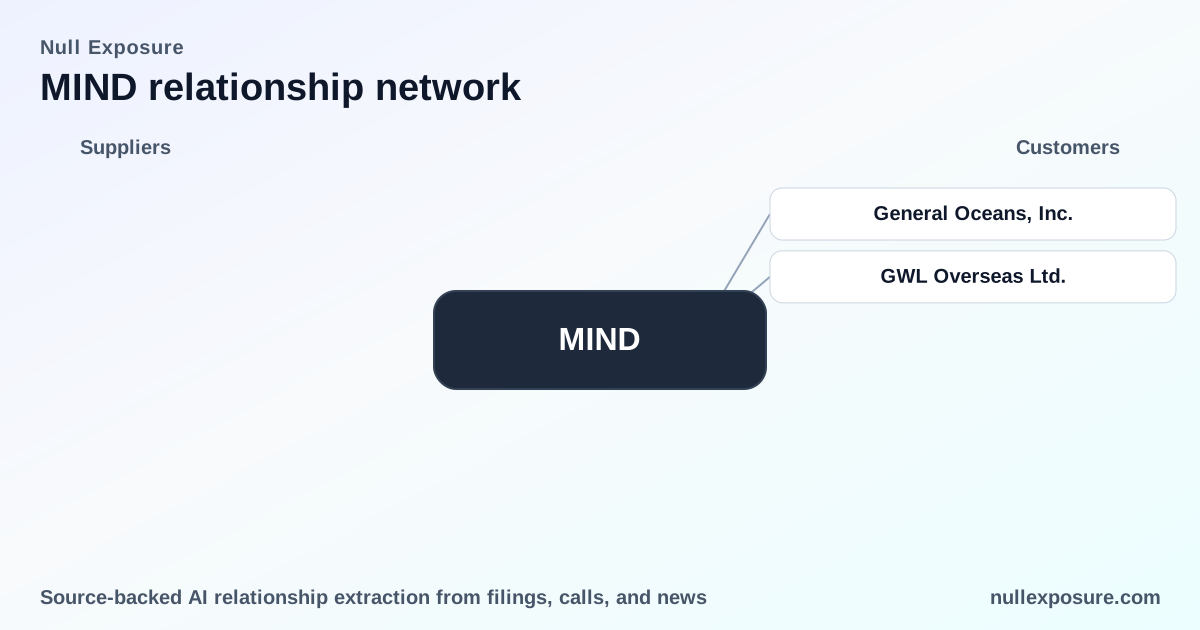
MIND Technology: customer map, concentration risks, and commercial posture
MIND Technology (NASDAQ: MIND) sells and supports oceanographic and hydrographic instrumentation and software through its Seamap unit and related businesses, monetizing via hardware sales, recurring yearly support and software licenses, and project-specific engineering and repair contracts. Revenue mixes into hardware, services and software with materially concentrated customer wins: a handful of buyers drive the majority of sales while recurring support contracts provide a modest, ratable revenue stream. For investors evaluating customer relationships, the commercial picture is one of product-led contracts, significant concentration and a geographically global footprint that ties performance to cyclical exploration and maritime spending.
Explore a clean, investor-focused view of these customer ties and what they imply for durability and risk on the company balance sheet: https://nullexposure.com/
Three customer relationships that move the needle
MIND’s public disclosures and industry reporting identify discrete commercial links with General Oceans, Inc. and GWL Overseas Ltd. Below I summarize each documented interaction in plain English with the reporting source.
General Oceans — asset sale to consolidate product lines (FY2025)
MIND sold Klein Marine Systems to General Oceans for $11.5 million as part of a transactional realignment of product families; the deal reduced MIND’s ownership of that legacy product line and delivered immediate cash consideration. According to SimplyWallStreet reporting in March 2026, the transaction closed for $11.5 million.
General Oceans — strategic software license for side-scan sonar (FY2023)
Separately, MIND licensed its Spectral Ai software suite to General Oceans for specified side‑scan sonar applications, establishing a commercial software relationship that allows General Oceans to deploy MIND’s analytics on its sonar systems. Marine Technology News reported this licensing arrangement in coverage associated with prior corporate activity (FY2023).
GWL Overseas Ltd. — collaboration to develop Floatseis acquisition system (FY2025)
MIND’s Seamap unit entered a collaboration agreement with GWL Overseas to further develop, promote and produce GWL’s Floatseis data acquisition system, positioning Seamap as a co‑developer and channel for an emerging marine seismic acquisition product. Ocean News covered the collaboration announcement in March 2026.
What the relationship map reveals about how MIND operates
The discrete deals above sit inside a few consistent commercial themes that define MIND’s operating model.
-
Product-led manufacturer and seller. Seamap both designs and manufactures hardware and sells integrated solutions to marine survey companies, seismic contractors, research institutes and non-military government agencies, so MIND acts as an OEM and solutions seller across hardware and software lines. Company filings explicitly state Seamap “designs, manufactures and sells a broad range” of products.
-
Mixed revenue streams with recurring support. MIND recognizes revenue from annual support contracts ratably over 12‑month terms, creating a modest recurring component to overall sales; however, filings indicate revenues from service contracts are not material in isolation even as they provide predictable tail revenue.
-
High customer concentration; single customers can move results. In fiscal 2025, the single largest customer represented roughly 36% of consolidated revenues and the top five customers accounted for 73% of revenue, signaling material concentration risk where the loss or slowdown of any major account would materially affect results.
-
Geographically global but regionally concentrated demand cycles. MIND operates out of the U.S., Singapore, Malaysia and the U.K. and reports material revenue by country (including Norway and China), showing a global footprint that exposes the company to regional oil & gas, seismic survey and maritime security spending cycles.
-
Orderbook-driven, cyclical fulfillment. Seamap reported an active backlog—about $16.9 million as of January 31, 2025—down from $38.4 million the prior year, indicating order volatility that translates directly into revenue timing and margin pressure as backlog levels normalize.
-
Customer mix includes government and research buyers. Sales target a mix of non-military governmental organizations, research institutes and commercial seismic and survey contractors, meaning several contracts are with government or quasi-governmental counterparties and often require compliance with procurement and long-term support expectations.
-
Segmentation across hardware, software and services. Filings and disclosures show MIND’s commercial model blends hardware manufacturing, software licensing and engineering/repair services, producing diversified product lines but also raising integration and after‑sales support demands.
How these characteristics translate to investment risk and upside
-
Risk: Concentration and order volatility. The combination of a top customer delivering 36% of revenue and a volatile backlog (declined >50% year-over-year) makes short-term revenue growth and margin recovery contingent on a small number of large contracts. This elevates operational leverage and execution risk.
-
Risk: End-market cyclicality. Exposure to seismic contractors and marine exploration ties performance to commodity-driven capex cycles in energy and national research budgets in EMEA/APAC, increasing revenue cyclicality despite a global footprint.
-
Upside: Software licensing and partnerships create higher-margin hooks. The Spectral Ai license to General Oceans and the Seamap–GWL collaboration illustrate a path to monetize software and co-development arrangements that can create recurring or annuity-like cash flows and broaden addressable markets beyond core hardware.
-
Upside: Strategic divestitures free capital and sharpen focus. The sale of Klein Marine Systems for $11.5 million demonstrates an ability to monetize non-core assets and streamline the product portfolio, which supports reinvestment into higher-margin software and systems development.
Investor takeaways and action points
- Primary thesis: MIND is a product-centric marine instrumentation company with concentrated customers and a modest recurring revenue base; value will be realized if management sustains software licensing growth and stabilizes order backlog through diversified customer wins.
- Monitor these signals: quarterly backlog trends, revenue contribution of the top five customers, progress on software licensing deals and the financial terms of any new collaborations or divestitures.
- Potential catalysts: accelerating Spectral Ai adoption, securing multi-year government survey contracts, or repeatable collaborations like the Seamap–GWL agreement that scale production and margins.
If you evaluate supplier and customer counterparty exposure, this profile helps prioritize diligence on concentration and backlog durability. For a concise exposure analysis and ongoing monitoring, see more at https://nullexposure.com/.
Closing perspective
MIND’s customer footprint is a mix of concentrated corporate accounts and strategically useful partnerships that reposition the firm from purely hardware provider toward hybrid hardware‑plus‑software vendor. The investment case is binary in the near term: execution on diversifying revenue away from a few large customers and growing recurring software income will materially compress risk and expand valuation; failure to do so keeps volatility high. Investors should weight current balance‑sheet strength and recent divestiture proceeds against the company’s demonstrated customer concentration and cyclicality when sizing exposure.