Mirum Pharmaceuticals (MIRM): Commercial relationships and what investors should know
Thesis: Mirum Pharmaceuticals monetizes by commercializing a focused portfolio of orphan and specialty liver medicines—principally LIVMARLI—through a hybrid model of direct U.S./North America commercialization and selective partnerships for international markets; product sales and partner supply agreements generate the company’s top-line, while gross margins reflect specialty pricing and modest operating leverage. For investors, the priority is assessing partner economics, geographic rollout cadence, and customer concentration—each of which drives near-term revenue variability and the durability of margins. For deeper relationship intelligence, see https://nullexposure.com/.
How Mirum makes money and where the leverage lies
Mirum’s revenue profile is a classic commercial-biotech model: product sales of three approved medicines (LIVMARLI, CHOLBAM, CHENODAL/CTEXLI) are the primary cash flows, supplemented by partner supply arrangements for markets where Mirum cedes commercialization to local pharmaceutical partners. Revenue for the trailing twelve months was approximately $521.3 million, with gross profit of about $421.1 million, indicating high product-level margins driven by specialty pricing. Mirum retains direct selling resources in the U.S., Canada and selected European countries while relying on partners for some international launches—this mix sets the contracting posture between captive selling costs and partner-shared commercialization expense.
One-page summary of customer relationships in the record
The dataset returned two relationship records, both from Mirum’s 2025 Q3 earnings call. Both entries reference the same partner activity in Japan.
-
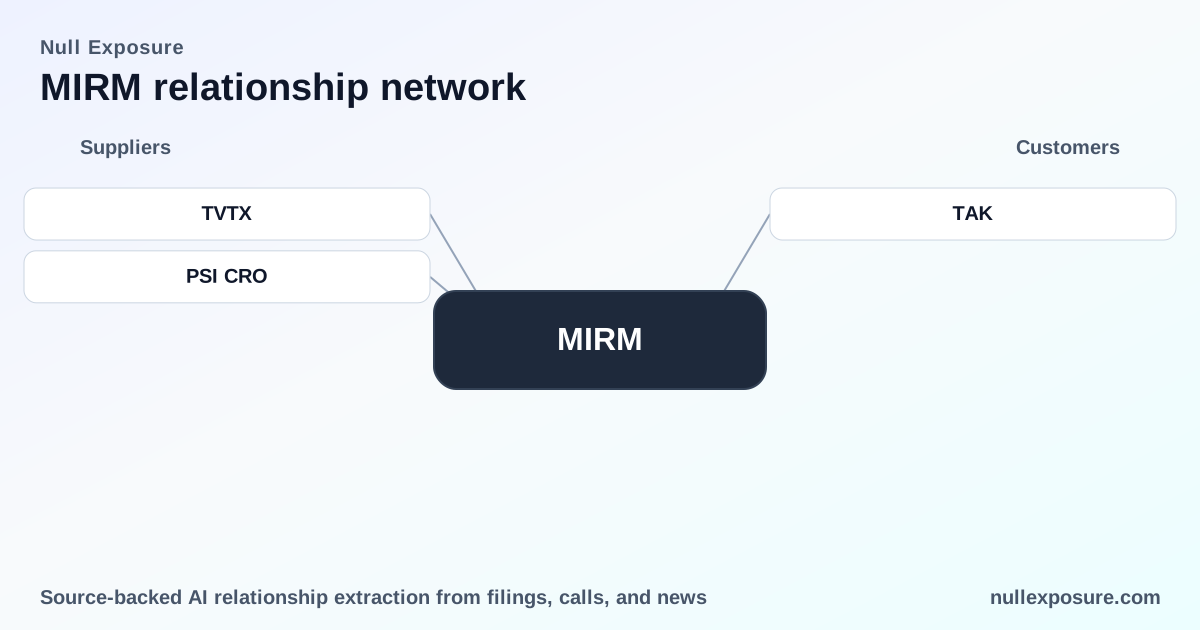
Takeda / TAK — 2025 Q3: Mirum reported that Q3 represented the first full quarter of commercialization through its partner Takeda in Japan, and that the quarter included approximately $5 million in sales to Takeda. This reflects Mirum supplying product to a commercial partner who is conducting local market activities in Japan. (Source: Mirum 2025 Q3 earnings call, commentary on Japan commercialization.)
-
TAK — 2025 Q3: The second record repeats the Takeda disclosure: Q3 was the first full quarter of in-market commercialization in Japan and included roughly $5 million in takedown sales to the partner. The duplicate capture reinforces that partner sales into Japan are active and reported explicitly in quarterly results. (Source: Mirum 2025 Q3 earnings call.)
Key relationship takeaway: Mirum has an active supply/commercialization relationship with Takeda in Japan; reported partner sales are currently modest relative to Mirum’s total revenue but represent the company’s strategy of using partners to scale outside North America. Investors should treat Takeda as a strategic international commercialization partner rather than a single-source revenue driver.
What the company-level constraints tell investors about commercial posture
The relationship data is limited to the Takeda disclosures, but the extracted constraints provide company-level signals that meaningfully shape the investment thesis.
-
Geography and go-to-market: Mirum directly markets LIVMARLI in the United States, Canada and certain European countries through a specialized commercial team, and the product has approvals in various other countries around the world. This confirms a hybrid model—direct commercialization in core markets with partners deployed for other territories, which reduces capital outlay for foreign launches while preserving higher margin sales in direct markets.
-
Materiality and concentration: Mirum reports that no single customer accounted for more than 10% of accounts receivable or annual sales in recent years. This is a material company-level signal: customer concentration risk is low, and partner sales such as the $5 million to Takeda are immaterial to overall revenue at present.
-
Role and stage: The firm is the seller of its core products and is in an active commercialization stage across its portfolio, including CHENODAL/CTEXLI and CHOLBAM alongside LIVMARLI. This positions Mirum as a revenue-generating commercial-stage biotech rather than a pure R&D-stage story; sales momentum and channel execution now drive valuation multiples.
-
Product mix and criticality: Mirum’s core products are approved medicines (LIVMARLI, CHOLBAM, CHENODAL/CTEXLI). Approval status and current commercialization make these products critical revenue drivers, but the business remains dependent on successful geographic expansion and uptake in orphan indications.
Together, these signals describe a mid-sized commercial biotech with low customer concentration, a balanced contracting posture (direct sales where practical, partner-based where necessary), and commercial maturity sufficient to generate consistent product sales. For operational diligence and competitor mapping, visit https://nullexposure.com/.
Investment implications and risk factors
-
Revenue durability and upside: With high gross margins and an active commercial footprint, Mirum’s near-term upside is tied to market penetration in existing direct markets and execution by partners like Takeda in new regions. Incremental partner rollouts could be earnings accretive without proportionate SG&A increases.
-
Partner reliance but low concentration: While Mirum leverages partners for international launches, partner revenue to date is small relative to total sales, and corporate disclosures indicate no customer exceeds 10% of revenue—this reduces single-counterparty dependency risk.
-
Operational and execution risk: Commercial-stage biotech margins are sensitive to reimbursement dynamics, specialty pharmacy access, and launch execution. The company’s specialized commercial team and partner network mitigate some risk, but geographic expansion remains execution-dependent.
-
Valuation context: Analysts show a positive bias—consensus target prices and buy ratings outnumber holds and sells—so market expectations are priced for continued commercial traction. Assess relative valuation against product growth and the pace of partner rollouts.
Bottom line for investors
Mirum operates as a focused commercial biotech: direct commercialization in key markets, partnered launches internationally, and product sales as the primary monetization engine. The Takeda relationship is active and producing partner sales (reported $5 million in 2025 Q3), but Mirum’s financials disclose low customer concentration, making partner receipts currently supplementary rather than central to revenue. Investors should emphasize monitoring partner rollout milestones, region-by-region uptake of LIVMARLI, and quarterly disclosures of partner sales to detect inflection points in international revenue contribution.
For tailored customer-relationship intelligence and ongoing tracking of Mirum’s partner performance, explore the platform at https://nullexposure.com/.