Milestone Pharmaceuticals (MIST): Customer relationships that underwrite early commercialization
Milestone Pharmaceuticals develops and commercializes CARDAMYST™ (etripamil) nasal spray for paroxysmal supraventricular tachycardia (PSVT) and monetizes through U.S. product sales, selective regional licensing, and upfront/royalty finance transactions. The company’s revenue profile is nascent, with commercialization anchored in a recently FDA‑approved product and amplified balance‑sheet flexibility from a $75 million royalty purchase; commercial traction will depend on formulary access and PBM coverage in the U.S. Learn more at https://nullexposure.com/.
Quick read: why relationships matter now
Milestone’s business transforms from development to commercial execution with CARDAMYST as the single critical product. Formulary wins, licensing partners in Greater China, and a monetization of U.S. royalty streams are the three customer-facing relationships that drive near‑term revenue and liquidity. Investors should treat these relationships as strategic levers: formulary placement unlocks prescribing and reimbursement, license partners broaden geographic reach, and royalty sales convert future cash flows to immediate funding.
The partner roster, one by one
Express Scripts — PBM national formulary placement
Express Scripts added CARDAMYST to its commercial national formularies effective March 27, 2026, giving Milestone access to a large commercial PBM network that materially improves potential patient access and reimbursement for U.S. sales. This formulary placement is documented in Milestone’s commercial announcement distributed via press channels in March 2026 and subsequently reported by multiple outlets. (Company press release / GlobeNewswire & March 2026 reporting)
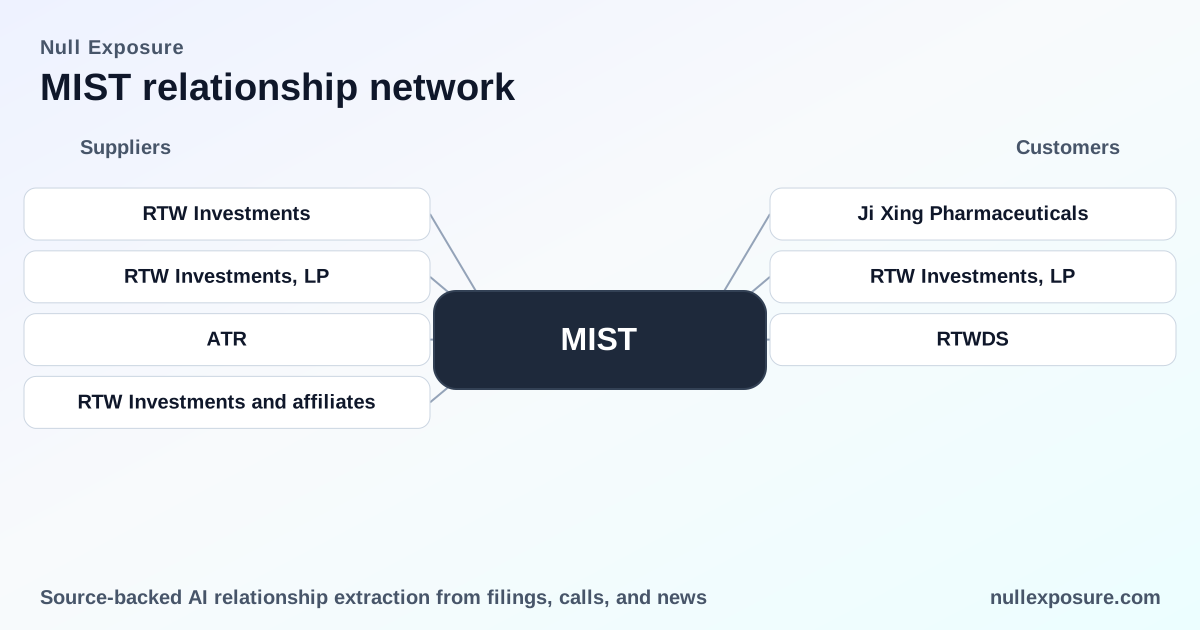
RTW Investments (RTW / RTWDS) — royalty purchase financing
Milestone completed a $75.0 million royalty purchase agreement with RTW Investments that transfers tiered U.S. royalties on etripamil sales to RTW in exchange for upfront cash, with the transaction structured to trigger upon FDA approval conditions. The agreement converts a portion of future U.S. sales economics into immediate liquidity and was disclosed in Milestone’s FDA approval materials and accompanying press releases in December 2025 and March 2023 documentation referenced in follow‑up reporting. (GlobeNewswire press release, Dec 13, 2025; trading/market coverage, March 2026)
Ji Xing Pharmaceuticals — Greater China development and supply license
Milestone executed an exclusive license with Ji Xing Pharmaceuticals to develop and commercialize etripamil for PSVT in Greater China, under which Milestone will supply etripamil and delivery devices to Ji Xing. This arrangement extends Milestone’s commercial footprint beyond direct U.S. sales via a regional licensing partner and was announced via PR Newswire in 2021 with restated terms referenced in later company communications. (PR Newswire, March 10, 2026 referencing the 2021 agreement)
JNPR / “Mist” mention — unrelated reference captured by matching
A healthcare technology article cited the co‑founder of Mist and Juniper’s AI‑native networking platform; that mention refers to a networking product named “Mist” and is not a customer or commercial partner of Milestone Pharmaceuticals. The item was captured in a May 2026 news crawl but does not reflect a commercial relationship relevant to CARDAMYST or Milestone’s go‑to‑market. (Healthcare IT News, May 3, 2026)
How these relationships define Milestone’s operating constraints and posture
- Contracting posture: Milestone intends a direct U.S. commercial effort using a focused sales force for CARDAMYST and will rely on PBMs for broad payer access; outside the U.S., the company prefers collaborations or licensing rather than building large local affiliates. This is a company‑level operating choice disclosed in Milestone’s commercialization strategy.
- Concentration and criticality: The business is product‑centric and single‑asset dependent—CARDAMYST is the core revenue driver, so relationships tied to that product (Express Scripts formulary, Ji Xing license, RTW royalty sale) are highly critical. Loss or underperformance in any of these channels would have outsized impact on revenue conversion.
- Geographic focus: The company is squarely U.S.‑focused for initial commercialization, seeking to maximize value in North America while pursuing selective collaborations internationally. This constrains near‑term revenue to U.S. reimbursement dynamics.
- Maturity and financing posture: Milestone is early commercial with limited current revenue (reported Revenue TTM of roughly $1.55M) and negative operating margins; the RTW royalty purchase is a de‑risking liquidity event that accelerates cash availability but reduces future upside from U.S. net sales.
- Relationship role: As the seller/brand owner, Milestone acts as vendor to PBMs and licensee counterparties and as a supplier to regional partners; its go‑to‑market positions Milestone as a buyer of coverage and as a counterparty selling product and economic rights.
Investment implications and risk vectors
- Upside: Formulary acceptance by Express Scripts materially improves addressable patient access in the U.S. and supports scale economics for a direct commercial launch. The RTW $75M royalty sale provides near‑term funding to execute commercialization, reducing immediate capital risk.
- Dilution of economics: The royalty sale accelerates cash but ceded tiered U.S. royalties to RTW, which reduces long‑run free cash‑flow capture from U.S. sales—an important valuation tradeoff for investors modeling long‑term margins.
- Execution sensitivity: Success depends on Milestone’s sales execution, PBM contracting, and Ji Xing’s ability to commercialize in Greater China under supply terms; as a single‑asset commercial company, operational missteps or slower uptake translate quickly into financial pressure.
- Regulatory and reimbursement risk: FDA approval completed a key regulatory hurdle, but payer coverage and formulary positioning will be determinative for prescribing volume and revenue ramp.
Learn more about how these commercial relationships affect valuation and risk modeling at https://nullexposure.com/.
Bottom line
Milestone is transitioning into a commercial-stage specialty pharma with CARDAMYST as the single pivotal asset. Its partnership mix—PBM formulary placement, a royalty purchase for liquidity, and a regional licensing partner—creates a pragmatic commercialization architecture that balances immediate funding needs with geographic scale through third‑party partners. Investors should price both the benefit of accelerated commercialization and the permanent economic concessions embedded in the RTW royalty sale into any forward earnings or cash‑flow projection.