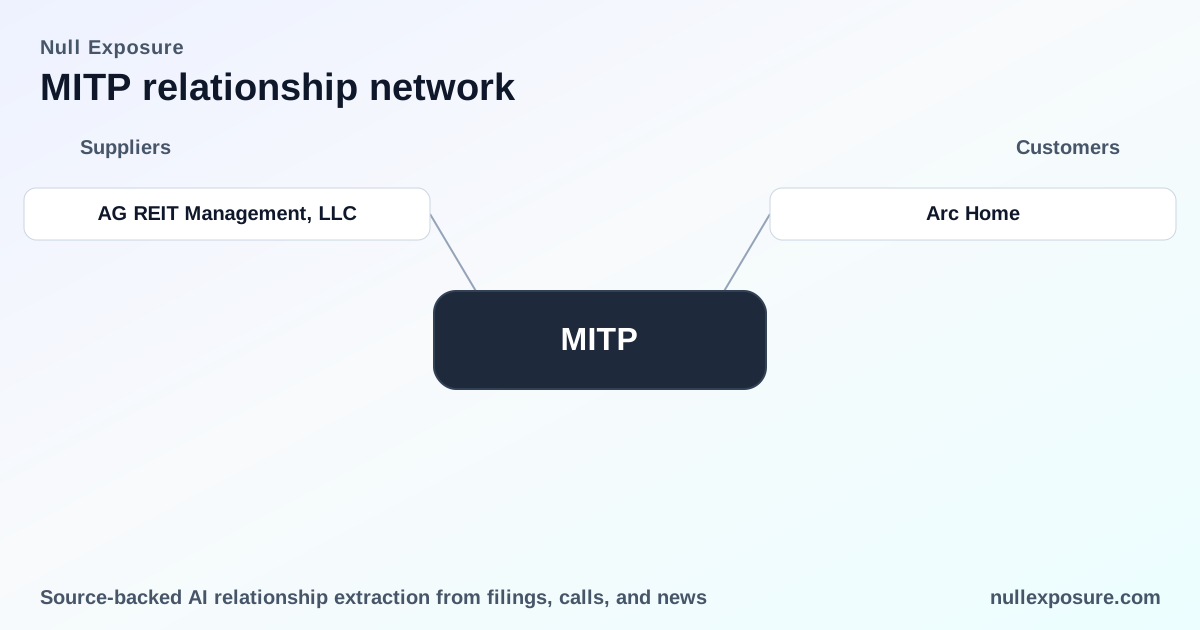
How AG Mortgage Investment Trust (MITP) Sources Mortgage Inventory — an investor view
AG Mortgage Investment Trust (MITP) operates as a mortgage-focused REIT that acquires and manages residential mortgage loans and mortgage-backed securities, generating shareholder value through net interest margin, capital gains on security dispositions, and distribution of income via dividends. MITP monetizes by purchasing loan inventory from originators and intermediaries, funding that inventory with a mix of secured financing and long-dated unsecured notes, and actively managing credit and interest-rate risk across a single Loans & Securities operating segment. For a concise view of platform-level exposure and customer counterparties, visit https://nullexposure.com/.
How to read MITP’s customer footprint: one mission, concentrated exposures
MITP operates as a single, focused REIT whose commercial model centers on the acquisition and management of U.S. residential mortgage-related assets. That single-segment focus makes each customer and originator relationship operationally critical because mortgage purchases feed the asset base that produces interest income and funds dividend distributions.
Key company-level signals drawn from MITP’s disclosures:
- Contracting posture — long-term financing in place. MITP disclosed issuance of senior unsecured notes in 2024, including $34.5 million of 9.50% notes due February 2029 and $65.0 million of 9.50% notes due May 2029, signaling a commitment to longer-dated funding rather than purely short-term warehouse lines. This comes from the company’s FY2024 Form 10-K filing.
- Counterparty type — individual borrowers are a material source of underlying credit. The company explicitly describes exposure to Non‑QM loans, which are originated to individuals and can carry lower credit quality relative to Qualified Mortgages. This is presented in MITP’s FY2024 disclosures.
- Geographic concentration risk — meaningful state-level concentration. As of December 31, 2024, 35% of residential mortgage loan fair value was secured by California properties and 11% by Florida properties, highlighting state-level sensitivity to natural disasters and localized housing markets (FY2024 10‑K).
- Business model maturity — core product orientation. MITP reports one operating and reportable segment, Loans and Securities, which underscores that mortgage purchasing and related financing are the firm’s core, mature operating activities (FY2024 10‑K).
These signals together describe an operator that is portfolio-driven and funding-intensive, reliant on a steady flow of mortgage-originator counterparties to replenish assets while using medium-term unsecured debt and secured financing to support leverage.
Arc Home — a named supplier of residential loans to MITP
Arc Home sold residential mortgage loans to MITP, with the company reporting amounts of $432,543 in the most recent year versus $674,955 in the prior comparable period in its FY2024 Form 10‑K. Arc Home is therefore an identified originator/seller in MITP’s supply chain for mortgage inventory. The transaction is disclosed in MITP’s FY2024 10‑K, which lists residential mortgage loans sold by Arc Home to the Company.
Why the Arc Home tie matters to investors
- Direct inventory channel: The Arc Home disclosure confirms MITP sources mortgage assets not only in aggregated pools but through named originators, indicating visibility into provenance and the potential to assess originator-level underwriting practices (FY2024 10‑K).
- Scale and variability: The decline from $674,955 to $432,543 year-over-year suggests variation in sourcing volumes from a single originator; for an issuer with a concentrated geography and a single operating segment, annual swings in supplier volumes can influence portfolio composition and near-term earnings.
Portfolio-level implications: concentration, credit, and funding interact
MITP’s customer relationships — exemplified by sellers like Arc Home — sit inside a broader operating model that creates specific investment implications:
- Concentration amplifies counterparty risk. Because MITP reports a concentrated state footprint (notably California and Florida), originators focused in those states or servicing borrowers in those markets become more economically important. Credit stress or regional shocks would propagate through both loan performance and the market value of RMBS holdings (FY2024 10‑K).
- Individual-borrower exposure raises credit-sensitivity. The company’s Non‑QM exposure indicates a meaningful share of loans originated to individuals that do not meet CFPB “Qualified Mortgage” standards; this elevates loss severity sensitivity during downturns relative to strictly QM portfolios (FY2024 10‑K).
- Financing tenor affects operational flexibility. The 2024 issuance of longer-dated senior unsecured notes signals deliberate lock-in of term financing, reducing refinancing urgency in the near term but creating fixed-cost obligations that pressure net interest margin if asset yields compress (FY2024 10‑K).
- Operational criticality of originators and aggregators. Named suppliers like Arc Home are not peripheral; they are conduits of assets that directly replenish MITP’s revenue-generating base. Monitoring originator origination volumes, underwriting standards, and geographic focus will capture much of MITP’s near-term asset risk.
Practical takeaways for investors and operators
- Assess originator concentration beyond headline names. Arc Home’s inclusion in the filing confirms named-seller disclosure exists; require MITP to disclose whether other originators comprise material shares of purchases and whether any single seller exceeds a governance threshold.
- Stress regional scenarios. With 46% of loan fair value concentrated in two climate‑sensitive states, run downside scenarios that combine credit deterioration with localized natural-disaster shocks and mark-to-market volatility in RMBS holdings (FY2024 10‑K).
- Map funding duration to asset repricing. The issuance of term unsecured notes through 2029 reduces immediate funding rollover risk but locks in interest expense; model the impact of margin compression if asset yields decline while note coupons remain fixed (FY2024 10‑K).
For a one-page executive brief and tracking of named counterparties like Arc Home, visit https://nullexposure.com/ to see how counterparty disclosures affect portfolio-level risk.
Bottom line
MITP’s business is straightforward in structure but sensitive in execution: a single-segment mortgage REIT that relies on named originators to supply loan inventory, carries concentrated geographic exposures, holds an identifiable set of individual-borrower risks, and finances assets with a mix that includes long-dated unsecured notes. Arc Home is a confirmed supplier whose year-over-year volumes illustrate the variability in originator flows that investors must monitor. Active due diligence on originator concentration, geographic concentration, and funding tenor is the most effective way to assess MITP’s risk-adjusted return profile going forward.