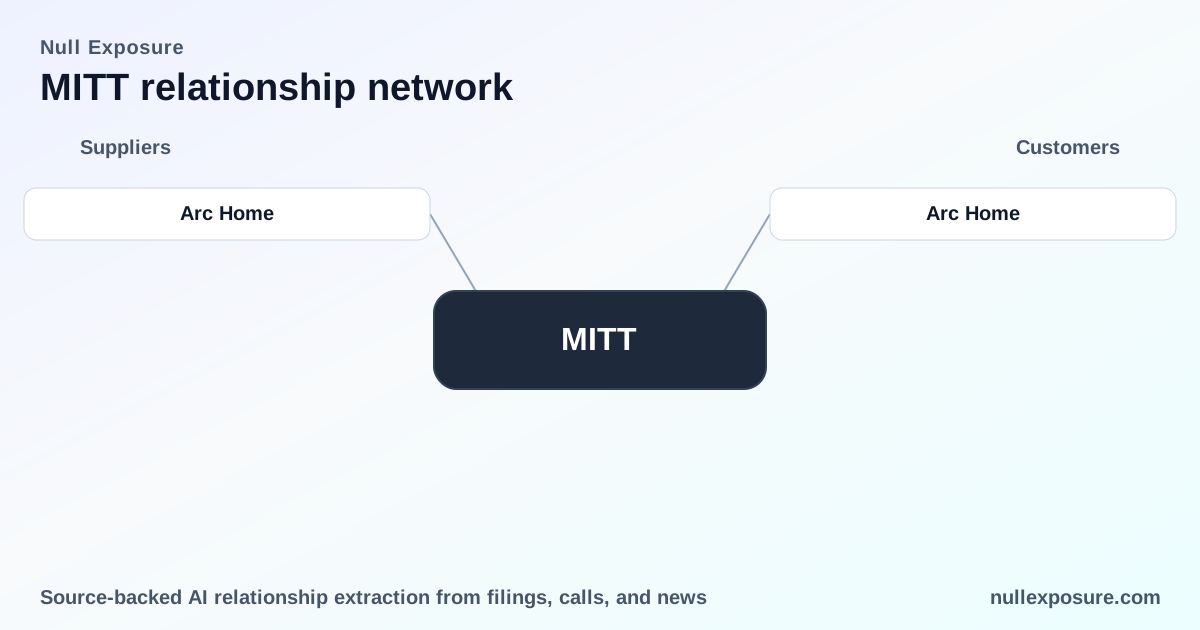
MITT customer relationships: where incremental loan flow meets concentrated geographic exposure
AG Mortgage Investment Trust (MITT) acquires and manages portfolios of residential mortgage loans and related securities, generating income through interest yield and spread management while returning capital via dividends. MITT monetizes by purchasing whole loans and mortgage-backed securities, harvesting carrying income and trading gains, and periodically selling positions to rebalance yield and duration exposure. For investors focused on customer-side counterparty risk, the company’s disclosed loan-buying counterparties and geographic concentration are the most actionable inputs into credit and liquidity analysis. Learn more at https://nullexposure.com/.
How MITT sources revenue and why counterparties matter
MITT’s business model is a classic mortgage REIT structure: buy or finance mortgage assets, collect cash yield, and actively manage the portfolio’s interest-rate and credit profile. Counterparty relationships that supply whole loans or loan pools are a direct driver of asset composition, funding needs, and realized credit losses. A significant seller relationship that supplies high-quality, agency or non‑agency loans can reduce sourcing costs and underwriting friction; conversely, reliance on a narrow set of sellers increases concentration and operational dependency.
The disclosed customer relationship: Arc Home
Arc Home sells residential mortgage loans to MITT. According to MITT’s Form 10‑K for the fiscal year ended December 31, 2024, Arc Home sold residential mortgage loans to the company with line-item amounts reported as $432,543 and $674,955 in the filing’s schedule, and the filing states Arc Home “may sell loans to the Company, third‑parties, or affiliates of the Manager.” This indicates a transactional seller role rather than an exclusive or captive channel. (Source: MITT 2024 Form 10‑K.)
What Arc Home’s presence tells investors
- Seller, not servicer or joint venture. The filing language positions Arc Home as a loan originator and seller into MITT’s portfolio; there is no disclosure of operational integration such as servicing or co‑investment. (Source: MITT 2024 Form 10‑K.)
- Transaction-scale evidence is public. The two reported line items in the filing provide a measurable flow of acquisitions from Arc Home into MITT’s holdings for the periods disclosed. (Source: MITT 2024 Form 10‑K.)
Portfolio geography and company-level constraints
MITT’s loan portfolio is concentrated in a handful of U.S. states, a company-level signal with direct implications for counterparties and collateral risk. As of December 31, 2024, 35% of the total fair value of MITT’s residential mortgage loan portfolio was secured by properties in California and 11% by properties in Florida; the portfolio otherwise consists of mortgage loans located throughout the United States. This geographic concentration amplifies regional credit, legal, and property-market exposures for all seller relationships that funnel loans into MITT. (Source: MITT 2024 Form 10‑K.)
Contracting posture, concentration, criticality, and maturity: how MITT operates
- Contracting posture: MITT operates primarily as a buyer of whole loans and mortgage securities on a transactional basis. Filings show purchases and sales activity rather than long‑term strategic partnerships, indicating a purchase-for-investment contracting posture that preserves optionality in sourcing. (Source: MITT 2024 Form 10‑K.)
- Concentration: The portfolio-level geography and the discrete line items for sellers like Arc Home signal a non-trivial concentration risk—if a small set of sellers accounts for a disproportionate share of purchased loans, MITT’s underwriting and cashflow become more sensitive to that counterparty mix. (Source: MITT 2024 Form 10‑K.)
- Criticality: Seller relationships are operationally important but replaceable in the short-to-medium term; MITT can source loans from multiple originators or the secondary market, but a persistent channel like Arc Home provides predictable supply and reduces sourcing friction. (Source: MITT 2024 Form 10‑K.)
- Maturity: Disclosed transactions show established trading flows through the fiscal periods reported; however, the filing does not describe strategic exclusivity or long-dated purchase agreements, implying a mature but flexible sourcing footprint rather than locked-in bilateral arrangements. (Source: MITT 2024 Form 10‑K.)
Explore MITT relationship maps and filing extracts at https://nullexposure.com/ for deeper diligence.
Implications for credit and operations due diligence
- Asset quality depends on seller underwriting standards. When a seller like Arc Home feeds a material volume of loans into MITT, the REIT’s credit exposure tracks that originator’s underwriting decisions; investors should push diligence on pre-sale credit screening and repurchase frameworks disclosed in filings. (Source: MITT 2024 Form 10‑K.)
- Geographic concentration increases systemic exposure. The 35% California weighting concentrates property-market, regulatory, and catastrophe risk into a single region; buyer-side portfolio management must compensate with either granular credit overlays or hedging strategies. (Source: MITT 2024 Form 10‑K.)
- Liquidity posture reflects transactional sourcing. MITT’s ability to sell securities and whole loans (the company itself reports sales activity in 2023–2024) is an operational tool to manage balance sheet liquidity; transactional seller relationships support that agility but also create timing and pricing risk. (Source: MITT 2024 Form 10‑K.)
Key risks and investor takeaways
- Counterparty concentration risk: A small number of repeat sellers can increase MITT’s exposure to originator underwriting cycles. The Arc Home disclosure is a concrete example of transactional dependence. (Source: MITT 2024 Form 10‑K.)
- Regional collateral concentration: With more than one-third of loan fair value tied to California, local housing market shocks or policy shifts will disproportionately affect performance. (Source: MITT 2024 Form 10‑K.)
- Operational replaceability balanced with frictions: Although MITT can source elsewhere, replacing established seller channels can introduce execution risk and incremental cost during market stress. (Source: MITT 2024 Form 10‑K.)
Bottom line
For investors and operators evaluating MITT’s customer relationships, the Arc Home disclosure confirms a standard seller/buyer dynamic that contributes measurable volumes to MITT’s portfolio but does not indicate exclusive or strategic integration. The more consequential company-level facts are the geographic concentration and the transactional nature of sourcing, which together define MITT’s credit and liquidity profile. For targeted due diligence on counterparties and to access parsed filing references, visit https://nullexposure.com/.