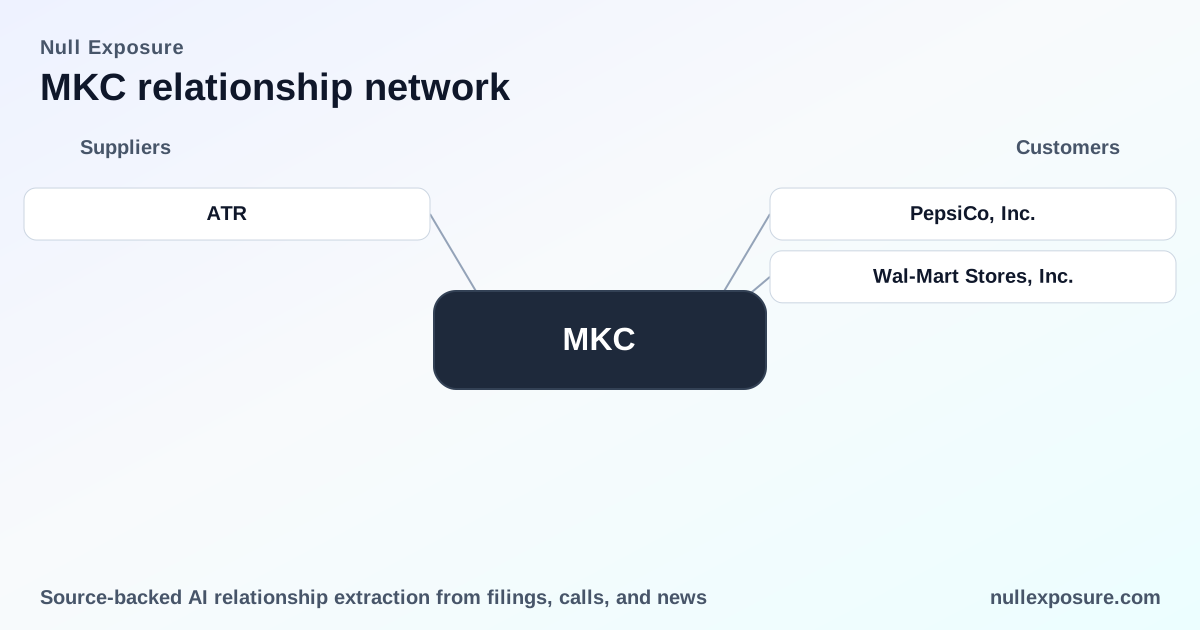
McCormick & Company: Customer Footprint, Contracting Posture, and Partnership Risks
McCormick & Company manufactures and sells spices, seasonings, condiments and flavor solutions to two distinct customer cohorts: retail consumers through branded consumer products, and large food manufacturers and foodservice operators through its Flavor Solutions business. The company monetizes via product sales across retail and B2B channels, leveraging global brands and bespoke flavor R&D to lock in recurring orders from large enterprise customers while capturing margin in consumer-packaged goods.
For a concise, structured view of McCormick’s customer relationships and what they mean for revenue durability and negotiation leverage, see https://nullexposure.com/.
How McCormick’s customer model actually operates
McCormick runs a two-track commercial model that produces predictable cash flow but concentrates counterparty risk in large customers. Key operating characteristics that shape outcomes for investors:
- Contracting posture — short-term, transaction-driven: McCormick establishes pricing and quantities frequently, with most customer arrangements and incentives set for one year or less, which creates recurring re-pricing points and exposure to demand swings. This is disclosed in the company’s 2025 Form 10‑K.
- Counterparty profile — large enterprises with procurement leverage: The Flavor Solutions business explicitly serves multinational food manufacturers and foodservice customers, implying sophisticated buyers with negotiating power.
- Geographic reach — truly global with regional concentration: McCormick reported net sales by region in FY2025 of approximately $4,867.8M in the Americas, $1,268.5M in EMEA, and $704.0M in APAC, establishing a diversified footprint across markets while maintaining pronounced exposure to the Americas.
- Concentration risk in Flavor Solutions — material: The top three customers in the Flavor Solutions segment represented 49% of Flavor Solutions sales in 2025, signaling concentrated revenue risk within that business line.
These signals combine to create a business that is resilient on margins and brand strength but sensitive to shifts in procurement terms from a small set of large buyers and to short-cycle pricing pressures.
The relationships called out in filings and press (what investors must track)
PepsiCo, Inc.
PepsiCo is a material Flavor Solutions customer, and sales to PepsiCo accounted for approximately 12% of consolidated sales in FY2025 (and 13% in FY2024 and FY2023). This indicates PepsiCo is a major buyer within the Flavor Solutions channel and represents meaningful negotiating leverage over formulations, volumes and contract terms. According to McCormick’s FY2025 Form 10‑K, PepsiCo’s share is explicitly disclosed in the customer concentration section of the filing (FY2025).
Wal‑Mart Stores, Inc.
Wal‑Mart is a core Consumer-segment customer, and sales to Wal‑Mart accounted for approximately 12% of consolidated sales in FY2025 (the same percentage reported for FY2024 and FY2023). That consistent share of consolidated revenue underscores Wal‑Mart’s significance as a retail distribution and shelf-placement partner. McCormick’s FY2025 Form 10‑K lists Wal‑Mart in the customer concentration disclosures (FY2025). The company also signals that customers in this band represent large spend buckets; the filing context supports treating Wal‑Mart as a >$100M customer by spend band.
Red Robin (RRGB) and branded menu partnerships
Recent press from Red Robin highlights menu items featuring Frank’s RedHot and other branded flavors that McCormick owns, demonstrating McCormick’s brand reach into foodservice partnerships. A Red Robin press release from March 2026 describes new sandwiches featuring Frank’s RedHot Buffalo‑style Buzz Sauce, and an earlier report from January 2026 similarly references the menu additions. These items reflect brand licensing and ingredient supply relationships with foodservice operators, where McCormick’s branded sauces and flavorings are used as menu drivers (Red Robin press release, Mar 2026; Sahm Capital coverage, Jan 2026).
What those relationships imply for revenue, risk and bargaining leverage
- High single-customer shares translate to concentrated counterparty risk. When a customer represents ~12% of consolidated sales, changes in that buyer’s procurement strategy, private-label substitution or promotional intensity can shift McCormick’s top-line materially. The 49% concentration in Flavor Solutions amplifies this dynamic within that segment.
- Short contract durations increase price and margin volatility. With most arrangements set on an annual or shorter cadence, McCormick must continuously negotiate pricing or absorb cost inflation until new terms are agreed, putting margin pressure during commodity or logistic shocks (Form 10‑K, FY2025).
- Large-enterprise buyers bring scale and organized procurement. Serving multinationals like PepsiCo and major retailers like Wal‑Mart delivers volume and distribution but also places McCormick on the wrong side of procurement leverage in specific negotiations, particularly for global program contracts.
- Branded foodservice placements (e.g., Red Robin) are marketing multipliers but not revenue anchors. Menu partnerships reinforce brand relevance and provide route-to-market for sauces and co‑branded flavors; they are valuable for brand equity but are typically smaller, transactional revenue compared with multinational supply contracts.
Operational constraints that should guide monitoring
Investors should treat the constraints disclosed as operational realities, not isolated metrics:
- Short-term contracting forces a constant cadence of renegotiation and trade spend allocation across customers.
- Customer concentration in Flavor Solutions creates one-off event risk—a large customer contract loss would meaningfully depress segment revenue.
- Geographic diversification provides resilience, but McCormick remains disproportionately exposed to the Americas, which accounted for the bulk of FY2025 sales.
- Large-enterprise counterparties are the norm, so sales execution and contract management capabilities are strategic strengths the company must maintain.
For deeper monitoring of customer-level exposures and how they evolve quarter to quarter, Nillexposure tracks these disclosures and news signals in a single view at https://nullexposure.com/.
Investment takeaways
- Positive: McCormick’s branded consumer business and global scale generate consistent margins (FY2025 revenue of roughly $7.11B with a profit margin above 20%), supported by recurring retail demand.
- Watchlist: The business is sensitive to contract renegotiation cycles and customer concentration, especially in Flavor Solutions where the top three customers equal nearly half the segment.
- Event triggers to monitor: material changes in shares from PepsiCo or Wal‑Mart, significant contract renewals/losses, and commodity cost pass-through effectiveness under short-term contracting regimes.
McCormick is a predictable, brand‑driven operator with clear strengths and quantifiable counterparty exposures; investors should price in concentrated B2B risk alongside durable consumer demand. For ongoing signals and a consolidated view of these customer relationships, visit https://nullexposure.com/.