McCormick & Company (MKC-V) — Customer Relationships That Drive Flavor, Scale, and Concentration Risk
McCormick monetizes through the manufacture and sale of spices, seasonings, condiments and bespoke flavor solutions sold to retailers, food manufacturers and foodservice operators; revenue is recognized at the point control transfers (shipment, delivery, or pickup). The firm’s business model combines stable retail volume with higher-margin B2B Flavor Solutions contracts, which deliver concentrated, recurring revenue from a small number of large customers while exposing McCormick to short-term commercial terms and pricing pressure. For a quick company overview, visit https://nullexposure.com/.
Why customer relationships matter for valuation and risk
McCormick’s top customers directly influence revenue stability and margin dynamics. Large enterprise clients in the Flavor Solutions segment account for a significant portion of segment sales, amplifying both negotiating leverage and concentration risk. At the same time, decades-long relationships and product indispensability in manufacturing and foodservice create durable demand that supports steady cash flow and a defensive sector position.
For a deeper look at counterparties and how they shape McCormick’s operating posture, see https://nullexposure.com/.
Who the company sells to — the explicit customer list
Below are every customer relationship found in the reviewed materials, with a concise, plain-English description and a short source note.
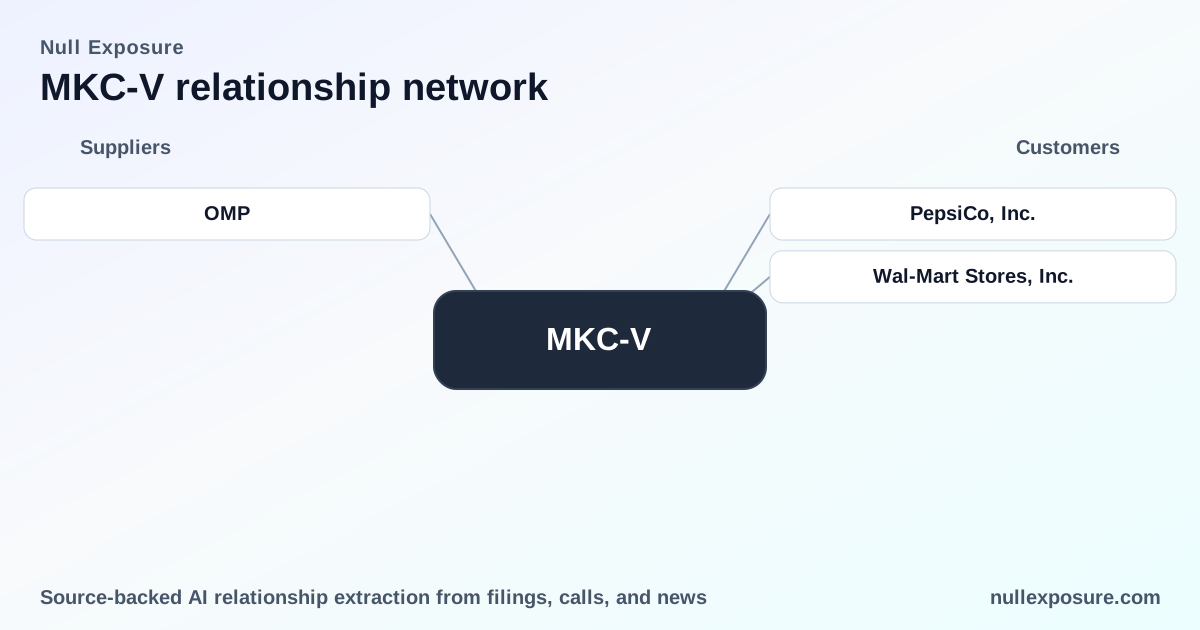
PepsiCo, Inc.
McCormick’s Flavor Solutions segment reported that PepsiCo accounted for approximately 12% of consolidated sales in FY2025 (12% in 2025; 13% in 2024 and 2023), signifying a material, multi-year commercial relationship that contributes meaningful top-line scale. According to McCormick’s FY2025 Form 10‑K, this is a large, recurring manufacturing/customer relationship that materially influences segment revenue.
Wal‑Mart Stores, Inc.
Wal‑Mart represented approximately 12% of consolidated sales in FY2025 and the two prior years, reflecting a substantial retail distribution relationship that supports McCormick’s consumer-facing volume and shelf presence. McCormick’s FY2025 Form 10‑K discloses this concentration in the Consumer segment and the company’s reliance on major retail partners for broad market access.
Hellmann’s (front-of-house expansion via McCormick Food Service)
McCormick is expanding Hellmann’s front‑of‑house presence in the U.S. through its Food Service channel, signaling strategic partnerships that extend McCormick’s condiment and sauce reach into operator-facing programmes. This development was reported by FoodNavigator‑USA on April 9, 2026, documenting channel expansion via McCormick Food Service.
Mission BBQ
McCormick partnered with Mission BBQ to launch a co‑branded line of sauces, illustrating active product collaboration with restaurant chains to drive incremental branded revenue and cross‑channel distribution. Food Business News reported this partnership in 2026, highlighting McCormick’s tactical alliances with smaller national chains to broaden retail and foodservice penetration.
Operating model constraints and what they imply for investors
The firm‑level signals drawn from McCormick’s filings and public reporting define an operating posture that investors should weigh alongside financials.
- Contracting posture — short-term commercial terms. McCormick establishes prices and order quantities frequently; most customer arrangements and incentives are one year or shorter. This creates ongoing margin exposure to commodity costs and buyer negotiation, requiring active commercial management and price realization. (Company 10‑K disclosure.)
- Counterparty mix — large enterprises plus end consumers. The company serves multinational manufacturers and foodservice customers while also reaching individual consumers across ~150 countries; the mix produces both scale accounts and broad retail exposure. (Company disclosure of Flavor Solutions clients and geographic reach.)
- Geographic concentration — Americas weight. Reported net sales by region show the Americas as the dominant market (Americas ~$4,867.8m of total ~$6,840.3m), indicating that macroeconomic or retail trends in the Americas will disproportionately affect results. (Company regional sales table.)
- Materiality and concentration — top clients are significant. McCormick reports that the top three customers in its Flavor Solutions segment represented 49% of global Flavor Solutions sales over 2023–2025, a signal of concentrated counterparty risk inside a high-value segment. (Company 10‑K excerpt.)
- Relationship roles and maturity — seller, distributor and long-lived ties. McCormick sells directly and through brokers/wholesalers; many Flavor Solutions relationships have existed for decades, producing durable, but negotiable, revenue streams that lock in demand while leaving pricing power subject to change. (Company disclosures on distribution channels and relationship duration.)
These constraints describe a business that is both commercially agile (short-term price resets) and structurally concentrated (few large B2B customers) — a combination that supports steady cash generation but elevates counterparty and contract risk.
Investment implications: what investors should watch next
- Concentration risk vs. durable demand: Large customers like PepsiCo and Wal‑Mart provide scale and predictability, but the 49% segment concentration in Flavor Solutions means any contract loss or price squeeze would materially affect margins and organic growth.
- Margin sensitivity to pricing cadence: With most customer arrangements established on annual or shorter cycles, McCormick’s near‑term gross margin trajectory depends on its ability to negotiate price escalators or pass through input cost changes.
- Channel diversification and execution: Partnerships with foodservice brands (Hellmann’s expansion via McCormick Food Service and Mission BBQ collaboration) are deliberate moves to broaden channels and product formats; these initiatives reduce single-channel dependence but require execution to convert into durable incremental profit.
- Geographic exposure: Heavy reliance on the Americas makes McCormick vulnerable to regional retail trends and supplier disruptions; successful expansion in EMEA and APAC would materially improve diversification metrics.
Bottom line and actionable takeaways
- McCormick combines defensive consumer demand with concentrated B2B revenue; top customers deliver scale but concentrate commercial risk.
- Short-term contracting is a structural feature: frequent price/quantity resets require constant margin management.
- New foodservice partnerships are strategically meaningful as they extend the company’s branded and co‑branded product reach beyond traditional retail.
Key next steps for analysts and operators:
- Monitor FY2026 customer disclosures for any movement in percentage contributions from top customers.
- Track contract renewal terms and price pass‑through language in quarterly disclosures and earnings calls.
- Evaluate the financial impact of foodservice partnerships on margins and revenue diversification.
Bold, concise assessments like these make customer analysis actionable; for more customer‑level signals and relationship monitoring tools, visit https://nullexposure.com/.