Markel Corporation (MKL) — who Markel underwrites for and why it matters to investors
Thesis: Markel is a diversified specialty insurer and financial holding company that earns premiums and investment income while monetizing distribution and risk-transfer services through program services, fronting arrangements, and insurance‑linked securities. Its profitability profile now increasingly reflects fee revenue from service arrangements and reduced reinsurance underwriting after strategic exits, while legacy reinsurance recoverables and fronting relationships remain material to cash flows and capital management. For primary research on counterparties and counterparty risk, visit https://nullexposure.com/ for the underlying filings and news aggregation.
What the relationship data says about Markel’s operating model
Markel’s disclosures and the accompanying news flow together sketch a company with short-term underwriting posture, broad counterparty mix, and a U.S. concentration that shapes both opportunity and vulnerability.
- Contracts are typically short‑term (one year or less), consistent with specialty insurance industry norms and Markel’s 10‑K language on policy terms. That implies recurring renewal risk and frequent repricing opportunities.
- Counterparty mix spans individuals, small and mid‑market businesses, large and very large enterprises, and even government investor participation through third‑party funds — signaling diversified distribution but varied credit profiles.
- Geography is global in scope, but North America (particularly the U.S.) is dominant, with roughly 75% of gross premiums written tied to U.S. risks per recent disclosures; this concentrates underwriting and economic exposure to U.S. loss trends and regulatory conditions.
- Markel functions as both seller (insurance/product revenues, fronting fees and program services) and buyer (accessing third‑party capital and reinsurance) through its underwriting and ILS capabilities.
- Segment mix includes services and manufacturing exposures via Markel Ventures, underscoring non‑insurance revenue diversification that complements underwriting but introduces different cash‑cycle dynamics.
In short: short contract duration, concentrated U.S. premium base, and a shift from risk‑taking to service/fee arrangements are the dominant operating themes.
Counterparty relationships that matter — line by line
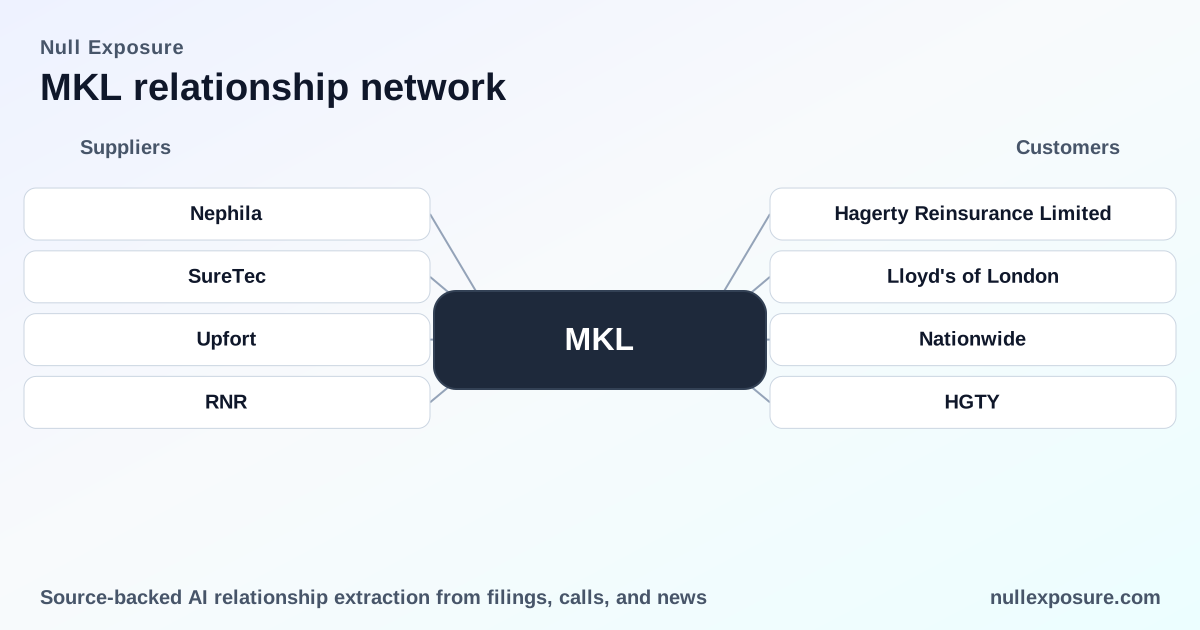
Below I cover every counterparty mentioned in Markel’s customer relationship results and summarize the commercial impact in plain English.
Lloyd’s of London — a single large reinsurance recoverable
Markel reports that, as of December 31, 2024, Lloyd’s represented the largest reinsurance balance, equal to 9% of reinsurance recoverables before allowances and collateral, making Lloyd’s a material reinsurance counterparty on Markel’s balance sheet. This is drawn from Markel’s FY2024 10‑K.
Hagerty Reinsurance Limited — ceded premium counterparty in Markel’s accounts
Markel’s FY2024 10‑K records premiums ceded to Hagerty Re of $708,147 (with prior periods lower at $616,491 and $456,637), indicating a meaningful ceded relationship over recent years and a flow of premium/ceding economics to Hagerty Re. (Source: MKL 2024 10‑K disclosure.)
Nationwide — buyer of Markel’s reinsurance renewal rights and runoff transaction
In mid‑2025 Markel agreed to sell renewal rights for its Global Reinsurance book to Nationwide, effectively putting that reinsurance division into runoff and transferring renewal economics; the transaction closed the following month, reshaping Markel’s reinsurance footprint and near‑term premium base. (Source: Insurance Business, July–August 2025 coverage.)
HGTY (Hagerty, Inc.) — strategic shift from quota‑share to fronting, and fee model
Multiple disclosures from Hagerty and Markel show that Hagerty and Markel renegotiated their alliance so that, effective January 1, 2026, Hagerty retains 100% of premium and underwriting risk while Markel provides fronting services for a fee (reported around 2%); Hagerty disclosed commission and ceding commission figures for 2025 and guidance reflecting lower reported revenue but improved underwriting economics under the fronting model. This transition is documented in Hagerty press releases, earnings transcripts, and Markel earnings commentary (PR Newswire, Hagerty newsroom, and Markel earnings call transcripts, FY2025–FY2026).
Hagerty (as referenced across news items) — commercial terms and agreement extensions
Hagerty’s investor communications and analyst notes indicate extensions of key agreements with Markel through 2028 and material recalibration of revenue recognition and profitability expectations tied to the fronting arrangement, affecting both companies’ top‑line and underwriting metrics in 2026. (Sources: Hagerty press releases and Investing.com coverage of agreement amendments, FY2026.)
Hagerty Re (news references) — fronting arrangement impact on Markel premiums
Industry press highlights that Hagerty Re (classic‑car specialist) shifted to a fronting arrangement where it takes 100% of underwriting and investment economics and pays Markel a small fronting fee, a change that materially reduces Markel’s gross written premium reported but also limits Markel’s loss exposure from that partner. (Source: Insurance Business and ReinsuranceNews, Q1 2026 coverage.)
SLND (Southland Holdings) — surety advances by Markel Insurance Company
Public filings and press articles report that Markel Insurance Company advanced approximately $5 million to Southland Holdings under a general indemnity agreement to fund bonded construction obligations, creating a short‑term surety exposure that Southland must indemnify and reimburse. (Sources: The Globe and Mail and Investing.com reporting on Southland filings, FY2026.)
What these relationships mean for investors
- Concentration and recoverable risk are material: Lloyd’s representing 9% of reinsurance recoverables signals concentrated counterparty credit exposure that investors should monitor alongside collateral and allowance quality disclosed in the 10‑K.
- Business model migration affects reported revenue and margin dynamics: The shift with Hagerty from quota‑share underwriting to a fronting / fee model reduces Markel’s gross written premiums but increases fee and service revenue predictability while removing underwriting volatility tied to that partner.
- Runoff of the Global Reinsurance book shifts capital and profitability levers: Selling renewal rights to Nationwide and placing the reinsurance business into runoff reduces Markel’s active reinsurance underwriting footprint and transfers renewal economics, affecting future premium growth and capital deployment strategy.
- Short‑term contracts imply faster cycle risk and repricing leverage: With standard one‑year policy terms, Markel can reprice exposures quickly, but investors must watch renewal volumes and market capacity as leading indicators of underwriting trajectory.
Bottom line and where to look next
Markel is deliberately reshaping where it earns underwriting returns versus service and fee income; the transition away from large reinsurance underwriting and toward fronting and program services materially alters risk exposure and earnings composition. Monitor the 10‑K detail on reinsurance recoverables and collateral, upcoming quarterly earnings commentary on fronting fees and GWP trends, and filings from counterparties such as Hagerty and Nationwide for second‑order impacts.
For a consolidated view of filings, transcripts, and market coverage that underpins this overview, see our collection at https://nullexposure.com/.