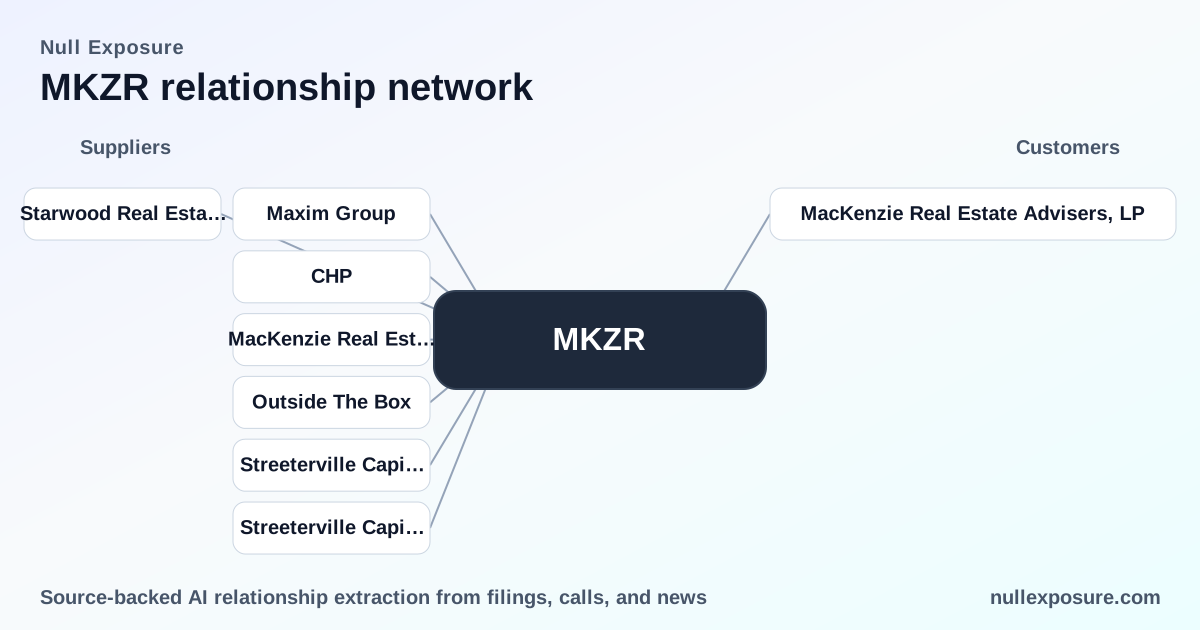
MacKenzie Realty Capital: customer relationships that define a small, concentrated REIT
MacKenzie Realty Capital operates as a West Coast‑focused REIT that earns cash flow primarily by owning and leasing commercial and multifamily real estate, and supplements that model with secured financing arrangements and related-party share purchases that influence capital structure and insider alignment. The company monetizes through straight‑line rental income from operating leases across nine commercial properties and four apartment complexes, and through credit facilities and note issuances when equity and retained cash are insufficient to fund acquisitions or distributions. For a concise company overview and service offering, see https://nullexposure.com/.
How counterparties illustrate capital and liquidity behavior
MacKenzie’s disclosed counterparties fall into two functional groups: credit counterparties who provide short‑to‑medium term secured notes, and its adviser and insiders whose purchases align management incentives with shareholders. Together these relationships show a REIT that relies on stable rental cash flow but uses secured promissory notes and insider purchases to manage liquidity and ownership concentration.
Streeterville Capital, LLC — secured note counterparty (Investing.com, FY2026)
MacKenzie executed a secured promissory note for $1,635,000 under an existing Note Purchase Agreement that allows issuance up to $3,270,000 to Streeterville Capital, indicating recourse financing availability and incremental debt capacity. Source: Investing.com SEC filing coverage, reported May 3, 2026 (https://m.investing.com/news/sec-filings/mackenzie-realty-capital-board-approves-preferred-share-dividends-for-june-quarter-93CH-4619485?ampMode=1).
Streeterville Capital, LLC — duplicate notice of the same note program (Investing.com South Africa feed, FY2026)
A second Investing.com feed reiterates the same Note Purchase Agreement capacity permitting issuance of up to $3.27 million in secured promissory notes to Streeterville Capital, reinforcing that this credit facility is an active and material component of MacKenzie’s short‑term financing toolkit. Source: Investing.com (South Africa mobile feed), reported May 3, 2026 (https://m.za.investing.com/news/sec-filings/mackenzie-realty-capital-board-approves-preferred-share-dividends-for-june-quarter-93CH-4216782?ampMode=1).
MacKenzie Real Estate Advisers, LP — adviser and insider buying shares (MarketScreener, FY2025)
MacKenzie’s adviser, MacKenzie Real Estate Advisers, LP, along with Robert Dixon and an affiliate, acquired an additional 15,000 shares, bringing adviser‑related ownership above 7%, a move that increases insider alignment and concentrates voting power with the adviser and affiliated parties. Source: MarketScreener news summary, March 10, 2026 (https://www.marketscreener.com/news/mackenzie-realty-capital-announces-starwood-reit-tender-offer-adviser-stock-purchases-and-aurora-l-ce7d5ad8d08df02d).
Operating-model constraints investors should price into the valuation
MacKenzie’s public disclosures contain several company‑level signals that frame counterparty risk and operational durability:
-
Contracting posture — long‑term, non‑cancelable leases. The company recognizes rental income under ASC 842 and reports future minimum rental income from non‑cancelable operating leases (lease expirations extend into 2029–2031 for certain properties), signaling stable cash flow duration and predictable tenant roll risk. This is a structural advantage for debt capacity but creates sensitivity to local market leasing cycles.
-
Geographic concentration — U.S. only, West Coast core. MacKenzie states that U.S. customers accounted for 100% of revenues and its real estate inventory is concentrated in California and selected other U.S. locations, underscoring regional market risk and limited geographic diversification.
-
Business role and revenue mechanics — landlord/seller and buyer dynamics. The firm’s primary role is as owner‑landlord: it both sells lease exposure to tenants (collects rental revenue) and purchases/manages real estate assets, recorded as a single reportable segment of income‑producing real estate.
-
Relationship maturity and activity — active asset base with high occupancy on key properties. Disclosures show specific properties at high occupancy (for example, one building reported 96% occupancy as of June 30, 2025), which supports near‑term cash flow stability but also implies that future growth depends on acquisition financing and successful re‑tenanting at lease expirations.
-
Concentration of governance and economics. Adviser and insider purchases raising adviser ownership above 7% is a corporate governance signal: alignment of management with shareholders increases, yet voting concentration and insider control rise.
These constraints are company‑level signals derived from MacKenzie’s filings and investor releases; they are not exclusive to any single counterparty unless explicitly named in a constraint excerpt.
What investors should watch in each relationship
-
For the Streeterville note program, monitor remaining availability under the Note Purchase Agreement and any changes to collateral terms; this is an active liquidity buffer that reduces near‑term refinancing risk but increases secured leverage on specific assets (Investing.com, May 3, 2026).
-
For the adviser ownership increase, track potential governance outcomes—insider purchases improve alignment on capital allocation and dispositions, but also raise the possibility of related‑party decision making that benefits concentrated owners (MarketScreener, March 10, 2026).
Investment implications — concise takeaways
- Stable cash generation from long‑term leases underpins valuation, but the company’s small market capitalization and regional concentration create sensitivity to local economic downturns and tenant credit cycles.
- Secured promissory notes from third parties like Streeterville provide tactical liquidity, reducing immediate cash strain but increasing secured obligations and asset encumbrance.
- Insider/adviser buying increases alignment but concentrates control, which can be positive for rapid decision making and capital returns, yet requires scrutiny of related‑party transactions and board independence.
- Single‑segment maturity suggests limited diversification, so growth is likely to be incremental and financed through targeted secured debt or insider‑led equity moves.
If you want a compact dashboard of MacKenzie’s counterparties and financing vehicles, visit https://nullexposure.com/ for a tailored view.
Bottom line: small REIT, active financing, concentrated governance
MacKenzie Realty Capital is a niche REIT that converts localized real estate cash flows into distributable earnings while supplementing capital through secured note agreements and adviser equity purchases. For investors, the story is straightforward: predictable rental revenue and high occupancy on key assets provide base‑case stability, but regional concentration, secured leverage, and adviser ownership concentration are the primary risk levers to monitor. Review upcoming lease expirations, the remaining capacity under the Streeterville note program, and any further insider transactions to update your thesis.