Mesa Laboratories (MLAB): Why a regulator buying hundreds of calibrators matters for investors
Mesa Laboratories designs, manufactures and sells quality-control instruments and consumables used across regulated healthcare, pharmaceutical and industrial safety workflows. The company monetizes through hardware sales, accompanying perpetual or annual software licenses, and recurring service, maintenance and calibration contracts, with a global direct-and-distributor go-to-market footprint. For investors, the core thesis is simple: durable installed bases of mission‑critical calibrators and services drive high-margin recurring revenue, while short contract durations and broad end‑market coverage limit single‑counterparty concentration risk.
If you want a concise playbook for tracking commercial momentum at Mesa, start with product adoption by regulated customers and follow recurring service sales tied to installed hardware. For more on how we source and validate customer relationships, see https://nullexposure.com/.
How Mesa actually gets paid — the operating model in plain English
Mesa sells physical instruments (the Defender series and other calibrators), often bundled with software licenses that are required for device operation, and then sells follow-on maintenance and calibration services. This creates a layered revenue model: initial capital equipment sales followed by higher-margin recurring service and consumable revenue. Hardware is the gateway; software licenses and services are the annuity.
The company’s contracting posture is short-term at the customer level: Mesa states that the significant majority of revenues and receivables come from contracts of 12 months or less, which produces quick revenue recognition but places a premium on repeat sales and service renewals to sustain growth. Customer concentration is low—no single customer represents 10% or more of consolidated revenue—so counterparty risk is dispersed. Mesa operates globally with manufacturing in the U.S. and Europe and sales coverage across North America, EMEA and APAC, which reduces geography-specific risk while exposing the business to multi-region distribution complexity. Collectively, these facts present a manufacturing-driven company with a services-annuity overlay and a commercial mix that balances short contractual tenure with long operational engagement.
Key commercial constraints and what they imply for investors
- Short contract tenure: The majority of Mesa’s contracts are ≤12 months, which pressures management to keep a steady new-sales cadence and strong renewals book to smooth revenue. This favors execution-focused management and predictable aftermarket offers.
- Licensing attached to hardware: Hardware often ships with perpetual or annual software licenses required for full functionality; this increases revenue per device and creates stickiness.
- Government counterparty exposure: The company sells into government facilities among other end markets; winning government standards contracts can be revenue‑accelerating and reputationally reinforcing.
- Global manufacturing and distribution: Operations span the U.S. and Europe, with sales in NA, EMEA and APAC; geographic breadth supports resilience but increases supply-chain and regulatory complexity.
- Low customer concentration: No single customer accounts for ≥10% of revenue, limiting idiosyncratic counterparty risk.
- Mixed go‑to‑market (direct + distributors): Mesa sells both directly and through independent distributors, which helps scale internationally but introduces margin and control variability.
- Product segments: Core offerings are hardware, software licenses, and services (maintenance/calibration), with manufacturing capabilities in-house — a mature, vertically integrated model.
These are company-level signals investors should treat as persistent characteristics of Mesa’s commercial model rather than one-off tactical choices.
Regulator adoption: OSHA standardized on Mesa’s Defender series calibrators
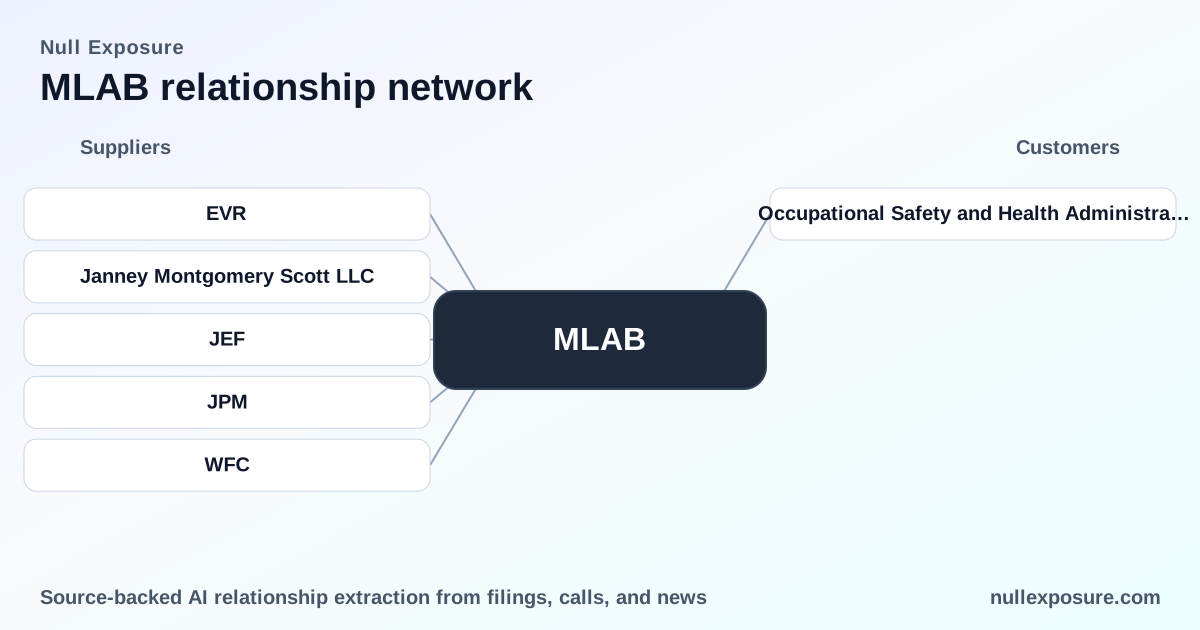
Mesa’s most visible customer development in the public record is a direct procurement by the U.S. Occupational Safety and Health Administration (OSHA). According to a February 2026 press release syndicated by GlobeNewswire and covered by outlets such as News-Medical and The Manila Times, OSHA standardized its field enforcement operations on Mesa’s Defender series calibrators and purchased more than 120 units in 2025, with additional orders planned for 2026. This adoption signals both product validation in safety-critical workflows and the prospect of follow-on service and calibration revenue tied to those units (News-Medical/GlobeNewswire, Feb 2026; Manila Times syndication, Feb–May 2026).
Sources:
- A GlobeNewswire press release, syndicated to News-Medical (Feb 2026) described OSHA’s standardization and its 120+ unit purchases in 2025.
- The same GlobeNewswire release was syndicated by The Manila Times (Feb 2026 and an AMP republished version in May 2026), reiterating the purchase figures and planned 2026 orders.
Why the OSHA relationship matters to the investment case
- Validation and sales catalyst: Government standardization provides a clear reference customer for other regulated buyers and can accelerate institutional procurement cycles. OSHA choosing Mesa’s calibrators is a signal buyers use when selecting equipment for compliance and enforcement programs.
- Aftermarket leverage: Instruments that must be maintained and periodically recalibrated create durable service revenue streams. Given Mesa’s stated service offerings, each deployed OSHA unit represents a multi-year service opportunity.
- Non-concentration reassurance: Even though OSHA is a high-visibility buyer, Mesa’s filings state no customer accounts for 10%+ of revenue, so a single government program—even one with 120+ units—is important for credibility but not mission-critical to consolidated revenue stability.
Risk factors and what to monitor
- Revenue visibility is transactional: Short‑term contracts mean Mesa needs constant new orders and renewals; therefore, trending hardware bookings and service renewal rates are early indicators of revenue durability.
- Channel complexity: Use of independent distributors worldwide is a growth enabler but creates margin and forecasting variability; monitor gross margin trends and distributor inventory levels.
- Regulatory dependence in some use cases: Government adoption increases reputational strength but also concentrates product-roadmap expectations; new regulatory choices or competing standards could influence future procurement cycles.
- Execution over scale: Mesa is a manufacturer with a mid-market capitalization (~$569M market cap) and modest EBITDA; scaling internationally while preserving margins requires disciplined capital allocation and supply-chain execution.
Bottom line — what investors should take away
Mesa Laboratories is a manufacturing-led, service-anchored business whose growth path depends on converting landmark product wins into recurring aftermarket revenue. OSHA’s decision to standardize on the Defender series is a substantive commercial win that validates Mesa’s product in a high-stakes buyer segment and supports the annuity narrative for investors. Watch bookings, service backlog, and geographic sales execution as the primary indicators of durable growth.
For deeper signal tracking and to monitor how key customer relationships evolve, consult the analysis and source collection available at https://nullexposure.com/.
If you want a short briefing tailored to portfolio-level exposure to MLAB or recurring-revenue scenarios tied to government customers, contact our research team through the NullExposure homepage.