Mount Logan Capital (MLCI): Customer Relationships That Drive Fee Revenue and Strategic Moves
Mount Logan Capital operates as a specialist asset manager focused on public and private debt strategies and closed-end structures; it monetizes through management fees, profit-sharing arrangements and intercompany asset-management agreements while executing strategic fund-level transactions (asset acquisitions and tender offers) to consolidate scale. For investors, the revenue mix is fee-driven and concentrated: recurring management fees and intercompany arrangements are the principal earnings lever. For deeper context on MLCI’s customer relationships and operational implications, see NullExposure’s company page: https://nullexposure.com/.
How Mount Logan gets paid and why customers matter
Mount Logan’s economic model is straightforward: investment-management revenues plus performance/profit-sharing make up the bulk of top-line cash flow, with transactional activity (asset acquisitions, tender offers) used to reset NAV and scale fee-paying AUM. The company reported TTM revenue of approximately $44.2 million against a market capitalization near $49.0 million, indicating a compact public equity base where single contractual relationships can meaningfully influence reported results and investor sentiment.
MLCI discloses revenue flows that include intercompany management fees and recently introduced profit-sharing arrangements, establishing a two-fold revenue profile: stable recurring fees from fund and insurance-asset management and incremental upside from profit-sharing and transactional gains. These commercial levers are evident across the company’s public releases and transaction notices.
Customer relationships you need to know (complete coverage)
The following are every customer-related relationship called out in public reporting and press activity during FY2025–FY2026.
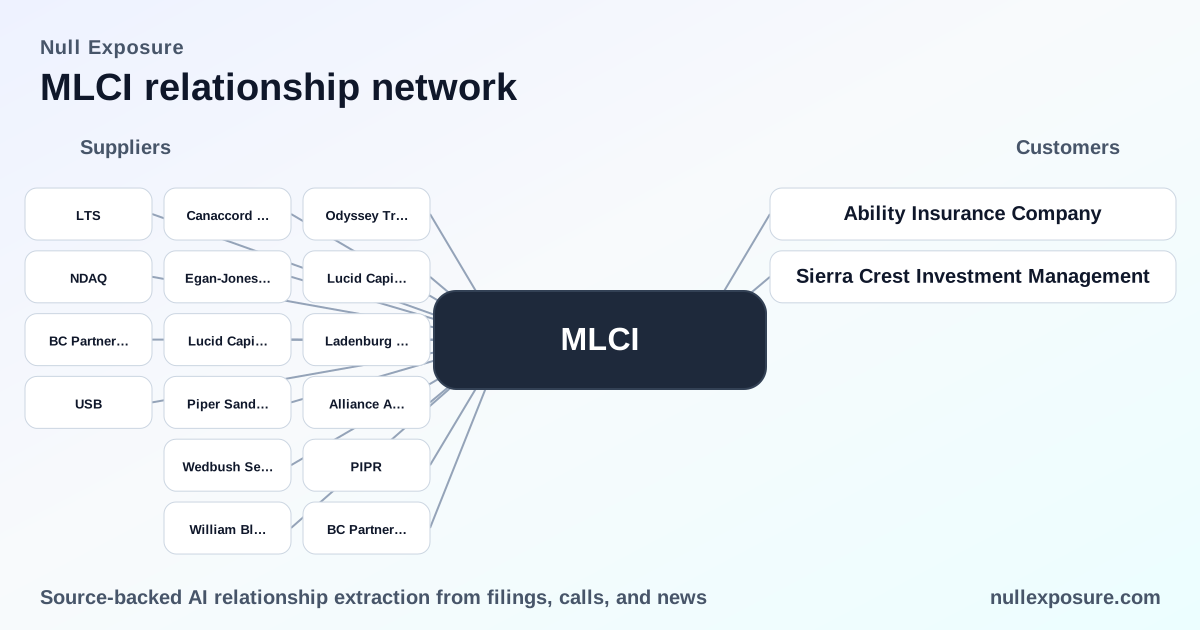
Ability Insurance Company
Mount Logan’s management arm provides investment management services for Ability and records intercompany management fees as part of asset-management revenue reporting. Asset-management disclosures show intercompany fees from Ability increased to $6.0 million excluded from consolidated asset-management revenues for FY2026 and were $1.6 million in Q3 2025 reporting, underscoring the economic importance of this internal client relationship. Source: Mount Logan Capital Inc. press releases and financial results (GlobeNewswire, Nov 13, 2025 and Mar 19, 2026) and related news items (Yahoo Finance, Mar 10, 2026).
MLCIL (Opportunistic Credit Interval Fund / Tender Offer activity)
MLCIL has been active in both organic and inorganic portfolio actions: Mount Logan’s registered advisor executed an asset acquisition to buy YS AIF assets (a transaction that included a Transition Services Agreement for books-and-records access), and the fund ran a public tender offer supported by third-party service providers (Information Agent, Dealer Manager, Depositary). These transactions show the firm’s playbook of using fund-level acquisitions and capital-structure actions to scale fee-bearing assets and manage investor liquidity. Source: SahmCapital transaction bulletin (Mar 19, 2026) and Mount Logan Capital tender-offer notice (GlobeNewswire, Feb 4, 2026).
Sierra Crest Investment Management
Mount Logan introduced a recurring revenue stream from a profit-sharing agreement with Sierra Crest Investment Management during Q3 2025; management flagged this new income line as likely to scale with the growth of BCIC (a related vehicle). This illustrates the firm’s use of profit-sharing contracts to diversify fee profiles beyond straight asset-management charges. Source: Mount Logan Capital Inc. third-quarter 2025 financial release (GlobeNewswire, Nov 13, 2025).
What these relationships imply for operational and financial risk
Across these customer relationships, the operating model signals are clear and actionable for investors evaluating exposure.
- Contracting posture: Mount Logan relies on a mix of formal management agreements, profit-sharing arrangements and transition services arrangements to capture fees and operational control. The firm also engages standard third-party advisors to execute capital actions (information agents, dealer managers, depositaries).
- Concentration: With a market capitalization around $49 million and TTM revenue near $44.2 million, individual large contracts or intercompany clients can be material to reported revenue and cash flow, raising sensitivity to single-counterparty outcomes.
- Criticality: Management of insurance assets, interval funds and closed-end vehicles indicates operational criticality—disruptions to investment-management access or record continuity would directly affect fee inflows and NAV management.
- Maturity and scalability: The addition of profit-sharing lines and fund-level asset acquisitions shows an active growth playbook beyond organic portfolio management; however, these are still nascent revenue streams relative to established management fees.
These company-level signals are consistent with a small-cap asset manager that uses both internal client relationships and transactional tactics to build recurring revenues and fee-bearing assets.
Key risks and what to watch in the next 12 months
- Revenue concentration: Watch quarterly disclosures for the size and trajectory of intercompany management fees and profit-sharing receipts; swings here will move margins and reported asset-management revenue materially.
- Execution on fund acquisitions: The firm’s use of asset purchases and TSAs to acquire portfolios creates integration risk and dependence on counterparties for books-and-records access—monitor post-acquisition performance and expense run-rate changes.
- Liquidity and shareholder mechanics: Tender offers and dealer-manager activity highlight active balance-sheet management; track future capital actions for signals about NAV stabilization and shareholder liquidity needs.
Bottom line for investors
Mount Logan’s commercial model is fee-first and transaction-enabled: recurring management fees and intercompany arrangements supply the base, while profit-sharing agreements and fund-level acquisitions are the levers for scale. Given the company’s compact market cap and revenue base, customer contracts and fund transactions are high-impact levers for performance and risk. For a closer read on customer exposures and event-driven items, visit NullExposure for company-level coverage and source documentation: https://nullexposure.com/.
Bold, disciplined monitoring of quarterly fee disclosures, contract renewals and the outcomes of announced asset acquisitions will be decisive for evaluating MLCI’s next phase of earnings stability and growth.