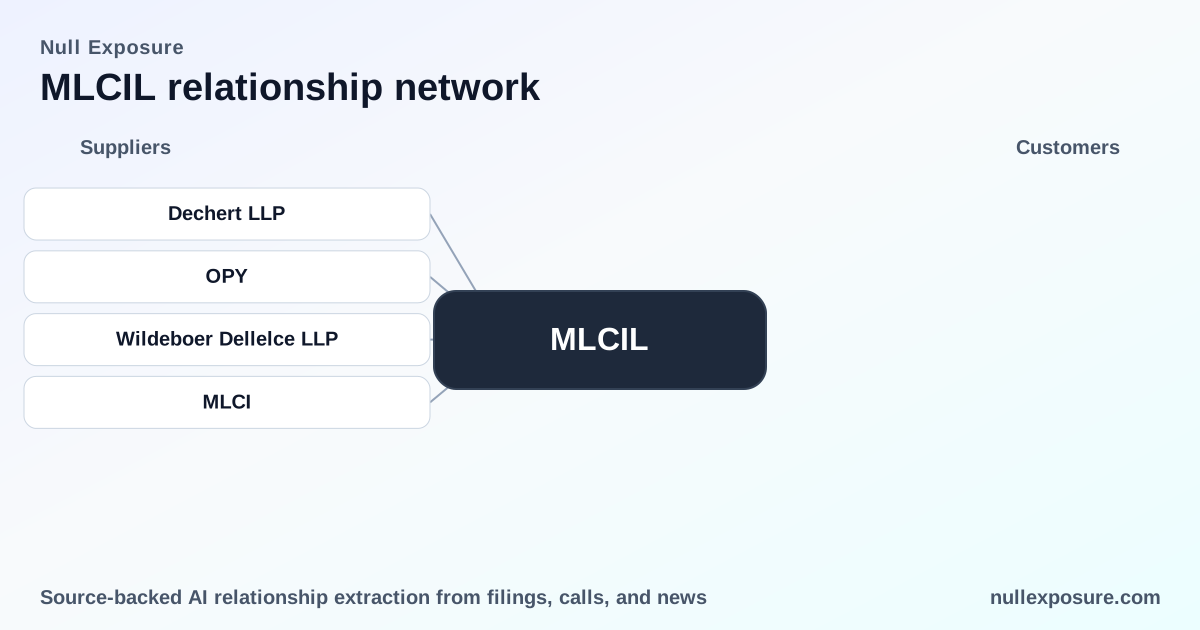
Mount Logan Capital (MLCIL) — Customer Relationships and Revenue Drivers
Mount Logan Capital operates as an alternative credit and insurance holding company that monetizes through three core levers: investment income from private and public debt positions, management and performance fees collected by its affiliate ML Management, and insurance/reinsurance spreads produced by Ability Insurance Company. The firm supplements those cash flows with structured financing — including the company’s 8.00% notes due 2031 — to fund yield-bearing assets and support capital deployment. For investors, the commercial relationships disclosed to date point to a vertically integrated model that both concentrates fee capture and centralizes asset management in a handful of affiliated entities.
For more detailed coverage and monitoring, visit the Null Exposure homepage: https://nullexposure.com/
How the customer map reveals Mount Logan’s operating posture
Mount Logan’s public statements make two features of its operating model obvious. First, asset management is internalized: ML Management is the engine that sources and manages credit exposures and sells those services to funds and insurance affiliates, enabling fee capture and tighter alignment of asset and liability management. Second, the firm combines asset management with insurance/reinsurance execution, where Ability functions as a captive reinsurance conduit for annuity and other insurance products. Together these features create a business structure that is concentrated but vertically integrated, which amplifies upside to successful origination while increasing single-counterparty and affiliate concentration risk.
Company-level signals for contracting posture, concentration, criticality, and maturity:
- Contracting posture: Mount Logan uses an internal management vehicle (ML Management) as the primary contracting counterparty for investment services, signaling a controlled, captive contracting posture rather than arms‑length external manager arrangements.
- Concentration: The limited universe of named counterparties and the prominence of Ability in disclosures indicate material revenue and asset concentration at the affiliate level.
- Criticality: Relationships with Ability and profit-sharing partners are operationally critical because they link asset management revenue to insurance balance sheet scale and reinsurance flows.
- Maturity and capital cadence: The presence of tradable debt (8.00% notes due 2031) provides a fixed-maturity financing anchor that impacts capital allocation decisions through 2031.
No formal contracting constraints were provided in the source material; the absence of explicit contract terms and concentration metrics in the available disclosures is itself a company-level signal that public detail on counterparties and contract economics is limited.
Who the customers are — relationship-by-relationship review
This section covers every customer relationship disclosed in the provided results.
Ability Insurance Company
Mount Logan discloses that ML Management provides investment management services to Ability, positioning Ability as both a customer of the manager and as an insurance affiliate that depends on Mount Logan for asset management and reinsurance execution. According to the company’s Nasdaq listing press release (GlobeNewswire, Sept 17, 2025), Ability is a primary conduit for the firm’s reinsurance of annuity products through its wholly owned subsidiaries.
A subsequent company filing reported that Ability’s assets managed by Mount Logan (excluding funds-withheld under reinsurance and Modco) were $660.7 million as of December 31, 2025, an increase of $40.6 million year-over-year, highlighting Ability’s growing scale within the group (GlobeNewswire, Mar 19, 2026). Another investor update reiterates ML Management’s role in providing investment services to Ability and related fund vehicles (GlobeNewswire, Nov 13, 2025).
Source citations: GlobeNewswire press releases — Sept 17, 2025; Nov 13, 2025; Mar 19, 2026.
Sierra Crest Investment Management
Mount Logan reported the initiation of a profit‑sharing arrangement with Sierra Crest Investment Management that generated a new recurring revenue stream in the third quarter; management signaled this revenue line will scale as the referenced BCIC vehicle grows (GlobeNewswire, Nov 13, 2025). The arrangement is described as profit-sharing rather than a straight fee-for-service, which implies Mount Logan has structured upside participation tied to Sierra Crest-managed performance rather than a pure fixed-fee contract.
Source citation: GlobeNewswire press release — Nov 13, 2025.
What these relationships mean for value and risk
Investors should treat the disclosed relationships as core structural drivers of Mount Logan’s revenue profile.
- Revenue concentration is meaningful. Ability is both a customer and an affiliate balance sheet conduit, and the $660.7 million of assets managed by Mount Logan as of year-end 2025 shows this tie has scale. That creates earnings leverage but also single‑counterparty concentration risk.
- Vertical integration boosts fee capture and margin control. By internalizing asset management through ML Management, Mount Logan retains fees that otherwise would go to third‑party managers. This improves gross margins but ties risk outcomes to internal governance and execution.
- Profit-sharing arrangements are upside-biased but opaque. The Sierra Crest profit‑share provides recurring revenue with performance linkage; its scale depends on the growth trajectory of BCIC and the underlying performance of the managed portfolios.
- Capital structure interaction matters. The 8.00% notes due 2031 create a fixed coupon demand that competes with growth capital needs; investors should model interest coverage and liquidity impacts through the 2031 maturity.
Practical implications for operators and research teams
- Monitor Ability’s assets-under-management trajectory and the composition of those assets; increases in AUM will translate into higher management revenue but also heavier reserve and capital requirements for the insurance business.
- Track disclosures regarding the Sierra Crest profit‑sharing arrangement for metrics on payout frequency and the underlying performance base; those details will determine how material the stream becomes to recurring revenue.
- Stress-test the group’s liquidity and interest coverage with the 8.00% notes due 2031 in mind; the note coupon and maturity profile are key to capital flexibility.
For ongoing surveillance and to see how these customer relationships evolve in filings and press releases, visit Null Exposure: https://nullexposure.com/
Bottom line for investors
Mount Logan’s model combines asset management and insurance balance-sheet origination, with Ability representing a material, integrated customer and Sierra Crest providing a nascent profit‑sharing revenue stream. That structure delivers high operational leverage and concentrated counterparty exposure — attractive if the firm sustains asset growth and portfolio performance, but requiring active monitoring of affiliate asset scale, contract economics, and the firm’s 2031 financing horizon.