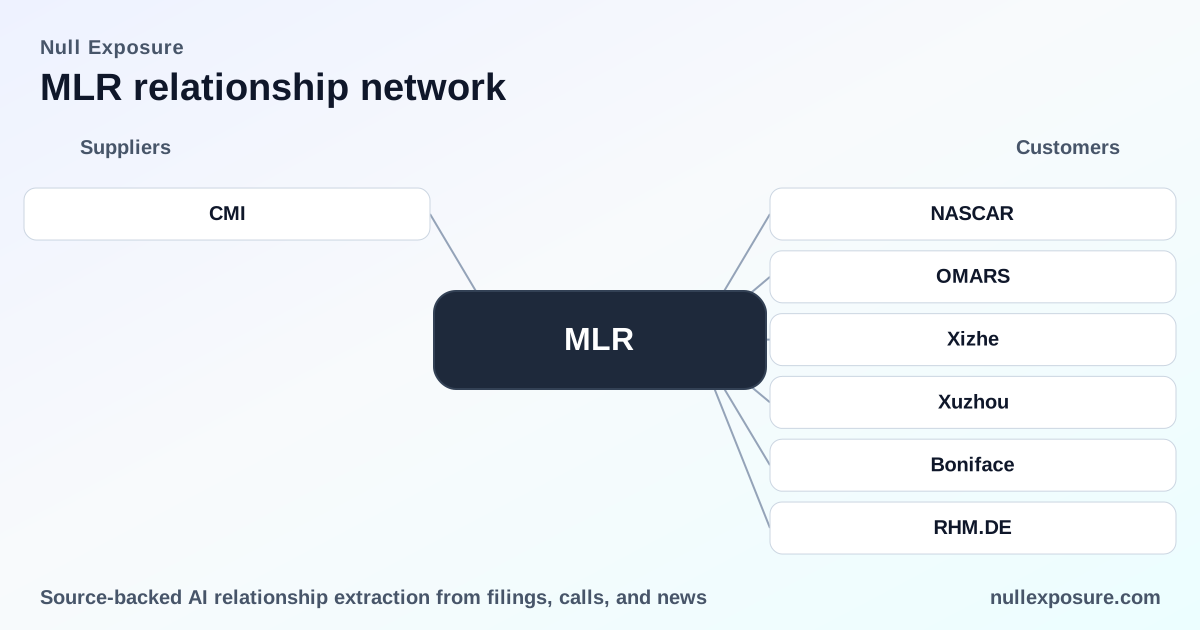
Miller Industries (MLR): Customer Relationships and What They Signal for Investors
Miller Industries manufactures towing and recovery equipment and monetizes through equipment sales to an extensive distributor network and direct end users, plus targeted government and prime-contractor work. Recent press and company disclosures show a mix of commercial fleet deliveries, motorsport partnerships and a defense-related award — a combination that reinforces recurring OEM-style sales cycles, geographic diversification, and a modest reliance on distributor channels for go-to-market execution. For primary research and ongoing monitoring, visit https://nullexposure.com/.
How Miller sells and where value is created
Miller’s core business is manufacturing bodies and complete recovery/tow units that are mounted on third‑party chassis and sold primarily through distributors or directly to end users. The company discloses roughly 76 distributor locations in North America and sells into government customers via prime contractors, signaling a dual sales posture: traditional distributor-led commercial sales plus selective direct/contract sales for public-sector work. The firm reports manufacturing footprints in the United States, United Kingdom and France, supporting both North American and European markets.
- Contracting posture: Predominantly distributor-driven sales with direct contracting capability for large or government orders.
- Concentration: Company-level disclosures state no single distributor accounted for more than 10% of consolidated sales in 2024, supporting a low single-customer concentration risk profile.
- Geographic footprint: North America is the primary revenue base, with a meaningful historical portion of sales in Europe (EMEA) — an important diversification signal for investors.
- Maturity and criticality: Relationships range from routine regional dealer deliveries to multi-unit fleet and government awards, indicating mixed maturity (ongoing distributor relationships) and variable criticality (high for defense or major fleet contracts).
Recent relationship activity — deliveries, partnerships and contract wins
Below I summarize every customer relationship reported in our coverage window and cite the public source for each item. These are concise, investor-focused takeaways.
NASCAR — national series fleet partner
Miller Industries signed an agreement to provide NASCAR with a complete fleet of towing and recovery equipment for national series events, expanding an existing motorsport support relationship and deploying specialized Century carriers and carriers on Ram chassis. This is a high‑visibility commercial partnership that supports brand recognition and product showcase to fleet and municipal buyers (NASCAR press release, Jan 29, 2026: https://www.nascar.com/news-media/2026/01/29/miller-industries-becomes-official-towing-and-recovery-equipment-partner-of-nascar/).
Stepp’s Race Recovery — operational deployment at events
Miller disclosed that vehicles from the NASCAR partnership will be utilized by Stepp’s Race Recovery crews to enhance race‑day operations, underscoring product suitability for high‑tempo, high‑visibility recovery work (tradersunion coverage of the NASCAR announcement, 2026: https://tradersunion.com/news/companies/show/1363914-miller-industries-nascar/).
Hannan Towing and Recovery — regional dealer delivery
Miller delivered a Century M100 on a Peterbilt 589 chassis to Hannan Towing and Recovery in Beltsville, Maryland, reflecting continued support for regional commercial customers and aftermarket delivery flows (tradersunion delivery report, 2026: https://tradersunion.com/news/companies/show/1907002-miller-industries-hannan-tow/).
Coletta Sales and Service — retail dealer acquisition
A new Century 9055 unit was delivered to Coletta Sales and Service in Providence, Rhode Island, demonstrating Miller’s steady dealer-level fulfillment to independent service and sales partners (tradersunion delivery notice, 2026: https://tradersunion.com/news/companies/show/1813969-century-9055-delivery-providence/).
Group Lussier Transport — Canadian recovery sale
Miller congratulated Group Lussier Transport in Quebec on acquiring a Century 5130 recovery vehicle, a sign of cross‑border commercial activity in Canada and validation of the firm’s aftermarket reach in North America (tradersunion report, 2026: https://tradersunion.com/news/companies/show/1813969-century-9055-delivery-providence/).
Rheinmetall Canada (RHM.DE) — defence supply award
During its Q4 2024 earnings call, Miller disclosed selection as the supplier to Rheinmetall Canada for eighty‑five recovery vehicles to support Canadian military requirements, indicating the company’s capability to win and execute on significant defense‑sector programs (MLR earnings call transcript, Q4 2024).
Boniface, OMARS and Xizhe — volume commitments and shorter lead times
Management told investors that Miller will supply Boniface, OMARS and Xizhe with reduced lead times, consistent quality and increased production volumes, which signals operational scaling and intentional capacity allocation to named customers (earnings transcript coverage via InsiderMonkey, Q4 2025: https://www.insidermonkey.com/blog/miller-industries-inc-nysemlr-q4-2025-earnings-call-transcript-1710557/).
Xuzhou — production sourcing note for European channels
Management also noted that Xuzhou and Boniface use roughly 50% U.S.-manufactured heavy‑duty product for the European market, highlighting a cross‑border supply pattern that helps manage logistics and tariff exposure for EMEA sales (earnings transcript coverage via InsiderMonkey, Q4 2025: https://www.insidermonkey.com/blog/miller-industries-inc-nysemlr-q4-2025-earnings-call-transcript-1710557/).
What these relationships imply for investors
The recent sample of relationships paints a coherent commercial picture:
- Brand and channel diversity: High‑profile partnerships like NASCAR deliver marketing value and product proof points, while dealer deliveries (Coletta, Hannan, Group Lussier) sustain steady replacement and incremental equipment revenue. This mix reduces single‑channel risk and supports a predictable equipment revenue runway.
- Government and defense optionality: The Rheinmetall Canada award signals access to defense procurement pathways, which tend to be lumpy but high‑margin and contractually rigorous; execution on such programs elevates Miller’s profile for future prime‑contractor work.
- Operational scaling and lead‑time management: Management comments about reduced lead times and increased production for named customers indicate improvements in capacity utilization or supply‑chain resilience, a positive for margins if maintained.
Risk considerations tied to customer relationships
- Program concentration risk remains elevated for large defense or fleet awards because individual contracts are lumpy; however, company disclosures that no distributor exceeded 10% of sales in 2024 mitigate distributor concentration concerns.
- Geographic exposure: North America dominates revenue; EMEA is meaningful but secondary, so macro shocks localized to the U.S. or Canada could compress demand more than global peers.
- Execution risk on large awards: Defense and large fleet deliveries demand strict quality and schedule compliance; failure to execute could damage distributor and government relationships.
Bottom line and next steps
Miller’s recent customer activity shows a balanced commercial model: stable dealer deliveries, brand partnerships that lift market visibility, and one-off but material defense wins that diversify revenue types. For modelers and operators, monitor backlog disclosures, win‑rate on large contracts, and whether reduced lead times translate into sustained gross‑margin expansion.
For a structured view of customer signals and ongoing relationship monitoring, consult our research hub at https://nullexposure.com/.