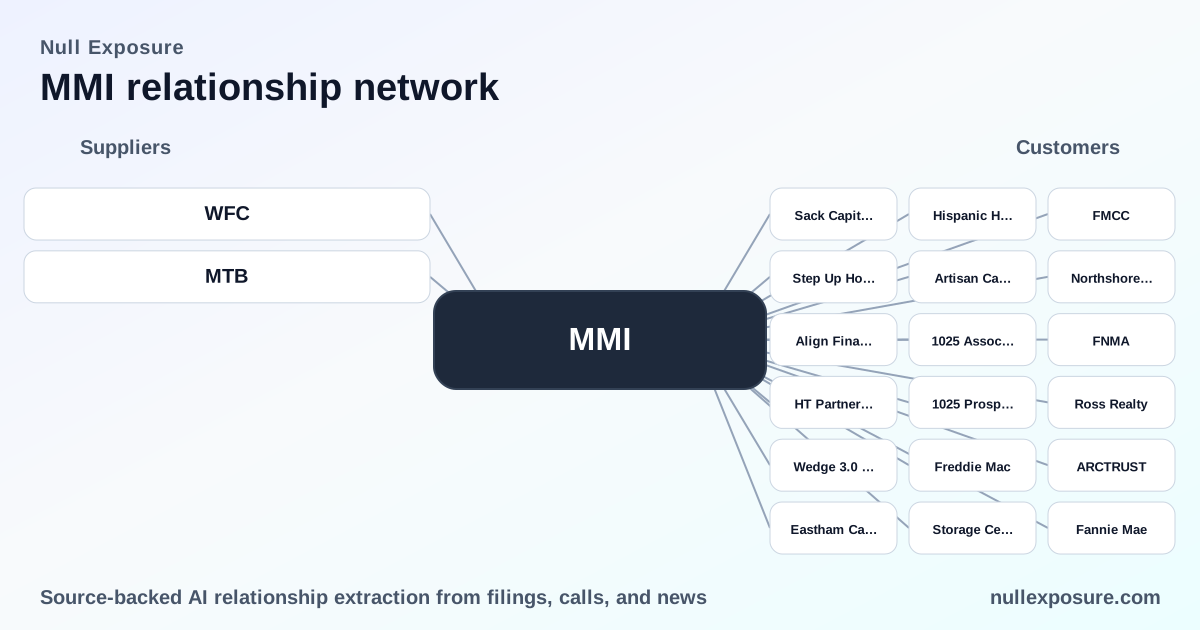
Marcus & Millichap (MMI): how transaction-driven brokerage revenue translates into investment exposure
Marcus & Millichap operates a national commercial real estate brokerage and financing platform that earns commissions and fees on a transaction-by-transaction basis, serving buyers and sellers across the U.S. and Canada. The firm monetizes through investment sales, financing placement and advisory services, with a disproportionate share of commissions coming from the $1 million–$10 million private client market and a material financing placement relationship that routes business to Fannie Mae and Freddie Mac partners. Learn more about our coverage at https://nullexposure.com/.
The operating model investors need to lock into their spreadsheets
Marcus & Millichap is a classic spot-market, fee-for-service business. Contracts are negotiated per transaction, listing agreements are short (typically expiring within six months), and the company recognizes revenue at the close of escrow when the outcome is final. That structure produces a business with high revenue volatility tied to transaction cadence, concentrated operational leverage in its licensed sales force, and relatively low contractual revenue visibility.
- Contracting posture: Spot and short-term engagements dominate; revenue is recognized upon close, not on retainer. (Company disclosures, FY2024–FY2025.)
- Customer role: Marcus & Millichap acts as a service provider and intermediary, representing sellers, buyers and lenders across deals rather than holding long-term client contracts.
- Geographic footprint: Operations are focused in North America — more than 80 offices across the U.S. and Canada — making earnings sensitive to regional CRE cycles.
- Client segment: The firm’s core brokerage clients are private investors in the $1M–$10M range, which generated roughly 62% of brokerage commissions in 2024.
- Maturity/criticality: The model is mature and scale-driven: persistent market access and a broad agent network are critical competitive advantages; single-transaction relationships are not strategic lock-ins.
These structural attributes make transaction velocity, commission rates and financing placement activity the principal drivers of near-term revenue and margin performance.
Recent counterparties and transaction flow — one-line takeaways
Below are every counterparty identified in recent press and earning commentary, with a concise description of Marcus & Millichap’s role and a short source note for verification.
- Step Up Housing — Marcus & Millichap subsidiary Institutional Property Advisors helped procure Step Up Housing as buyer on a Central Coast multifamily sale; the deal was announced in a BizWire release (Feb 2026). (BizWire, Feb 2026)
- Sack Capital Partners — Participated as a buyer partner on the same Central Coast multifamily transaction where IPA represented the seller; noted in the same press release. (BizWire, Feb 2026)
- HT Partners, L.P. — Identified as the seller on that Central Coast transaction, represented by IPA brokers from Marcus & Millichap. (BizWire, Feb 2026)
- Align Financing Partners — Named as a financing partner on the Central Coast transaction procured by IPA. (BizWire, Feb 2026)
- Eastham Capital — Partnered with Artisan Capital Group on multiple acquisitions; Marcus & Millichap brokers procured the buyer in an Arrowhead Apartments sale in the Chicago Oak Brook market. (YieldPro, Feb–Mar 2026)
- Sirius LLC / Sirius — Marcus & Millichap’s Wooten Group exclusively marketed a DC apartment property on behalf of Sirius and arranged sale and financing. (ConnectCRE / MultifamilyAffordableHousing, May 2026)
- White Crest CT LLC / White Crest LLC — Identified as buyers in Marcus & Millichap‑marketed DC transactions, with MMI arranging acquisition financing as part of the deal. (ConnectCRE / MultifamilyAffordableHousing, May 2026)
- Hispanic Housing Development Corporation — Managing partner in a JV that sold a Chicago-area apartment complex; Marcus & Millichap represented the seller in the transaction. (YieldPro / REJournals, Mar 2026)
- HUBB (HUBB NYC) — Seller of a Manhattan property that Marcus & Millichap marketed exclusively; the firm procured a private investor buyer. (YieldPro, Mar 2026)
- Artisan Capital Group — Buyer in Chicago-area and Palatine apartment acquisitions that Marcus & Millichap facilitated, noted as repeat partners with Eastham Capital. (YieldPro / REJournals, Mar 2026)
- 1025 Associates LLC — Buyer in a $10.3M La Jolla mixed‑use sale where Marcus & Millichap represented parties on both sides of the transaction. (ReBusinessOnline, Mar 2026)
- 1025 Prospect LLC — Seller of the La Jolla mixed‑use asset, represented by Marcus & Millichap in the sale. (ReBusinessOnline, Mar 2026)
- Wedge 3.0 LLC — Co‑buyer in the La Jolla mixed‑use acquisition alongside 1025 Associates; transaction noted in local commercial press. (ReBusinessOnline, Mar 2026)
- Compass Self Storage — Operator of two self‑storage properties for which Marcus & Millichap Capital Corp arranged $12M in financing. (CityBiz, May 2026)
- Fannie Mae (FNMA) — Marcus & Millichap Capital Corp and IPA Capital Markets placed a portion of ~$2.3B of financing volume with Fannie Mae as disclosed on the Q4 2025 earnings call. (MMI Q4 2025 earnings call)
- Freddie Mac — Freddie Mac joined Fannie Mae as a placement conduit for MMI’s financing volume via strategic alliances; cited on the Q4 2025 call. (MMI Q4 2025 earnings call)
- Oaklander, LLC — Identified as the purchaser on a recent sale arranged by Marcus & Millichap (Kane Place Apartments coverage). (YieldPro, Apr 2026)
- Niets Investment Co. / Niets Investment Company — Procured buyers for single-tenant and Chipotle‑occupied retail properties marketed by Marcus & Millichap in Wisconsin. (ReBusinessOnline / REJournals / ShoppingCenterBusiness, 2026)
- Northshore Development — Marcus & Millichap represented the Florida‑based buyer in a negotiated sale of a Hilton‑branded Baton Rouge hotel. (ReBusinessOnline, Mar 2026)
- Storage Center Group — Acquired a 554‑unit self‑storage facility in an off‑market deal where Marcus & Millichap represented the buyer. (ReBusinessOnline, Mar 2026)
- Ross Realty — Seller of a Vero Beach strip center that Marcus & Millichap marketed, with the firm procuring an institutional buyer. (ShoppingCenterBusiness, Mar 2026)
- Commonwealth Commercial — Seller in an Oakwood Plaza retail disposition marketed by Marcus & Millichap in Metro St. Louis coverage. (ShoppingCenterBusiness, 2026)
- ARCTRUST — Affiliate seller in a retail strip center near Washington D.C. where Marcus & Millichap marketed the asset and procured private buyers. (ShoppingCenterBusiness, Mar 2026)
- CLDT‑P‑A — Cited in reporting on an Institutional Property Advisors engagement around a San Mateo hotel disposition that could convert to housing; note appears in regional coverage. (The Real Deal, Jun 2025)
Each of the above entries is documented in industry press or MMI filings/earnings commentary between mid‑2025 and 2026.
What these relationships tell investors about risk and runway
- Revenue is episodic and sensitive to deal flow. The roster above is dominated by single‑asset sale and financing transactions, which confirms that MMI’s client relationships are largely transactional rather than recurring revenue agreements. That makes quarterly revenue highly dependent on market tempo and broker productivity.
- Financing placement is a lever for scale. The firm’s placement of roughly $2.3 billion with Fannie Mae and Freddie Mac (Q4 2025 disclosure) shows MMI’s ability to route institutional financing, which diversifies fee pools and reduces pure‑brokerage cyclicality.
- Concentration in the $1M–$10M private client band is a double‑edged sword. That segment offers volume and repeatable commissions but is also more sensitive to local liquidity swings than large institutional pipelines.
- Geographic concentration in North America keeps macro sensitivity high. A U.S./Canada footprint concentrates exposure to regional CRE cycles but benefits from scale in a single regulatory and financing ecosystem.
Bottom line: what investors should watch next
For investors, the core monitorables are transaction velocity, financing placement volumes (especially volumes routed to FNMA/FMCC), and retention/productivity of the independent sales force. These drivers determine whether the firm converts its broad pipeline of spot mandates into predictable earnings growth. For further primary‑source tracking and relationship mapping, visit https://nullexposure.com/ for our coverage and data tools.