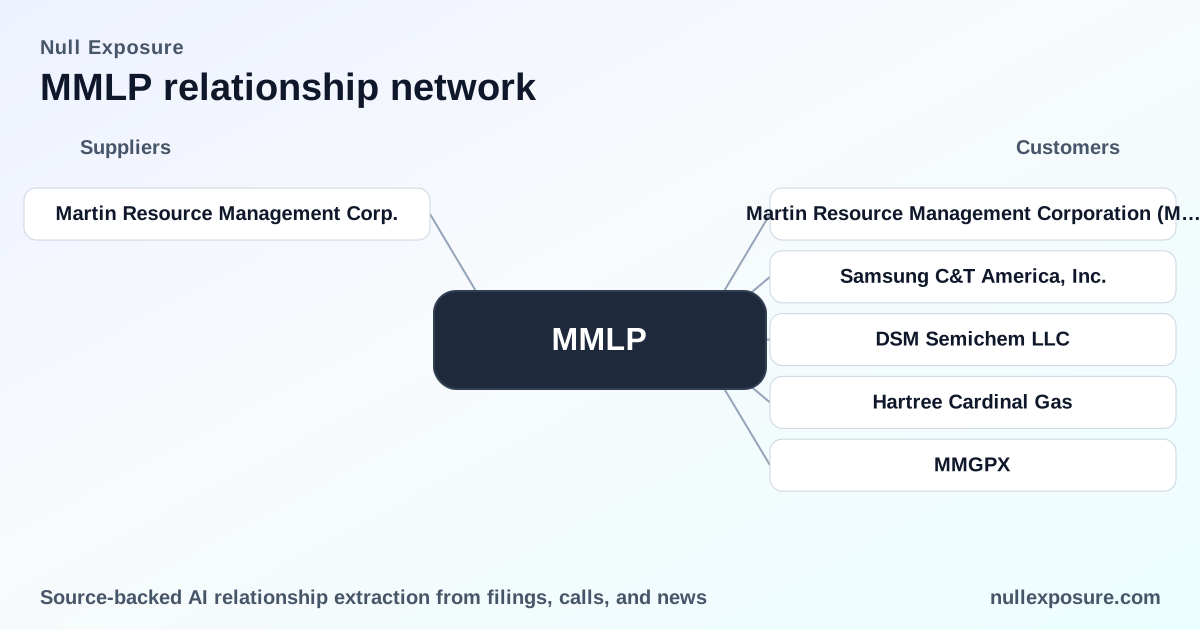
Martin Midstream Partners (MMLP): Customer Relationships and What They Mean for Cash Flow and Risk
Martin Midstream Partners operates a vertically integrated midstream platform—terminalling, processing, storage, transportation and sulfur/fertilizer manufacturing—concentrated on the U.S. Gulf Coast and monetizes through a mix of fee-based services, product sales and reservation fees tied to joint ventures. Revenue stability is driven by long-term terminalling and storage contracts and a material, captive relationship with its parent entity, while growth initiatives hinge on project-level joint ventures and spot marine/transportation activity. For a concise source of the relationship evidence used below, see the Martin Midstream filings and contemporaneous news coverage summarized in this note. To explore the underlying signals and documents, visit https://nullexposure.com/.
Quick investment thesis: cash stability with concentrated counterparty exposure
Martin’s core cash generation comes from contractually predictable terminalling and storage services and recurring transportation fees, complemented by product sales from sulfur and fertilizer operations. The firm’s contracting mix—long-term contracts for core assets and spot agreements for certain marine services—creates a hybrid revenue profile: steady base cash flow with episodic upside and project risk. However, parent-related concentration (roughly mid-teens of revenue) and progress on strategic projects determine the downside/upswing for distributions and free cash flow.
Relationships: who matters and why
Martin Resource Management Corporation (MRMC)
Martin Resource Management Corporation is both the parent and the largest customer; sales to MRMC represented about 15% of Martin’s revenues in 2024 (14% in 2023). The company also operates under a master transportation services agreement and receives demand‑based land transportation and spot marine services tied to MRMC. This relationship is material and strategically central to Martin’s revenue base and corporate support arrangements. According to the company’s FY2024 10‑K and a Fitch / MarketScreener coverage note (March 2026), MRMC is the largest customer and a primary counterparty for both services and corporate support.
Source: FY2024 10‑K (mmlp-2024-12-31) and MarketScreener coverage (March 10, 2026).
Samsung C&T America, Inc.
Martin’s Project ELSA is a joint venture to provide electronic level sulfuric acid to Samsung C&T America’s Texas semiconductor facility; the project’s ramp is progressing slowly because Samsung has delayed bringing the plant fully online, tempering near-term upside from that growth initiative. MarketScreener reported this update while reviewing Martin’s business and outlook.
Source: MarketScreener coverage of Fitch affirmation (March 10, 2026).
DSM Semichem LLC
Martin recognized reservation fees related to a DSM Semichem joint venture that contributed to a $1.0 million increase in adjusted EBITDA in the fertilizer division and higher sales volume during the quarter. That suggests joint-venture reservation economics are an active contributor to fertilizer segment profitability in recent quarters. This detail comes from Martin’s Q3 2025 financial release as syndicated on Sharewise/BusinessWire.
Source: Martin Midstream Q3 2025 financial results press release (posted via BusinessWire/Sharewise).
Hartree Cardinal Gas
Martin disposed of gas storage assets (Cardinal Gas Storage: Arcadia, Cadeville, Monroe and Peryville) to Hartree Cardinal Gas for $215 million in cash in mid-2019, a transaction that realigned Martin’s asset base toward refinery and services businesses. The sale reflects strategic portfolio rebalancing away from gas storage and toward fee-based refinery services.
Source: StreetwiseReports summary of the 2019 divestiture (June 2019).
MMGP / MMGPX (general partner context in 10‑K)
The FY2024 10‑K references an Omnibus Agreement under which Martin Resource Management Corporation provides corporate staff and support services on behalf of Martin’s general partner (listed in filings as MMGP / MMGPX). That arrangement centralizes corporate support and governance services with the parent company, embedding MRMC in both the customer and administrative relationships of the partnership.
Source: FY2024 10‑K (mmlp-2024-12-31).
(For more on contract language and evidence of these relationships, see curated document signals at https://nullexposure.com/.)
What the contracting posture and constraints say about business risk and resilience
Martin’s public filings and recent coverage reveal a mixed but coherent contracting posture:
- Framework and demand-based transportation agreements exist for land services to the parent (MRMC). Those agreements create ongoing transactional flow while keeping pricing aligned to market rates.
- Core terminalling and storage are run under long-term contracts, producing predictable, low-volatility cash flows that underpin EBITDA stability.
- Certain marine transportation services are provided on a spot basis, introducing commodity- and cycle-exposure in those lines.
- Counterparty profile skews toward large enterprises—majors, independent refiners, chemical companies and wholesale purchasers—consistent with operations concentrated in the Gulf Coast refining complex.
- Geographic concentration is primarily the U.S. Gulf Coast, a major hub for the products the company handles; this underwrites operations but creates regional risk exposure to refinery outages, hurricanes, and regulatory shifts.
- Materiality is non-trivial: MRMC accounted for approximately 15% of revenues in 2024, a level that creates single‑counterparty sensitivity although not outright dominance.
- Segment positioning is services-first: terminalling/storage, land/marine transportation, sulfur/fertilizer processing, and NGL marketing/blending—the firm sells services and product title transfers, recognizing revenue when the customer takes title.
These constraints indicate a company with stable base cash flow from long-term contracts and a measured exposure to project and spot cycles. The dual role of MRMC as parent, service counterparty and corporate support provider concentrates operational dependency but also streamlines governance and service delivery.
Investment implications and risk focus
- Stability driver: Long-term contracts for core terminalling and storage support predictability in EBITDA and free cash flow.
- Concentration risk: MRMC’s mid‑teens revenue share and central role in providing corporate services create asymmetric downside if that relationship changes.
- Project execution risk: Progress on Project ELSA and JV reservation economics (e.g., DSM Semichem) are the primary sources of near-term growth or upside; ELSA delays by Samsung reduce immediate revenue visibility.
- Cyclicality and spot exposure: Marine and certain transportation revenues are subject to spot pricing; commodity cycles will amplify volatility in those lines.
Bottom line: Martin Midstream’s operating model blends durable fee-based cash flows with concentrated counterparty exposure to its parent and a small set of large enterprise customers; credit and equity investors should weigh the dependable base EBITDA against single-counterparty and project execution risks.
If you want a focused dossier on all the underlying filings and news references used to form these takeaways, visit https://nullexposure.com/ for the primary-source links and document summaries.