Maximus (MMS): Government services backbone with predictable contract economics
Maximus operates as a tech-enabled business process services provider to government health and human services programs worldwide, monetizing through long-term, fee-for-service contracts and program-administration agreements with federal, state and international governments. Revenue derives from contractually backed service delivery, with a large share of receipts tied to U.S. federal and state customers and recurring performance obligations that smooth cash flow and margins. For investors and operators, the investment case rests on contract durability, government counterparty credit, and a steady backlog, while key near-term drivers are federal modernization wins and discrete nonrecurring emergency support work. Learn more at https://nullexposure.com/.
How Maximus contracts and what that means for revenue quality
Maximus’s operating model is dominated by government customers and contract structures that favor multi-year, framework-style engagements. These characteristics translate into high revenue visibility but concentration exposure.
- Contracting posture: Frameworks and pre‑competed vehicles are central to the business, supporting rapid tasking and repeat business under IDIQ/GWAC-like terms. This structure accelerates program scale-up and reduces reprocurement friction.
- Term and maturity: Contracts routinely run for multiple years with optional extensions, producing a long-term revenue base and predictable revenue recognition.
- Counterparty risk and criticality: Approximately half-plus of revenue is federal, positioning Maximus with very low commercial credit risk but heightened policy and budget-cycle sensitivity.
- Geographic footprint and diversification: The company operates in North America, EMEA and other international markets, providing geographic diversification but concentrated exposure to U.S. federal/state funding levers.
- Backlog scale: As of FY2025 the company reported roughly $330 million of remaining performance obligations, reflecting sizable near-term contracted work.
Collectively, these signals define Maximus as a service-provider to governments with material, long-duration contract cashflows and elevated policy-dependent revenue concentration (company FY2025 disclosures).
Recent customer relationships flagged in the coverage
The following relationships surfaced in recent coverage and transcripts; each entry is covered with a short practical read for investors and operators.
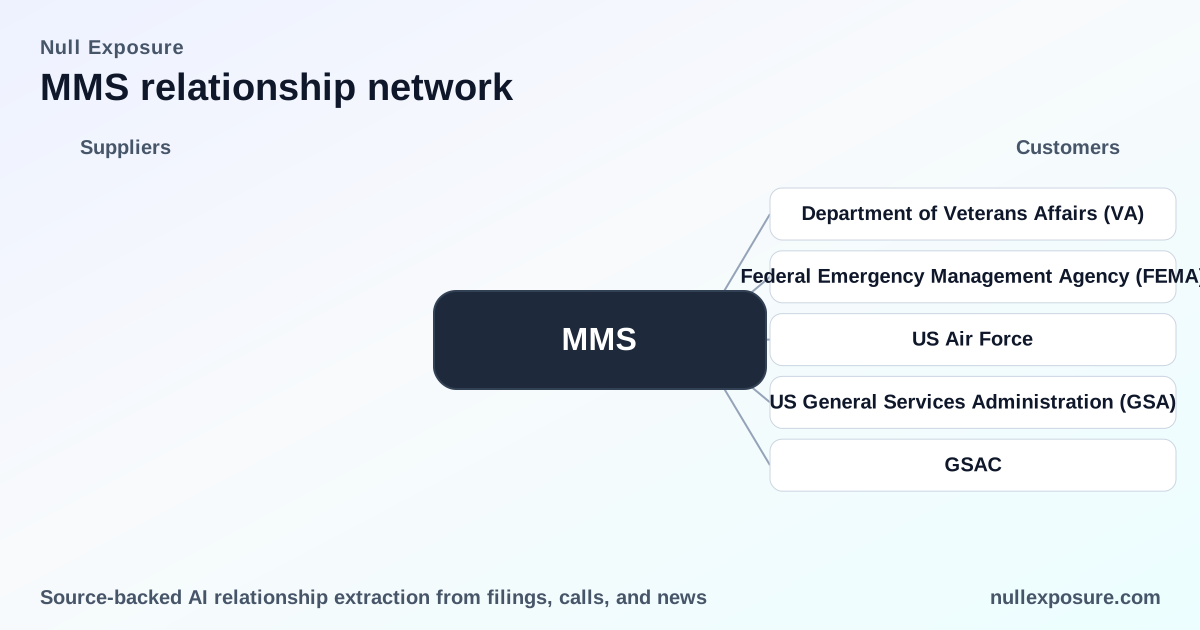
FEMA — episodic disaster support showed a ~$100 million nonrecurring element
InsiderMonkey’s transcript of Maximus’s Q1 FY2026 earnings call noted a FEMA-related, nonrecurring element in the prior year roughly in the $100 million range (about 2% of revenue) linked to natural disaster support, illustrating episodic revenue upside from emergency deployments (InsiderMonkey Q1 FY2026 earnings call transcript, March 2026: https://www.insidermonkey.com/blog/maximus-inc-nysemms-q1-2026-earnings-call-transcript-1690283/).
Department of Veterans Affairs (VA) — defined performance window through year-end 2026
Executives confirmed that current VA contracts have periods of performance running through 12/31/2026, signaling contracted coverage into late 2026 and implying upcoming recompetition or extension decisions investors should monitor (InsiderMonkey Q1 FY2026 earnings call transcript, March 2026: https://www.insidermonkey.com/blog/maximus-inc-nysemms-q1-2026-earnings-call-transcript-1690283/).
U.S. Air Force — expansion into defense customer set
Management cited expansion into the U.S. Air Force as evidence of platform leverage and cross-government opportunity capture, indicating an active pursuit of defense-adjacent programs beyond traditional health and human services work (InsiderMonkey Q1 FY2026 earnings call transcript, March 2026: https://www.insidermonkey.com/blog/maximus-inc-nysemms-q1-2026-earnings-call-transcript-1690283/).
U.S. General Services Administration (GSA) — single-award BPA for AI-driven contact center transformation
Maximus announced selection as the single awardee on a GSA blanket purchase agreement (BPA) to support government experience contact center (GXCC) transformation, positioning the company for expanded, AI-driven federal modernization work subject to the regulatory protest period (InsiderMonkey Q1 FY2026 earnings call transcript, March 2026: https://www.insidermonkey.com/blog/maximus-inc-nysemms-q1-2026-earnings-call-transcript-1690283/).
GSAC / GSA (analyst focus) — market interest in the GSA AI award
Independent coverage highlighted analyst questions about the GSA AI contract award; Finviz summarized that Charlie Strauzer requested details on the GSA AI award, showing investor attention and the strategic importance of the GSA win in the call (Finviz summary, March 2026: https://finviz.com/news/308529/the-top-5-analyst-questions-from-maximuss-q4-earnings-call).
YoungWilliams, PC — divestiture/transaction of Maximus subsidiaries
MarketScreener reported that on Jan. 21 YoungWilliams, PC acquired MAXIMUS Human Services, Inc. and Maximus US Services, Inc. from Maximus, Inc., reflecting corporate-level restructuring or carve-out activity that can affect segment composition and capital allocation (MarketScreener, May 2026: https://www.marketscreener.com/news/maximus-keeps-quarterly-dividend-at-0-33-a-share-payable-june-1-to-shareholders-of-record-on-may-1-ce7e51d2de8bf02c).
What these relationships and constraints mean for investors and operators
- Revenue resilience from government counterparty credit: With roughly 55% of revenue from U.S. federal agencies and extensive state coverage, Maximus benefits from low credit risk and high collectability; however, policy and procurement cycles drive timing risk (company FY2025 disclosures).
- Framework and long-term contract economics enable margin stability: Pre-competed vehicles and multi-year contract terms create operational leverage and predictable utilization, supporting stable operating margins versus transactional commercial outsourcing.
- Concentration is material but manageable: Heavy dependence on government customers concentrates political and budget risk; diversification into international and defense customers partially offsets this concentration.
- Backlog and RPO provide near-term visibility: Approximately $330 million of remaining performance obligations signals meaningful contracted work in the pipeline and supports short-term revenue forecasts (company FY2025 disclosures).
- Catalysts and risks: The GSA BPA win is a concrete growth catalyst tied to AI-driven modernization; FEMA episodic work underscores upside volatility; upcoming VA procurements in 2026 create both renewal risk and upside potential.
For operators, the priority is executing on the GSA transformation scope while maintaining program performance on legacy federal and state contracts to protect renewal economics. For investors, valuation must balance attractive EBITDA conversion and dividend yield against concentration and procurement timing risk (see company fundamentals).
If you want a consolidated view of Maximus’s customer relationships and the procurement signals that matter, visit https://nullexposure.com/ for direct access to structured relationship monitoring and contract-level alerts.
Bottom line: reliable government cashflows, policy sensitivity
Maximus delivers predictable, contract-backed revenue that supports durable margins and a modest dividend, driven by long-term relationships with federal and state agencies. The investment thesis is straightforward: durable cashflows with episodic upside from emergency support and modernization wins, while key risk vectors are procurement timing, political funding cycles, and any material shifts in program scope or protest outcomes. Active monitoring of VA renewals, GSA BPA implementation, and FEMA emergency tasking provides the clearest near-term signals for earnings and cashflow trajectory.