MakeMyTrip (MMYT): Customer relationships that define risk and optionality
MakeMyTrip operates an online travel marketplace that sells flights, hotels and ancillary travel products across India and selected international markets; it monetizes through transaction fees, merchant margins and platform services while retaining balance-sheet exposures such as receivables from airline partners. Investors should value MMYT as a high-growth travel platform with material partner counterparty risk and concentrated strategic investors that influence governance and disclosure sensitivity. For more structured signals and monitoring tools, see https://nullexposure.com/.
The short investment thesis up front
MakeMyTrip generates revenue by brokering travel transactions and operating marketplace services while occasionally carrying airline receivables and regulatory liabilities on its balance sheet. With trailing revenue just over $1.03 billion and a market capitalization near $4.45 billion, MMYT trades at a premium multiple (trailing P/E ~91.9) that prices continued growth and execution; the company’s partner network and minority shareholder base are central determinants of both upside and downside.
What investors need to know right away
- Concentration of influence: A strategic minority holder holds meaningful voting shares and is positioned to affect corporate decisions.
- Counterparty credit exposure: Receivables from defunct or distressed carriers are an explicit financial and disclosure risk.
- Short-seller scrutiny: Recent activist reports have prompted market sensitivity and share price volatility.
Customer-relationship breakdown (each reported relationship)
-
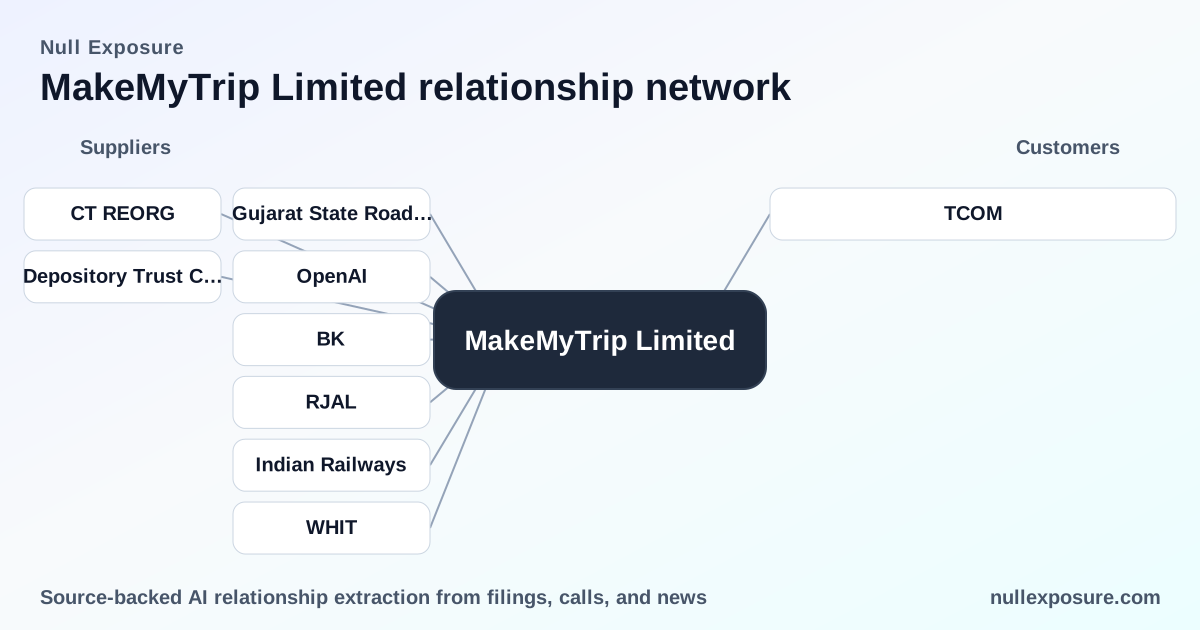
TCOM / Trip.com (earnings call, 2026 Q1). Trip.com is now the largest minority shareholder with approximately 16.9% voting shares in MakeMyTrip, a position disclosed in MMYT’s 2026 Q1 earnings call (March 2026). According to the call, this stake gives Trip.com material influence over shareholder dynamics and strategic conversations.
Source: MakeMyTrip 2026 Q1 earnings call (March 2026). -
GoAir — Economic Times report (May 2026). An activist short-seller flagged an exposure to a receivable from insolvent airline GoAir and stated that only part of that amount has been provisioned by MakeMyTrip, putting a balance-sheet credit exposure in focus.
Source: Economic Times / legal.economictimes.indiatimes.com report (May 2026). -
GoAir — Storyboard18 (May 2026). Coverage highlighted MMYT’s treatment of a roughly $20 million (≈₹189 crore) receivable from the now‑shut airline GoAir, reinforcing the market’s focus on how these receivables are recognized and provisioned.
Source: Storyboard18 article (May 2026). -
Go First — VCCircle (May 2026). A report summarizing activist research highlighted unprovisioned liabilities that include a potential CCI fine and a $20 million receivable from insolvent airline Go First, noting that only half of that receivable had been impaired per the short-seller’s contention.
Source: VCCircle coverage of Morpheus Research (May 2026). -
Go Air — SahmCapital summary (March/May 2026). Independent commentary reiterated the $20 million receivable claim and noted that competing platforms reportedly wrote off similar exposures, drawing comparisons in peer provisioning behavior.
Source: SahmCapital summary of the short-seller report (March/May 2026). -
Go Air — multiple news outlets (collective, FY2026). Consensus media reporting across outlets emphasizes that airline insolvencies create one-off provisioning demands and regulatory scrutiny that directly affect MMYT’s reported liabilities in FY2026.
Source: Aggregated press coverage (March–May 2026). -
FC / FranklinCovey — InfotechLead (March 2026). FranklinCovey cited savings and operational compression after moving away from an expensive legacy system and adopting a MakeMyTrip‑related solution named “Make,” reporting elimination of a $60,000-per-year cost and faster HR workflows, which the CIO said freed teams for higher-value work. This is an example of MMYT’s platform or product being used to generate cost savings for corporate customers.
Source: InfotechLead report quoting FranklinCovey (March 2026).
What these relationships collectively imply about MakeMyTrip’s operating model
- Contracting posture: MakeMyTrip operates as a marketplace with hybrid contracting — it is a commission-driven platform but also holds direct contractual exposure (receivables and regulatory contingent liabilities) that convert platform credit risk into corporate credit risk.
- Concentration and criticality: Strategic investors and a limited number of major airline partners create concentrated points of failure. Trip.com’s ~16.9% voting stake is a governance-level concentration; a handful of airlines are critical to supply and cashflow.
- Maturity and commercial profile: The business shows characteristics of a mature marketplace scaling international reach, evidenced by established revenue streams (~$1.04B TTM) and positive EBITDA, but valuation multiples imply market expectations of sustained revenue growth and margin improvement.
- Disclosure and governance sensitivity: The presence of a visible strategic minority shareholder and active short-seller allegations increases the importance of conservative provisioning, transparent disclosures, and proactive governance.
Near-term catalysts and risk checklist
- Catalyst — governance activity: Any coordinated action or public engagement from Trip.com will materially affect investor perception; keep track of shareholder communications and board activity.
- Risk — counterparty provisioning: The $20 million airline receivable and the short-seller’s allegation about unprovisioned regulatory fines are explicit downside risks that impact reported earnings and leverage. Coverage in mainstream press has already driven share-price reactions in 2026.
- Risk — reputational/regulatory: Allegations of anti‑competitive practices and accounting irregularities, as reported by activist research and covered in Indian press in 2026, raise the regulatory compliance premium investors must apply to valuation.
- Balance-sheet resilience: Use reported metrics (market cap ≈ $4.45B, EBITDA ~$165.8M, revenue ~$1.04B) to stress-test scenarios where provisions and fines are recognized; valuation multiples already price strong future execution.
For continued monitoring and structured tracking of partner exposures and public signals, review our coverage at https://nullexposure.com/.
Investment conclusion
MakeMyTrip is a platform play with clear growth levers in travel recovery and ancillary monetization, but governance concentration and explicit counterparty receivable exposures create asymmetric downside risk that is already reflected in market sensitivity and activist attention. Investors should weigh growth expectations embedded in elevated multiples against the probability and magnitude of provisioning and regulatory costs being recognized through FY2026 disclosures.