MNDR: Where commercial partnerships underpin a capital-light telehealth roll‑out
Mobile‑health Network Solutions (MNDR) operates as a Singapore‑headquartered investment holding company that monetizes a telehealth platform by licensing services and forming regional distribution partnerships. Revenue is driven by corporate wellness contracts, partner rollouts, and recurring telemedicine service fees rather than heavy capital investment in bricks‑and‑mortar care. For investors, the critical question is whether the company’s partner network can generate volume and predictable cashflows to offset negative operating leverage reflected in recent results. For quick reference, review MNDR’s investor intelligence at https://nullexposure.com/.
Market snapshot: MNDR reported trailing revenue of roughly $7.32 million with negative margins and an EPS loss of $3.05 (FY‑TTM). This is a small‑cap, capital‑light healthcare technology operator with concentrated institutional ownership and limited analyst coverage, trading well below its 52‑week high and carrying significant downside volatility.
Why partners matter more than product for MNDR
MNDR’s commercial strategy centers on distribution and white‑labeling rather than direct patient acquisition. Partnerships turn MNDR’s software and telemedicine offerings into scalable revenue channels: corporate wellness bundles expand the addressable user base, while regional deals extend the company’s footprint into markets where MNDR lacks local sales infrastructure. Given MNDR’s operating losses and low institutional ownership, partner performance will disproportionately determine near‑term revenue growth and margin improvement.
Key operating model constraints and what they signal for investors
- Contracting posture: MNDR’s model is partner‑led—contracts will typically be MOUs or commercial agreements with third parties rather than large, capital‑intensive provider investments. This implies faster go‑to‑market but greater dependence on partners for customer acquisition and collections.
- Concentration risk: The company’s limited public disclosures and small revenue base create concentration exposure—a few partner wins or losses can swing quarterly performance materially.
- Criticality: MNDR’s platform is positioned as an adjunct to employer benefit programs and public health initiatives; its services are valuable but not mission‑critical to core healthcare delivery in most markets, suggesting pricing and renewal cycles will remain influenced by cost‑savings and convenience metrics.
- Maturity: The commercial relationships reflect an early‑stage roll‑out: memoranda of understanding and corporate wellness alliances rather than long‑term, multi‑year exclusive contracts, indicating early commercial maturity with upside contingent on partner conversion and scale.
A concise tour of MNDR’s disclosed customer relationships
Below I summarize every partner relationship surfaced in MNDR’s public signals and cite the relevant reporting.
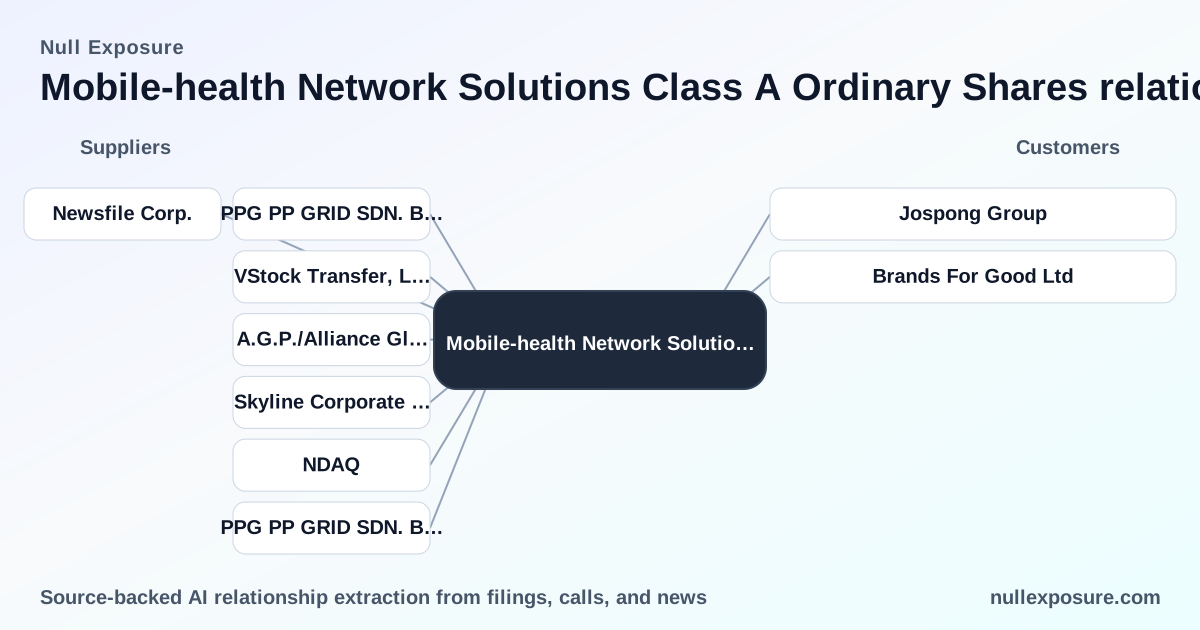
Jospong Group — West Africa JV MOU
MNDR signed a memorandum of understanding with Ghana’s Jospong Group to deploy its AI‑powered digital health platform in West Africa, positioning the company for regional expansion via local distribution and infrastructure partners. This engagement is described in a November 2025 news report and later referenced in industry summaries (tech media coverage, Nov 2025 / reported March 2026). Source: TechS2 report on MNDR’s regional JV MOU (Nov 2025) — https://ts2.tech/en/mobile-health-network-solutions-mndr-stock-surges-on-120-million-ai-data-center-deal-in-malaysia-november-20-2025-update/.
Brands For Good Ltd — Corporate wellness partnership
MNDR entered a partnership with Brands For Good Ltd to provide member companies and their employees access to corporate wellness services, including telemedicine, vaccinations, and health screenings; the collaboration is positioned to expand MNDR’s recurring B2B revenue through employer benefit programs. This partnership was announced in October 2025 and covered by MarketScreener and press releases in late 2025. Source: MarketScreener and SAHM Capital coverage of the Brands For Good partnership (Oct 2025 / reported Mar 2026) — https://www.marketscreener.com/news/mobile-health-network-solutions-and-brands-for-good-unite-to-champion-corporate-wellness-and-doing-g-ce7d5adcdb8bf023 and https://www.sahmcapital.com/news/content/mobile-health-network-solutions-and-brands-for-good-unite-to-champion-corporate-wellness-and-doing-good-2025-10-16.
What these relationships mean for revenue and risk
- Growth vector: The Jospong MOU unlocks a geographic growth vector (West Africa) with the potential for outsized incremental returns if the company secures payor or employer networks through the partner. The Brands For Good agreement targets recurring B2B revenue from wellness programs and should drive utilization and per‑user revenue if adoption by member companies scales.
- Execution risk: Both relationships are early‑stage commercial agreements—MOUs and partnership announcements—so revenue realization depends on conversion to signed commercial contracts, onboarding, and local regulatory or reimbursement dynamics.
- Leverage to volume: MNDR’s cost structure is largely technology and commercial; successful partner conversions will improve gross margins quickly, but failure to scale will keep operating leverage negative given current EBITDA losses.
Financial context that frames partner value
MNDR’s trailing revenue ($7.32M) and gross profit ($1.44M) indicate early revenue traction but negative operating margins and cash generation. With low institutional ownership and a market cap near $5.0M, the company trades as a high‑risk, high‑operational‑execution thesis: partner announcements like Jospong and Brands For Good act as the primary catalysts for rerating. Investors should prioritize disclosure of signed contracts, revenue contribution by partner, and customer retention metrics in forthcoming filings.
Operational diligence checklist for investors and operators
- Confirm contract types and term lengths for each partner; MOUs have different credit and renewal implications than firm multi‑year commercial agreements.
- Seek clarity on revenue recognition: direct billing to employers, platform licensing, or transaction fees per consultation.
- Analyze onboarding timelines and go‑to‑market resourcing needs in the partner’s region, especially for the Jospong‑led West Africa expansion.
- Monitor utilization metrics from Brands For Good member rollouts—employee uptake and recurring appointment rates determine sustainable ARR.
Conclusion: partnership announcements are necessary but not sufficient
MNDR’s announced partnerships with Jospong Group and Brands For Good are strategically aligned with a capital‑light expansion model, giving the company a clear path to scale distribution without heavy fixed investment. However, the current public record shows early‑stage commercial activity rather than locked‑in revenue streams; investors must watch for contract conversions and measurable utilization improvements before upgrading the investment thesis. For ongoing tracking of MNDR’s partner conversions and investor signals, visit https://nullexposure.com/.
Key takeaway: partner economics and conversion timing—not headlines—will drive MNDR’s valuation trajectory.