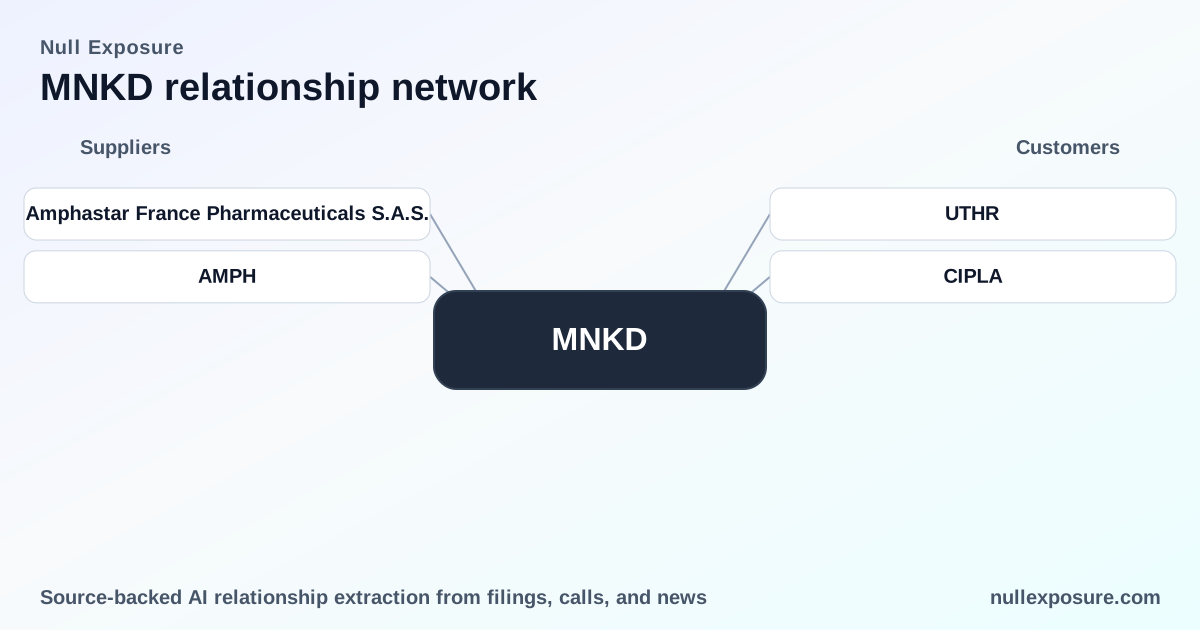
How MannKind monetizes customer relationships: manufacturing, royalties and selective co-promotion
MannKind (MNKD) operates as a hybrid commercial-stage biopharma: it sells endocrine products directly in the U.S. (Afrezza, V‑Go), and it generates recurring commercial revenue by manufacturing and licensing inhaled products for partners—most materially Tyvaso DPI for United Therapeutics—while also selling development and co‑promotion services. Its revenue base today is a mix of product sales, manufacturing fees and royalties, producing meaningful gross margins but leaving the company exposed to a small number of strategic partnerships. For investors and operators assessing MNKD, the crucial lens is contract structure and supplier concentration rather than pure R&D upside. For a concise view of the coverage methodology, see NullExposure: https://nullexposure.com/
Executive takeaway — what matters for valuation and operational risk
MannKind’s financial profile is driven by two commercial levers: direct U.S. diabetes product sales and a concentrated set of partner contracts that deliver manufacturing revenue plus royalty streams. The single largest commercial relationship—United Therapeutics—creates both predictable revenue and single‑point operational risk because MannKind is the primary manufacturer and receives a 10% royalty plus manufacturing fees. Investors should price in the durability of long‑dated supply arrangements, the operational risk of sole‑source manufacturing, and the limited but growing international rollout through partners such as Cipla. Key takeaway: revenue predictability is high where contracts are long and royalties are in place, but concentration and manufacturing criticality are material valuation risks.
Relationship map — every named partner in the coverage set
United Therapeutics (UTHR)
MannKind supplies and manufactures Tyvaso DPI under an exclusive license and collaboration; MannKind receives manufacturing fees and a 10% royalty on net sales, and United Therapeutics handles global development and commercialization. According to United Therapeutics’ SEC filing (FY2024 10‑K), United Therapeutics relies entirely on MannKind to manufacture finished Tyvaso DPI product and inhalers, and their supply arrangements include a cost‑plus purchasing structure and long‑dated contract terms. MannKind’s own 2025 Q3 earnings commentary underscores the collaboration as a commercial highlight. (Sources: UTHR 2024 10‑K; MannKind 2025 Q3 earnings call; Finviz coverage FY2026)
Sanofi (SNY)
Sanofi was the original U.S. co‑promotion partner for Afrezza; that agreement concluded in 2016, prompting MannKind to build its own U.S. commercial organization to sell Afrezza thereafter. Market commentary and analyst notes referencing MannKind’s historical co‑promotion with Sanofi describe the termination of that pact as the inflection point for MannKind’s direct U.S. commercialization strategy. (Sources: MarketBeat instant alerts; TradingView reporting FY2026)
Cipla (CIPLA)
MannKind partnered with Cipla to launch Afrezza in India, representing a strategic international distribution/partnering play rather than direct in‑market investment. TradingView reporting of MannKind’s 10‑K highlights Cipla as the vehicle for India commercialization. (Source: TradingView summary of MannKind FY2026 10‑K)
Pulmatrix (PULM)
Under a Master Services Agreement, MannKind provides development services to Pulmatrix, including activities to develop dry powder formulations using MannKind’s iSPERSE™ technology—an example of MannKind monetizing its inhalation platform as a service to third parties. MarketScreener’s reporting on Pulmatrix’s filings documents the MSA and its functional scope. (Source: MarketScreener — Pulmatrix quarterly report FY2025)
Contracts and constraints — how the agreements shape the operating model
MannKind’s customer relationships are best understood as a combination of strategic, long‑dated manufacturing licenses and smaller, shorter service engagements:
-
Long‑term, high‑criticality supply with United Therapeutics. The collaboration and CSA with United Therapeutics includes contractual language that extends the manufacturing/supply term through December 31, 2031, with automatic two‑year renewals unless advanced notice is given; United Therapeutics’ 10‑K confirms MannKind is the primary manufacturer and that UT pays a 10% royalty on net Tyvaso DPI sales. This creates multi‑year revenue visibility but also single‑supplier exposure—a critical operational constraint for MNKD. (Source: MannKind contract excerpts; UTHR 2024 10‑K)
-
Short‑term, fixed‑payment engagements exist alongside. The company runs shorter term, lower‑value co‑promotion and service contracts—e.g., a fixed quarterly payment obligation noted in filings through December 2025—which produce limited but predictable service revenue. These are lower criticality, lower concentration arrangements compared with the UT relationship. (Source: MannKind disclosures FY2024–FY2025)
-
Geographic split of responsibility. The Tyvaso DPI agreement is a global license with UT responsible for global development and commercialization while MannKind focuses on manufacturing; in contrast, Afrezza and V‑Go commercialization is U.S.-centric, with MannKind selling directly to distributors, pharmacies and DMEs in the U.S. This results in mixed exposure—global contract economics for partner products and domestic risk for core products. (Sources: UT License Agreement text excerpt; MannKind 10‑K summaries)
-
Revenue staging and deferred consideration. MannKind reports material deferred revenue tied to collaborations—$62.4 million of deferred revenue from UT as of December 31, 2024 (split between current and long‑term)—which indicates revenue recognition tied to long‑term performance obligations rather than one‑off receipts. That improves near‑term cash flow visibility while tying future recognition to contract execution. (Source: MannKind FY2024 disclosures)
-
Services and platform monetization are nascent but strategic. Agreements like the Pulmatrix MSA show MannKind positioning iSPERSE™ and formulation development as adjacent service revenue, which diversifies concentration risk but remains a smaller component today. (Source: Pulmatrix 2025 filing)
Operational implications for investors and operators
-
Concentration risk is primary. United Therapeutics is a single major counterparty that supplies both royalty and manufacturing revenue; any operational disruption, contract disagreement or partner commercialization change will have outsized effects on MannKind’s top line and cash flow. (Source: UTHR 2024 10‑K; MannKind commentary Q3 2025)
-
Contract maturity supports valuation stability, but lock‑ins are asymmetric. The long‑dated CSA and license terms create near‑term stability; however, clauses requiring long advance notice to terminate renewals give MannKind both protection and the responsibility of maintaining manufacturing readiness. That asymmetry is value‑supportive for revenue forecasts but operationally costly if demand declines. (Source: Contract excerpts; MannKind FY2024 filings)
-
Revenue mix is split between product sales and partner economics. Investors should model Afrezza/V‑Go direct U.S. sales separately from partner royalties and manufacturing fees; the latter are more durable when backed by long supply agreements but carry execution risk tied to production capacity and quality. (Source: MannKind financials TTM revenue; Finviz coverage FY2026)
-
Small service deals reduce downside but do not offset supplier concentration. Development MSAs and short co‑promotion payments (e.g., $2.5M transaction pricing in a recent co‑promotion agreement) are useful diversification but fall into the $1–10M spend band—insufficient to materially de‑risk a single large partner dependency. (Source: MannKind disclosures for FY2024 and FY2025)
Bottom line and next steps
MannKind’s commercial model generates recurring, contract‑backed revenue via manufacturing and royalties while relying on a narrow set of partner relationships to scale certain products globally. For investors, the central questions are: How durable is the United Therapeutics manufacturing/royalty stream? and Can MannKind grow international Afrezza sales while expanding services revenue to dilute single‑partner exposure? For a more systematic view of counterparty risk and contract maturity across MNKD’s book, explore NullExposure’s platform: https://nullexposure.com/
Bold, contract‑level signals (long‑dated supply, sole‑source manufacturing, royalty percentage) drive valuation sensitivity more than R&D pipeline outcomes for the current stage of the company.