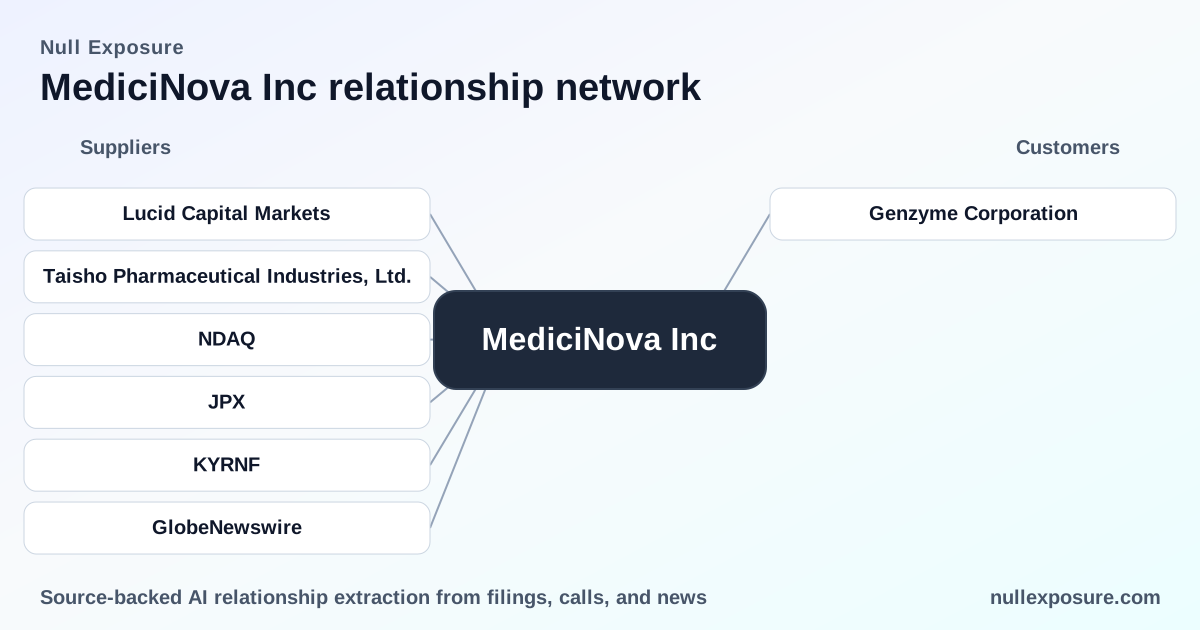
MediciNova (MNOV): Customer relationships that shape near-term revenue and capital dynamics
MediciNova is a small-cap biopharmaceutical developer that monetizes primarily through research collaborations, licensing milestones and episodic service revenue rather than product sales; investor returns will be driven by progress on clinical programs, partner payments and ongoing access to financing. Revenue is currently nominal and concentrated in early-stage collaboration and service fees, while capital facilities underpin operating runway. For a concise hub of intelligence on counterparties and commercial exposures, visit https://nullexposure.com/.
Why customers matter for a development-stage biotech
MediciNova runs a classic development-stage operating model: low recurring revenue, reliance on partners for development effort and milestone payments, and continual capital needs to fund trials. The practical implications for investors are straightforward — commercial traction is currently limited and every partnership or service agreement can move GAAP revenue and the company's cash runway materially.
All reported customer relationships, with what they mean for investors
Genzyme Corporation — development partnership language in the 2024 10‑K
MediciNova states in its FY2024 10‑K that the development milestones in the Genzyme agreement did not qualify as substantive revenue-recognizable milestones because Genzyme bore responsibility for development and no additional service effort from MediciNova was required. This indicates the Genzyme relationship is structured as a partner-led development effort where MediciNova’s future cash receipts depend on contract terms rather than ongoing services. According to MediciNova’s 2024 Form 10‑K (FY2024), the milestone language failed the authoritative milestone revenue criteria.
RenRe / RenaissanceRe (RNR) — third‑party capital raised that included Medici-related funds (Q1 2026)
A Reinsurance News report covering Q1 2026 notes that RenaissanceRe raised $61.4 million in third-party capital, including $46 million described as “in Medici” and $15.4 million in “Medici UCITS.” This reporting signals that institutional capital flows into vehicles connected to MediciNova increased in early 2026, which has implications for potential capital partnerships or investor appetite tied to the company or associated funds. Reinsurance News, Q1 2026 coverage of RenaissanceRe’s quarterly activity (May 2026).
Mayo Clinic — new clinical services agreement recognized as revenue in 2025
TradingView’s summary of MediciNova filings reports that the company recognized $0.4 million in 2025 from a new Mayo clinical services agreement, marking a first move into service revenue. This shows MediciNova is beginning to capture modest service income from established clinical organizations, which while small, demonstrates a pathway to diversify revenue beyond licensing and milestone streams. TradingView news summary, May 2026 (reporting on the company’s 2025 results).
(For further context on counterparties and contract language, explore the comprehensive customer intelligence at https://nullexposure.com/.)
How constraints shape the operating and commercial profile
The company-level signals extracted from available filings and disclosures give a clear sketch of MediciNova’s operating posture:
- Contracting posture — framework financing in place. The company disclosed an amended at‑the‑market (ATM) equity sales agreement originally executed in 2019 and amended in 2022 that permits sales of common stock up to $75.0 million, indicating a standing equity financing mechanism to address cash needs rather than one-off dilution events.
- Geographic concentration — U.S. commercial focus. MediciNova explicitly states a commercial focus on the United States, which concentrates regulatory, clinical and market risk within a single major jurisdiction.
- Revenue criticality — partnerships and service agreements carry outsized impact. Given minimal recurring sales, each collaboration, milestone or service contract materially affects reported revenue and investor perception of progress.
- Maturity and predictability — development-stage with episodic cash inflows. The company’s business remains development-heavy and capital-dependent; revenue recognition rules and partner-led programs reduce predictability of receipts.
Those constraints are company-level signals about how the business is run and financed; they are not assigned to any single counterparty unless the contract text explicitly names that party.
Investor implications: runway, dilution risk and revenue signals
MediciNova’s financials show negative EBITDA, limited revenue (Revenue TTM ≈ $0.41M) and small institutional ownership — a profile typical of a clinical-stage biotech that balances scientific progress with continuous capital needs. Key takeaways:
- Financing is a structural levers: The ATM framework provides a ready channel to raise equity, which reduces existential liquidity risk but increases dilution risk for existing shareholders when used.
- Partnerships substitute for scale revenue: Agreements like the Genzyme collaboration and the Mayo services contract are mechanisms to validate assets and to generate non‑product revenue; each contract’s design determines the timing and size of cash inflows.
- Third‑party capital activity is relevant: External capital movements tied to “Medici” vehicles reported in Q1 2026 suggest investor interest that can translate into either direct funding or secondary market support for equity transactions.
- Concentration adds policy and execution risk: The U.S. commercial focus concentrates regulatory timelines and market access variables; successful trial outcomes or approvals drive value, while setbacks have amplified consequences.
Bottom line and suggested investor actions
MediciNova is a small, development-stage biotech with modest current revenue but clear pathways to episodic receipts through partnerships and service work. Investors should track: (1) the timing and structure of partner payments (milestones vs. services), (2) use and pacing of the ATM facility for capital raises, and (3) further third‑party capital arrangements or fund-level investments that reference “Medici.” Monitor contractual language in new agreements for revenue-recognition triggers and responsibility for development effort, as these determine whether future milestones are recognized as revenue or are contingent partner obligations.
If you need continuous intelligence on counterparties, contractual profiles and how they affect MediciNova’s financial runway, visit https://nullexposure.com/ for deeper customer‑relationship reporting and stress-testing tools.
Key risks are capital dilution from equity raises, concentrated U.S. exposure, and revenue volatility tied to partner-driven milestones. For investors focused on binary clinical outcomes, these dynamics are familiar; for those prioritizing steady cash flow, the profile requires careful position sizing and monitoring of financing events.