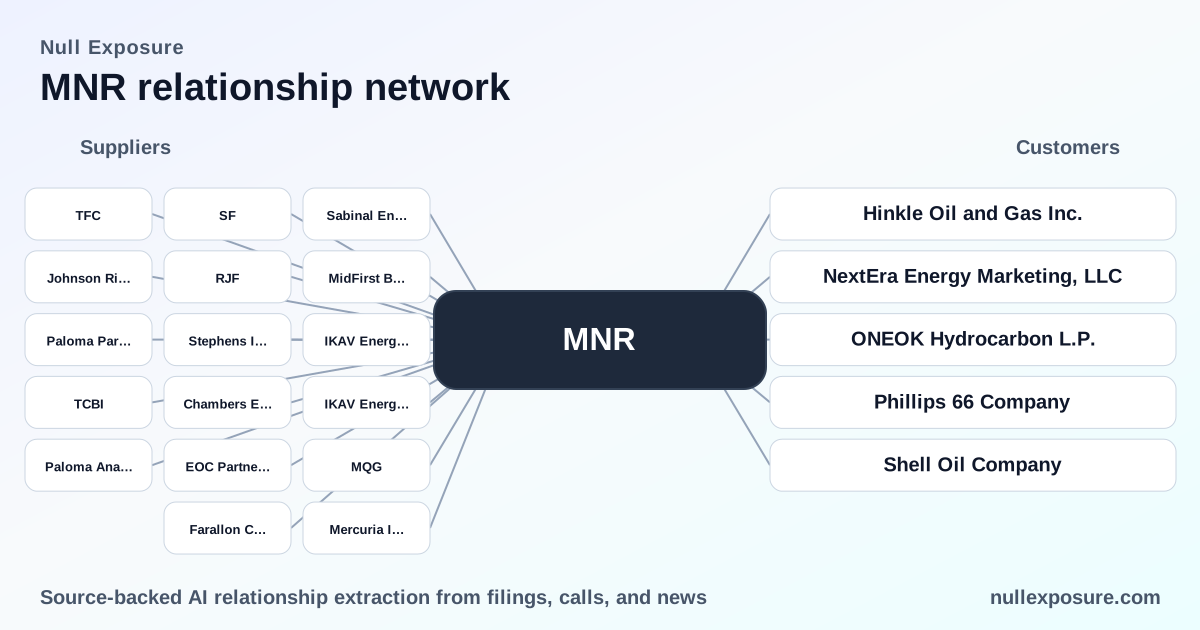
Mach Natural Resources (MNR): Customer Concentration Shapes Cash Flow and Risk
Mach Natural Resources operates and monetizes as a traditional upstream energy producer: it explores and produces oil, natural gas and NGLs and sells production at the wellhead to a small group of purchasers. Revenue is realized through commodity sales, largely under short‑term contracts, and several large purchasers drive a disproportionate share of cash receipts. For a deeper look at counterparty exposure and how it informs commercial leverage, see https://nullexposure.com/.
Investment thesis in one paragraph
Mach is an asset‑level E&P business that converts production into cash by selling hydrocarbons at the wellhead to a concentrated set of commercial buyers. High operating margins and positive EBITDA reflect effective field-level economics, but the company’s monetization is tightly dependent on a handful of counterparties and short-term commercial arrangements, which creates both liquidity simplicity and counterparty concentration risk.
How the business actually sells its production
Mach reports a single operating segment—exploration and production—and sells the overwhelming majority of production under contracts with original durations of 12 months or less, including month-to-month arrangements. According to the company’s 2024 Form 10‑K, the company uses the practical expedient for short‑duration contracts and explicitly states it does not maintain long-term sales agreements with buyers. This contracting posture delivers pricing flexibility but reduces long-term revenue visibility.
What concentration means for cash and negotiation
A small number of purchasers account for material shares of receipts. Phillips 66 and Shell stand out as material customers in 2024, together representing the single largest immediate demand sources at the wellhead. That concentration translates into predictable near-term cash collection when volumes are stable, but also concentrates counterparty credit and market access risk into a few commercial relationships. Mach’s consolidated metrics—roughly $1.05 billion revenue TTM and a 30.6% operating margin—underscore that commodity realization, not scale, drives profitability; but those realizations flow through only if large purchasers continue to take production on short notice.
Operational constraints and what they imply for an investor
- Contracting posture: short-term and transactional. Management discloses that most contracts have original durations of one year or less and the company relies on the practical expedient for such contracts (10‑K disclosure). This means revenue is responsive to market price moves but not protected by long-term offtake commitments.
- Geography: United States only. All operations and revenues are generated in the U.S., concentrating regulatory, logistics and market exposure domestically.
- Concentration: material dependence on a few purchasers. The company discloses multiple purchasers that exceeded 10% of receipts in recent years; that concentration is a company‑level signal of customer risk.
- Relationship role: seller to major buyers. Mach delivers oil at the wellhead and purchasers take custody, title and risk of loss—Mach’s primary market role is upstream seller rather than midstream owner.
- Relationship maturity: active, short-term engagements. The counterparty list covers recent fiscal years, indicating ongoing commercial activity rather than historical one-off transactions.
- Segment focus: single reportable E&P segment. Mach’s economics and customer exposure are concentrated in upstream hydrocarbons rather than diversified energy services.
These constraints collectively indicate high revenue cyclicality tied to commodity markets and concentrated counterparty credit risk, while simplifying operational execution through short transactional sales.
If you want a concise counterparty map and contract posture distilled for portfolio risk work, visit https://nullexposure.com/ for the full visualization and sourcing.
Counterparty roll call (what the 10‑K and market notices disclose)
Below are the relationships the company discloses or that appear in market reports, each with a succinct plain‑English summary and a primary source reference.
Hinkle Oil and Gas Inc.
Hinkle accounted for 31.5% of Mach’s receipts in 2022, but did not exceed the 10% threshold in Mach’s 2023 and 2024 customer concentration table. According to Mach’s 2024 Form 10‑K, Hinkle was a material purchaser in 2022 though not listed above the 10% cutoff for the most recent year. (Source: Mach Natural Resources 2024 Form 10‑K)
NextEra Energy Marketing, LLC
NextEra represented 17.0% of receipts in 2022 and 12.9% in 2023, falling below the 10% disclosure threshold for 2024. The company’s 2024 10‑K lists NextEra’s multi‑year presence in its purchaser schedule. (Source: Mach Natural Resources 2024 Form 10‑K)
ONEOK Hydrocarbon L.P.
ONEOK appears as a purchaser that exceeded 10% of receipts in 2023 (10.4%), but is not shown above the threshold in the 2024 disclosure. This is recorded in the purchaser table of the 2024 Form 10‑K. (Source: Mach Natural Resources 2024 Form 10‑K)
Phillips 66 Company
Phillips 66 was the largest purchaser in 2024, accounting for 32.2% of receipts, and was an even larger counterparty in 2023 (52.6%); it also represented 16.9% in 2022. Mach’s 2024 Form 10‑K identifies Phillips 66 as a principal purchaser and one of two entities that individually represented more than 10% of revenue for 2024. (Source: Mach Natural Resources 2024 Form 10‑K)
Shell Oil Company
Shell purchased 12.7% of receipts in 2024 and is explicitly called out in the 10‑K as one of the two purchasers exceeding 10% of revenue in 2024 alongside Phillips 66. That status makes Shell a material counterparty for the year. (Source: Mach Natural Resources 2024 Form 10‑K)
Morgan Stanley & Co. LLC
In a separate capital markets action, selling unitholders sold 9,000,000 common units to Morgan Stanley & Co. LLC in an underwritten offering that closed April 8, 2026, reflecting Morgan Stanley’s role as an equity purchaser/underwriter in a FY2026 transaction. This relationship is disclosed in market reports. (Source: TradingView news report on the April 2026 offering)
Key takeaways for investors and operators
- Concentration is real and persistent: a small number of purchasers drive a meaningful share of revenue, with Phillips 66 and Shell formally exceeding the 10% threshold in 2024.
- Short-term contracts reduce lock-in and increase price sensitivity: liquidity from sales is direct, but revenue visibility beyond 12 months is limited by the company’s contracting posture.
- Domestic, single-segment exposure focuses execution risk: all operations and revenues are U.S.-based and tied to Mach’s upstream asset base.
For analysts underwriting credit or equity exposure, model scenarios that stress the top purchasers and assume market‑level price moves, because recovery of cash depends on both volume and the continued willingness of these large buyers to take wellhead production. For a structured view of counterparties and contract posture, visit https://nullexposure.com/ to download the sourced breakdown.