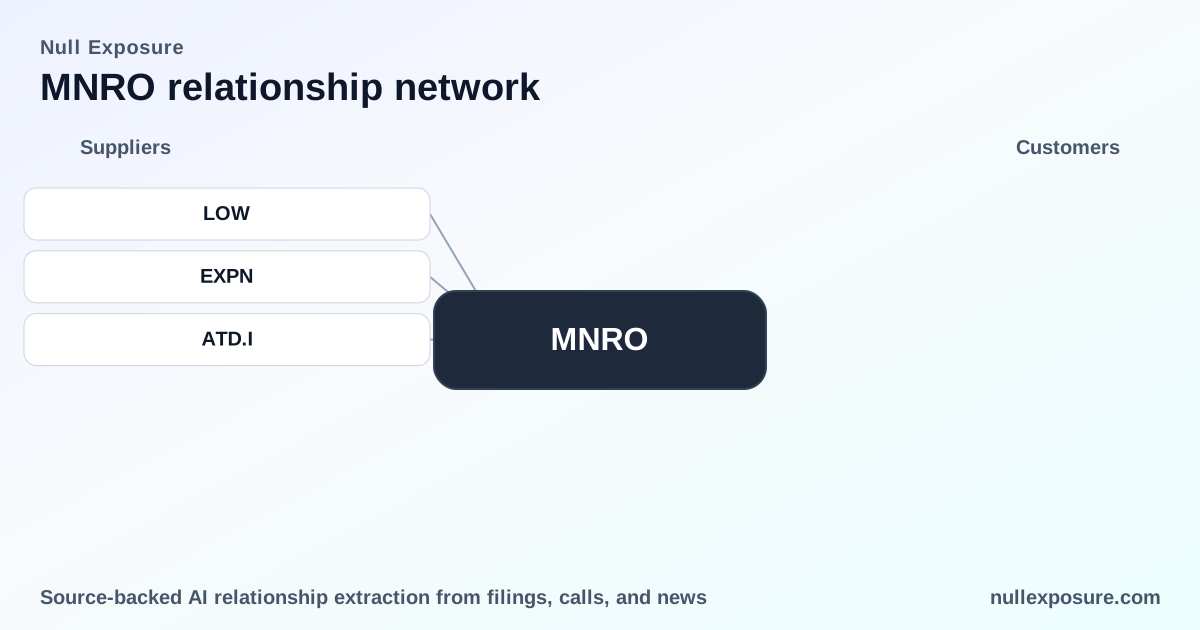
Monro (MNRO): Retail-service operator with embedded commerce partnerships driving volume and aftermarket revenue
Monro monetizes through retail automotive services and tire sales across a national footprint of service locations, collecting recurring revenues from services, parts and multi-year tire warranty agreements while leveraging partnerships to extend on-line product flows into its service network. With a market cap near $490 million and roughly $1.18 billion in trailing revenue, Monro’s earnings profile is driven by store throughput, aftermarket warranty deferrals and distribution partnerships that feed installation demand into its repair bays. For investors evaluating customer relationships, the practical takeaway is straightforward: Monro is a service operator whose value accrues from physical locations and customer convenience, and strategic partners that route unit volume into those locations are commercially significant even when no single external customer is material to consolidated revenue. Learn more about the coverage and signals at https://nullexposure.com/.
Executive summary: what the relationships prize
- Monro operates 1,260 U.S. retail tire and automotive repair stores, servicing millions of vehicles annually and collecting both one‑time and deferred warranty revenue streams.
- Partnerships that channel online tire purchases into Monro stores increase installation throughput and ancillary service upsell, improving per-visit revenue and utilization of shop capacity.
- Revenue concentration is low: the company states no single customer accounts for 10% or more of consolidated revenue, so partner relationships are complementary volume drivers rather than singular revenue anchors.
How Monro makes money and how partnerships fit the model
Monro’s core monetization rests on in-person service economics: tire sales, installation labor, undercar repairs and routine maintenance generate immediate revenues and profit; tire-related warranty agreements are deferred and recognized over 21–36 months, smoothing revenue recognition and tying future service obligations to current sales. The operating model is inherently physical and consumer-facing: counterparties are individual retail customers, and the company’s scale and location density are the primary sources of competitive advantage.
From a contracting posture perspective, Monro shows characteristics of a mature retail service operator: long-term customer commitments exist (warranty contracts) but overall counterparty concentration is low, and partner arrangements (e.g., online sellers routing customers) act as volume multipliers rather than contractual anchors that bear single‑counterparty risk.
Customer relationship coverage (complete)
Amazon.com, Inc. — expanded tire installation program channels e-commerce into Monro stores
Monro and Amazon expanded a program that allows Amazon customers who buy tires online to ship them to Monro locations for on‑vehicle installation; the program grew from 400 stores at launch to more than 800 locations, representing nearly two‑thirds of Monro’s store base and materially increasing installation touchpoints. According to a StockInvestor article reporting in May 2026, this partnership directs online tire purchases into Monro’s retail footprint and strengthens installation volume at many stores (https://www.stockinvestor.com/monro-inc-continues-steady-asset-appreciation-supported-by-rising-dividends-nasdaqmnro/amp/).
Operational constraints and company-level signals
Treat these as company-level operating characteristics rather than tied to any single partner unless explicitly stated:
- Long-term contract posture: Monro recognizes revenue from tire road hazard warranties over 21–36 months, indicating a recurring-service obligation embedded in unit sales and a deferred revenue liability profile.
- Individual retail counterparties: The business sells directly to consumers ("guests") for tires, repairs and routine maintenance, so cash flows are driven by foot traffic and appointment conversions.
- Geographic concentration in North America: Monro is a nationwide U.S. operator; its economics and risk exposure are tied to U.S. vehicle miles traveled, consumer maintenance spending and regional retail competition.
- Low customer concentration: No single external customer contributes 10% or more of consolidated net revenues, which positions Monro’s counterparty risk profile as diversified across many retail transactions.
- Service-provider role and active scale: With the company operating more than 1,200 stores and servicing approximately 4.2 million vehicles in fiscal 2025, Monro is a large, active service platform where throughput and utilization are critical operational levers.
- Segment orientation to services: The business is primarily services-driven, meaning margin and cash generation depend on labor productivity, parts margins and ancillary sales rather than standalone product distribution.
Investment implications: what matters for investors and operators
- Volume and utilization drive valuation. Partnerships that route tires to Monro stores increase installation throughput and create opportunities for service upsell—direct levers on same-store revenue growth. The Amazon program exemplifies a scalable channel that increases per-visit ARPU (average revenue per unit).
- Deferred warranty revenue smooths near-term earnings but creates future service obligations. Investors must monitor warranty reserve trends and vehicle servicing patterns to assess the real economics of tire sales.
- Low counterparty concentration reduces single‑partner dependency, but operational risk is concentrated in store execution, site economics and labor availability. Store-level underperformance is the main earnings risk, not the loss of any one external e-commerce partner.
- Margins are services-driven and sensitive to wage and parts-cost inflation; the most effective operational improvements come from service productivity and parts procurement.
Risks and opportunities framed for decision-makers
- Risk — dependence on physical throughput: While online partnerships feed volume, Monro’s profitability requires conversion of that footfall into higher-margin services, not just commodity installation. Operators should track conversion rates from partnered installations to ancillary work.
- Opportunity — scalable channel partnerships: Expanding relationships with large e-commerce platforms or OEM parts sellers is a direct, low-capex route to grow store throughput. The Amazon expansion is proof of concept for this approach.
- Risk — warranty liabilities: The deferred recognition window (21–36 months) creates a multi‑year liability profile; adverse claims trends would pressure margins and cashflow timing.
- Opportunity — distribution and procurement scale: Continued store consolidation and centralized parts purchasing can improve gross margins and service economics over time.
Bottom line and next steps
Monro is a physically anchored, services-led operator where strategic partnerships—like the Amazon tire program—act as volume accelerants that can materially improve shop utilization and aftermarket upsell. The company’s low customer concentration reduces counterparty risk, while warranty deferrals and store execution remain the primary drivers of earnings sustainability. For investors and operators evaluating MNRO, focus analysis on store-level conversion metrics, warranty claim trends and the scalability of e-commerce to in-store conversion.
If you want a concise map of Monro’s partner-driven exposure and company operating signals, review our coverage hub at https://nullexposure.com/. For bespoke customer-relationship diligence and monitoring on individual tickers, visit https://nullexposure.com/ for service details and example use cases.