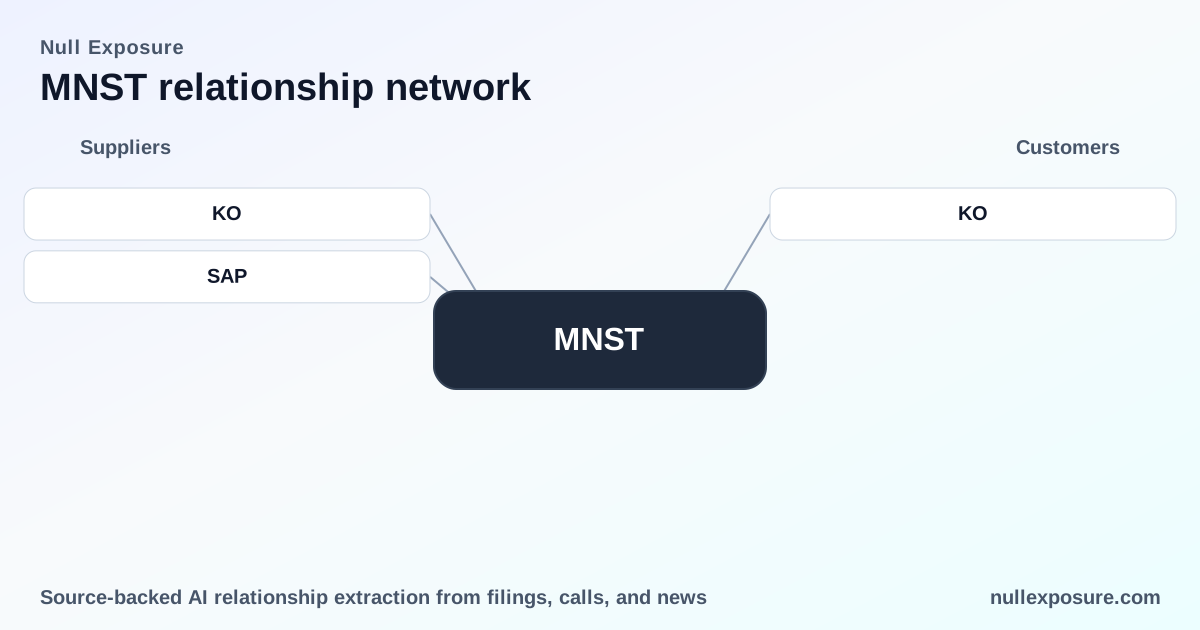
How Monster Beverage Monetizes Global Distribution and Why Coca‑Cola Relationships Matter
Monster Beverage builds value by developing and marketing energy drink brands and monetizing those brands through two principal streams: ready‑to‑drink packaged sales sold to bottlers and distributors, and sales of concentrates/beverage bases to authorized bottlers that produce finished product. The company leverages an extensive global network—products sold in roughly 159 countries and international sales running about 40% of total net sales—while depending materially on full‑service bottlers and large retail customers for distribution and scale. For deeper customer‑relationship signals and commercial risk profiling, see NullExposure for structured coverage: https://nullexposure.com/.
Executive thesis: scale through brand, distribution through partners
Monster is a brand‑led beverage manufacturer that outsources a majority of finished‑goods distribution to large bottlers and retail partners. Revenue is driven by branded product sales (ready‑to‑drink) and concentrate sales to bottlers, creating a capital‑light manufacturing footprint and a partner‑centric go‑to‑market model. This structure produces strong margins—Monster’s operating margin sits above 31%—but also concentrates operational and go‑to‑market risk in a small number of powerful distribution partners and retail customers.
Big picture operating characteristics investors should book into models
- Contracting posture: Monster maintains a mix of long‑term distribution agreements (contracts up to 20 years with renewals) alongside short‑term arrangements (ranging from one week to one year) for certain channels, producing a hybrid exposure where strategic bottlers are deeply embedded while tactical retail programs remain flexible.
- Concentration and criticality: U.S. full‑service bottlers account for ~46% and international full‑service bottlers ~41% of distribution activity, indicating high counterparty concentration and material potential impact from a major partner decision.
- Global reach and revenue mix: Products reach roughly 159 countries, with non‑U.S. net sales near 40% of total, underlining international growth leverage but also execution dependency on global bottling networks.
- Roles and maturity: Monster functions as manufacturer (concentrates) and seller (ready‑to‑drink) while also acting as a buyer across certain supply lines; relationships with bottlers show high maturity and structural integration into Monster’s route‑to‑market.
These company‑level signals should be read as fundamental constraints on operational resilience and upside: long contractual commitments lock distribution patterns for years, while short tactical arrangements preserve merchandising flexibility.
Customer relationships: the partners named in coverage
Below I cover every customer relationship observed in the recent monitoring set and summarize what each relationship means for Monster’s go‑to‑market.
Coca‑Cola Company (KO) — a global strategic partner and distribution backbone
Monster describes a strong global partnership with The Coca‑Cola Company and its global bottling partners, which underpins marketing, retail engagement and international distribution of Monster brands; this is the central strategic relationship for scaling outside Monster’s direct bottling footprint. Source: Monster’s FY2026 earnings call transcript published on InsiderMonkey (March 2026).
Coca‑Cola Consolidated, Inc. (COKE) — regional bottler and distributor carrying Monster products
Coca‑Cola Consolidated lists Monster among the third‑party brands it distributes, and its public results report volume growth in Monster within its still/energy category, confirming that regional bottlers deliver measurable velocity for Monster’s packaged products. Source: Coca‑Cola Consolidated press releases and earnings reports (GlobeNewswire, July 2025; GlobeNewswire, Feb 2026) and a market report noting distribution (MarketScreener, May 2026).
What those relationships mean for investors
- Distribution leverage through Coca‑Cola’s global system is Monster’s primary scalability engine. The Coca‑Cola Company does not just ship product—its bottling network provides Monster with retail shelf access, promotional muscle, and logistics scale that are difficult to replicate. This increases revenue upside but concentrates execution risk if the partnership terms or priority within bottler assortments shift.
- Regional bottlers like Coca‑Cola Consolidated are tangible demand points. Public reporting from consolidated bottlers that Monster achieved volume growth translates directly into sell‑through confirmation and supports Monster’s revenue trajectory in those territories.
- Contract structure blends durability and flexibility. The coexistence of up‑to‑20‑year distribution agreements and short‑term retail arrangements creates a stable backbone with room for tactical promotional programs; investors should prize predictable revenue from long contract tails while modeling episodic promotional variability.
Risk factors and watchlist for customer dynamics
- Counterparty concentration: With roughly 46% of distribution driven by U.S. full‑service bottlers and 41% by international counterparts, a decision by a major bottler or a change in Coca‑Cola’s prioritization could have a material impact on Monster’s results.
- Contractual lock‑in vs. agility: Long‑term contracts provide revenue visibility but limit Monster’s ability to pivot quickly in territories where consumer trends shift; short‑term arrangements help in retail activation but do not substitute for national distribution coverage.
- Channel complexity: Monster sells directly to a wide range of counterparties—including grocery chains, club stores, convenience channels and even the military—introducing a multi‑channel credit and execution profile that requires active account management and careful working capital oversight.
Investment implications and next steps for due diligence
- Model the Coca‑Cola partnership as a core driver of international and U.S. distribution growth; assume continued marketing alignment and joint retail programs given Monster’s public characterization of the relationship.
- Stress test scenarios where bottler prioritization shifts or promotional intensity increases cost of goods sold and marketing spend.
- Monitor regional bottler earnings (e.g., Coca‑Cola Consolidated) for sell‑through signals and promotional cadence; these reports function as high‑frequency checks on Monster’s channel health.
For a structured view of all customer relationships and contract signals, NullExposure maintains a consolidated feed with the underlying public citations and temporal tracking — see https://nullexposure.com/ for access and subscription details.
Bottom line: brand strength backed by partner scale — with concentrated counterparty risk
Monster’s business model combines brand power, a capital‑light production approach, and dependency on a few major bottling partners to achieve high margins and international expansion. The Coca‑Cola partnership and regional bottlers like Coca‑Cola Consolidated are core to that model—they deliver distribution scale and measurable volume gains but also concentrate commercial risk. Investors should reward Monster’s margin profile and global footprint while explicitly stress‑testing counterparty concentration and contract dynamics in valuation scenarios.