Montauk Renewables (MNTK): Customer Relationships Drive Revenue, but Concentration and Off-take Friction Raise Risk
Montauk Renewables operates and monetizes landfill- and farm-sourced biogas by converting it to renewable natural gas (RNG), electricity and environmental attributes (RINs, RECs) and selling those outputs under a mix of short-, medium- and long-term contracts to utilities, large owner-operators and refiners. The company's cash flow profile is driven by contracted off-take for energy and environmental attributes, while credit quality and contract tenor determine revenue visibility and valuation multiples. For a quick corporate snapshot: Montauk reports roughly $176m revenue TTM and a ~$196m market capitalization as of the latest quarter (2025-12-31). For an investor-ready deep dive on customer exposure and implications, read on or visit the company overview at https://nullexposure.com/.
How Montauk gets paid: contracts, volumes and attribute sales
Montauk’s operating model is straightforward: capture methane at biogas sites, upgrade or combust it, then sell physical fuel or electricity plus associated environmental attributes. Revenue is a hybrid of recurring contracted cash flows and short-term attribute sales—a structure that blends stable, long-tenor off-takes with transactional exposure to RINs/RECs markets.
Key monetization mechanics:
- Electricity sales are generally sold under long-term, fixed-price contracts with escalators, providing a durable revenue base with predictable cash flow profiles. Montauk disclosed contract terms up to 19 years with a weighted average remaining tenure of 17 years (based on 2024 electricity production), which underwrites long-dated cashflow visibility.
- RNG and environmental attributes are sold through short- to medium-term agreements (typically 3–5 years) and through near-term RINs/attribute sales that reflect commodity-like price volatility.
- Revenue recognition for electricity typically follows an output-based model (volume delivered), while attributes and RINs are treated under invoicing practical expedients for shorter tenors.
What this means for investors: long-term electricity off-takes anchor valuation multiple stability; short-term RNG/attribute sales introduce earnings volatility and sensitivity to regulatory and commodity cycles.
Customer exposure map: who Montauk sells to, and why it matters
Montauk’s counterparties cluster in a narrow set of credit-rich and operationally critical buyer groups. Company disclosures and filing excerpts identify the following counterparty categories: investor-owned and municipal utilities, large landfill and livestock owner-operators, and refiners and large energy companies that buy RNG and RINs. Those buyers are both large enterprise counterparties and government-related utilities, concentrating credit exposure but also offering high credit quality when contracts are in place.
Notable implications:
- Customer concentration is material—a limited number of counterparties account for a substantial portion of revenues, so counterparty disputes or unexpected off-take terminations can produce outsized earnings impacts.
- Geographic reach is North America-focused, with RNG traded on interstate pipelines, creating a unified market but exposing Montauk to regional pipeline and offtake dynamics.
The Blue Granite dispute — a client relationship you must know
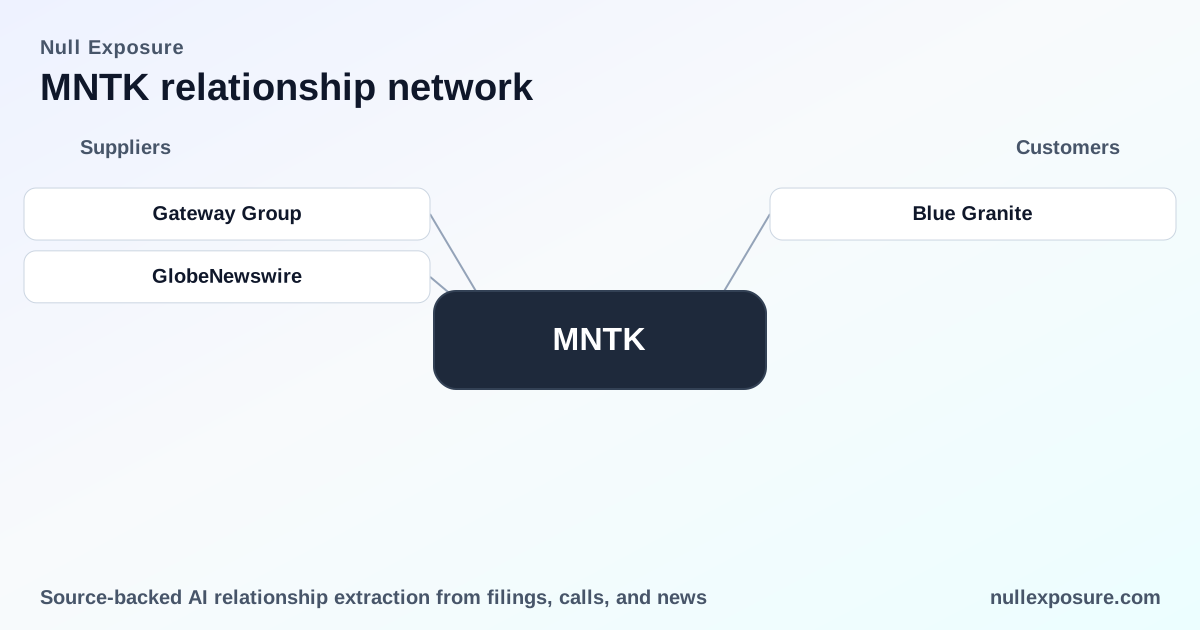
Montauk disclosed an off-take dispute with Blue Granite relating to an RNG facility that stopped accepting RNG, prompting Montauk to record an asset impairment tied to that facility. The dispute underscores execution and counterparty delivery risk when a buyer withdraws acceptance of product. According to Financial Mail/BusinessDay coverage of Montauk’s FY2025 results, the Blue Granite RNG facility’s notice that it would no longer accept RNG caused Montauk to take an impairment charge (Financial Mail, May 29, 2025: https://www.financialmail.businessday.co.za/fm/investors-monthly/2025-05-29-montauks-wild-ride-as-renewables-face-trump-pressure/).
Why this relationship matters: Blue Granite exemplifies how a single counterparty action can translate into asset-level write-offs given Montauk’s concentrated revenue base and facility-specific reliance on off-take acceptance.
Contracting posture and commercial constraints that shape the business
Montauk’s customer and contract profile sets the operating constraints investors must price into forecasts. These are company-level signals drawn from Montauk’s disclosures:
- Mixed contract tenors: the company sells electricity under long-term contracts (up to 19 years; weighted average remaining tenure ~17 years for electricity production), while RNG and environmental attributes are sold under short- and medium-term contracts (generally 3–5 years). This hybrid tenor structure creates a dual revenue character: stable base cash flows from electricity plus cyclical earnings from attributes.
- Usage-based recognition for electricity: revenue for electricity is generally recognized over time based on product quantity delivered, tying revenue to actual plant output and operational uptime.
- Counterparty profile skews large and creditworthy: customers include investment-grade utilities and large enterprise landfill owners, refiners and local utilities, which reduces counterparty credit risk where contracts exist but concentrates exposure.
- North America as the primary geography: RNG is marketed into the North American pipeline system, so regulatory and pipeline dynamics in the U.S. and Canada directly affect market access and pricing.
- Material customer concentration: the company discloses a significant concentration of revenues among a limited number of customers, creating idiosyncratic risk if key counterparties reduce volumes or terminate arrangements.
- Active role as both seller and buyer in certain flows: Montauk is primarily a seller of RNG, electricity and attributes but documents operational relationships with landfill and farm owner-operators as counterparties for fuel sourcing and RIN obligations.
- Relationship maturity is uneven: while electricity contracts show very long effective maturity, attribute sales and certain RNG agreements have shorter tenors, producing near-term renewal risk.
Collectively, these constraints deliver a company that is structurally de-risked at the plant-revenue level through long electricity offtakes, yet exposed to commodity and counterparty concentration risk through its RNG and attribute sales.
Investment implications: valuation, volatility and monitoring priorities
Investors should price Montauk’s stock as a hybrid of infrastructure-like stability and commodity-like volatility. Key investment takeaways:
- Valuation sensitivity to attribute prices and counterparty actions: a firm long-term electricity book supports a baseline valuation, but earnings and free cash flow can swing with RIN/REC pricing and discrete events like the Blue Granite dispute.
- Concentration risk is a source of operational leverage: asset impairments or off-take terminations from a small number of counterparties will disproportionately affect reported earnings and book value.
- Credit quality of counterparties matters more than volume profile: where off-takes are with investment-grade utilities, cash flow predictability improves materially; where short-tenor RNG contracts dominate, earnings volatility increases.
- Monitoring cadence: investors should track contract renewals, RIN/REC spot prices, pipeline access developments in North America, and any news of counterparties refusing acceptance or disputing contractual obligations.
Practical due diligence checklist for researchers
When evaluating Montauk customer risk, prioritize the following:
- Review contract schedules and remaining tenors for electricity off-takes versus RNG agreements.
- Quantify revenue share attributable to the top 5 counterparties to assess concentration.
- Monitor commodity/attribute markets and regulatory signals for RINs/RECs.
- Watch legal and news signals for disputes akin to the Blue Granite event.
For more structured coverage and relationship-level intelligence, consult the company overview and relationship tracking at https://nullexposure.com/.
Bottom line
Montauk Renewables combines long-duration electricity off-takes with short-to-medium tenure RNG/attribute sales; this structure produces stable base cash flows but concentrated counterparty and attribute-price risks. The Blue Granite dispute is a concrete example of how off-take friction translates into asset impairment and earnings volatility, reinforcing the need for active monitoring of counterparties, contract tenor rollovers and attribute markets before taking a position.