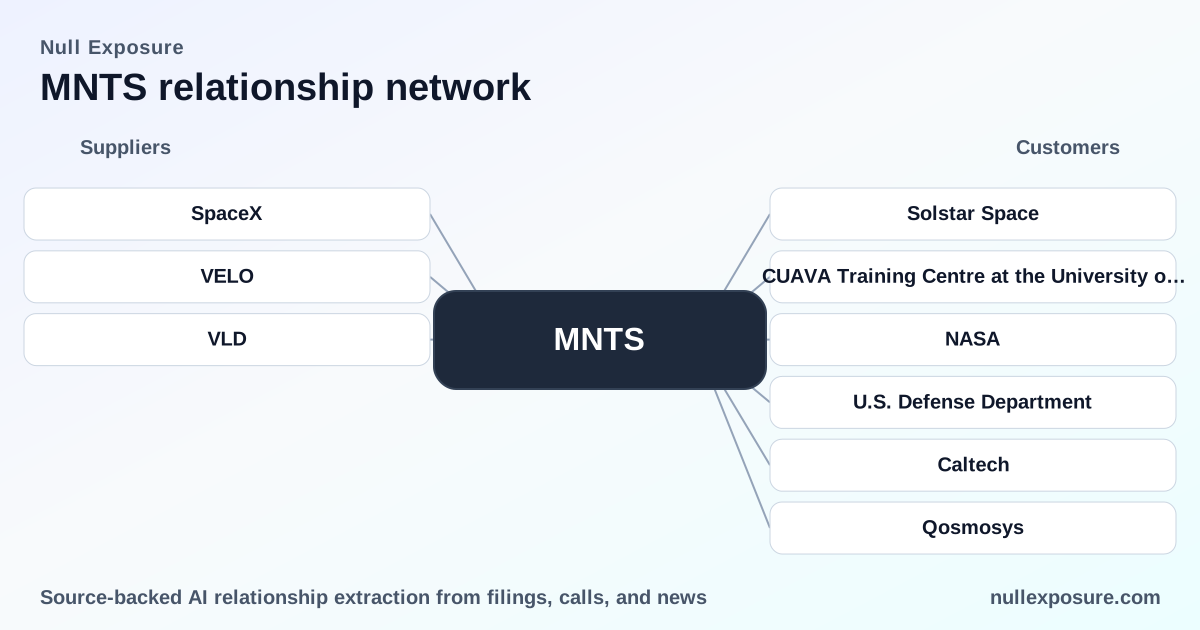
Momentus (MNTS) customer map: commercial payloads, government programs, and where revenue will flow next
Momentus operates and monetizes by selling short-term transport, payload hosting and in‑orbit services around its Vigoride orbital transfer vehicle while also acting as a satellite bus manufacturer for commercial and government customers. The company generates revenue from mission contracts, hosted‑payload fees, and engineering/vehicle sales, with a customer mix that includes both civil and defense agencies and international academic and commercial payload owners. For active diligence or partnership sourcing, see more at https://nullexposure.com/.
What the customer roster tells an investor about Momentus’ business model
Momentus’ customer relationships reveal a dual-mode operating model: a services‑led revenue engine (last‑mile delivery, hosted payloads, in‑orbit demonstrations) combined with a nascent manufacturing/prime contractor posture for satellite buses. That mix creates lumpy, milestone‑driven revenue, dependency on launch cadence and third‑party launch providers, and a steady pipeline of government awards that de‑risk backlog compared with pure-play small‑sat launchers.
Key company-level signals drawn from disclosures and the relationship list below:
- Contracting posture: short-term, transactional mission contracts for transport and hosted payloads, which implies revenue is tied to defined flight manifests and deposit schedules rather than long annuity streams.
- Counterparty mix includes government clients (NASA, DoD agencies), signaling higher contract credibility but also elevated compliance and program‑management demands.
- Global reach with a U.S. operational base — Momentus aggregates international payloads but holds long‑lived assets domestically, giving it export/control considerations alongside market reach.
- Company plays both manufacturer and service‑provider roles, increasing addressable market but requiring diversified engineering and production capabilities.
- Active contract stage and customer deposits indicate commercial traction and forward bookings, but revenue recognition will remain manifest/timing sensitive.
For partnership or licensing inquiries visit https://nullexposure.com/ for introductions.
Relationship-by-relationship review — what each customer means for revenue and risk
Solstar Space
Momentus signed a three‑year reciprocal services agreement worth up to $15 million, positioning Solstar as a commercial customer for in‑orbit services and hosted payload options; this is a near‑term revenue pipeline item tied to specific mission windows. According to MarketScreener (reported March 10, 2026) and corroborated by Investing.com (May 3, 2026), the agreement frames multi‑year service collaboration and potential mission flow.
NASA (civil programs)
Momentus is contracted to deliver NASA CubeSats and support civil missions, leveraging Vigoride as a transport/hosting platform for NASA payloads—an endorsement that supports credibility for future civil awards. Press reporting in May 2026 referenced Momentus’ role delivering a NASA CubeSat and broader civil engagements (Investing.com, May 2026).
CUAVA Training Centre at the University of Sydney
Momentus executed a contract to deploy the CUAVA‑2 cubesat to LEO, demonstrating academic and research market penetration and international payload hosting capabilities. SATNEWS covered the CUAVA‑2 deployment contract (reported December 2022), showing early commercial academic business.
U.S. Defense Department (broad)
Company statements emphasize Wardrobe‑level engagements with U.S. defense customers as part of Momentus’ strategic positioning to support military and civil government missions, increasing program stability and higher contractual margins associated with defense work. A Momentus corporate announcement (Spaceref, referenced March 2026) highlighted defense customer focus as a strategic priority.
Defense Advanced Research Projects Agency (DARPA)
Momentus is executing Phase 3 on a DARPA contract for an on‑orbit demonstration of large‑scale structure assembly, which places the company in advanced R&D demonstrations that validate vehicle utility beyond simple delivery missions. StockTwits reporting in May 2026 noted the Phase 3 DARPA engagement and on‑orbit demonstration objectives.
Juno Propulsion
Momentus will host and operate Juno Propulsion’s RDRE thruster test on Vigoride, providing a flight test environment for propulsion innovators and illustrating Momentus’ role as an in‑orbit testbed operator. Coverage in May 2026 called out this collaboration as part of on‑orbit thruster testing (StockTwits, May 2026).
NASA Armstrong Flight Research Center
A $2.5 million contract from NASA Armstrong was awarded to Momentus to demonstrate a Rotating Detonation Rocket Engine (RDRE) in orbit, directly funding technical demonstrations and supporting technology validation revenue. StockTwits and related May 2026 reporting named the Armstrong award and contract size.
DPhi Space
Momentus partnered with DPhi Space to launch the Clustergate‑2 payload on Vigoride 7, bringing dynamic computing and payload‑hosting revenue into early 2026 manifests and strengthening the company’s value proposition for edge computing in orbit. Investing.com (May 2026) documented the Clustergate‑2 launch partnership.
Qosmosys
Momentus’ Vigoride mission included a priority to host Qosmosys’ Zeus‑1 payload, signaling commercial payload hosting relationships for entrepreneurial satellite companies and contributing to manifest revenue. SATNEWS (December 2022) described Qosmosys’ payload inclusion on a Vigoride mission.
Caltech
Momentus committed to host Caltech’s space‑based solar power project payload on a Vigoride mission, anchoring academic/technical payloads on the manifest and reinforcing the company’s credibility for high‑profile research customers. SATNEWS (December 2022) listed Caltech’s payload among mission priorities.
Pulsar Fusion
Momentus contracted to demonstrate Pulsar Fusion’s Hall Effect Thruster technology in orbit, another example of Momentus monetizing Vigoride as a technology testbed and creating technical‑services revenue streams tied to demonstration milestones. Investing.com reporting in May 2026 referenced the Pulsar Fusion demonstration contract.
Missile Defense Agency
Momentus was selected for participation in the Missile Defense Agency’s IDIQ contract vehicle, giving the company access to scalable homeland defense work and an additional government procurement channel for services and hardware. StockTwits reporting in May 2026 noted Momentus’ selection onto the MDA contract vehicle.
How these relationships translate into financial and operational realities
- Revenue is episodic and mission‑based. The customer roster is dominated by short‑term, milestone‑backed contracts and hosted‑payload fees; investors should model cash flow around manifest timing rather than steady SaaS‑style recurring revenue.
- Government customers increase program credibility but add compliance overhead. NASA, DARPA, MDA and DoD participation increases addressable spend but requires program management, security compliance, and performance milestones that can extend cost bases.
- Technical demonstration work positions Momentus as an in‑orbit services platform. Hosting thruster and propulsion demonstrations (Juno, Pulsar, NASA Armstrong) strengthens differentiation and can convert demonstration contracts into repeat commercial hosting bookings.
- International payloads drive market scale but introduce export controls. The global aggregation of payloads supports revenue diversification, while domestic asset custody and export regimes require operational controls.
Bottom line for investors and operators
Momentus’ customer relationships show a credible pipeline of mission‑driven revenue anchored by government programs and commercial hosted payloads, supporting a services‑first monetization while the company matures its manufacturing/prime capabilities. Key risks are manifest timing, launch dependency, and program execution; key opportunities are recurring hosting contracts, technology demonstration monetization, and expanded defense IDIQ work. For diligence support or to explore introductions to Momentus’ partner network, visit https://nullexposure.com/.