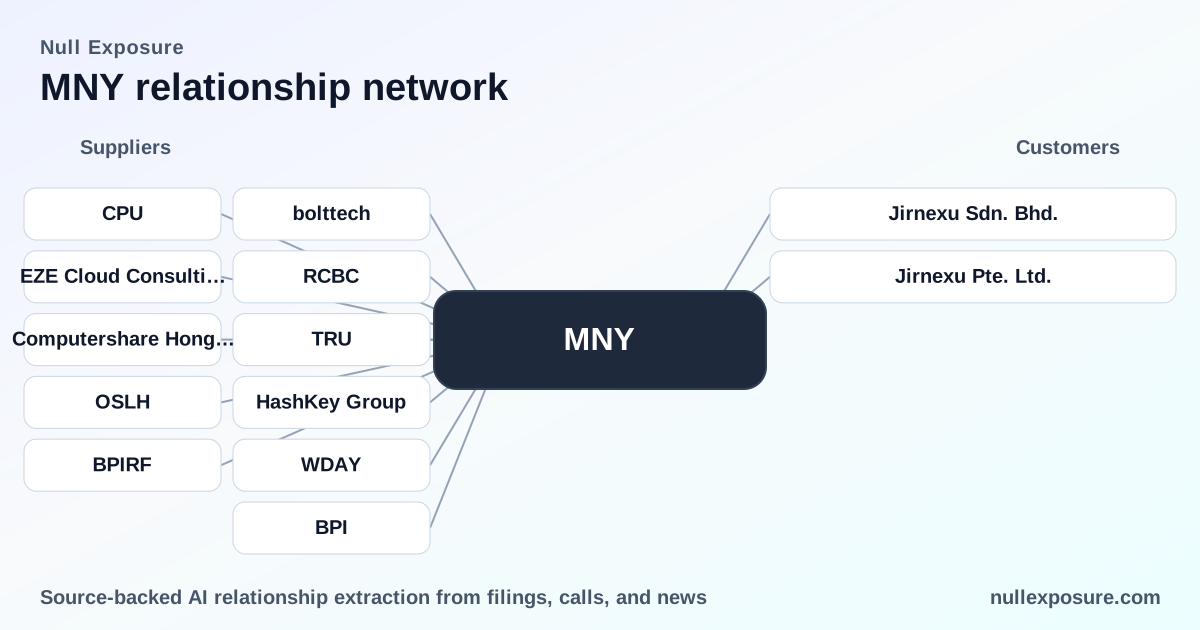
MoneyHero (MNY) — Customer relationships, the Malaysia pivot, and what investors should price in
MoneyHero operates a consumer-facing comparison platform across Greater Southeast Asia and monetizes primarily through referral fees, lead generation and commercial partnerships with banks and insurers; the company supplements platform revenue with strategic asset transactions and localized partnerships to optimize capital allocation. Investors should view the recent Malaysia transaction as an explicit repositioning of customer-facing assets toward partnership and asset-sale economics, not a retreat from the region. For a concise mapping of customer ties and commercial implications, see https://nullexposure.com/.
What the Malaysia transaction actually is — quick investor thesis
MoneyHero signed a strategic transaction with Jirnexu, where the company’s Malaysian B2C brand CompareHero — including the website, domain names, select user data and certain IP rights — is being acquired by Jirnexu’s Malaysian operating entity while Jirnexu Pte. Ltd. is the parent counterparty in the deal. This structure converts a direct B2C asset into a monetized partnership/asset sale, crystallizing value while reducing direct operational exposure in a specific market. A FinancialContent report describing the announcement is available at: https://markets.financialcontent.com/worldnow.katv/article/gnwcq-2024-6-28-moneyhero-group-announces-strategic-partnership-with-jirnexu-pte-ltd-in-malaysian-market.
The relationships on record — concise, sourced statements
-
Jirnexu Sdn. Bhd.: MoneyHero’s Malaysia B2C brand CompareHero, together with the website, domain names, select user data and IP rights, will be acquired by Jirnexu Sdn. Bhd., transferring the local consumer-facing assets into Jirnexu’s operating unit. This is an asset-level transfer of the Malaysian consumer interface and associated digital assets. Source: FinancialContent report announcing the strategic transaction (June 2024): https://markets.financialcontent.com/worldnow.katv/article/gnwcq-2024-6-28-moneyhero-group-announces-strategic-partnership-with-jirnexu-pte-ltd-in-malaysian-market.
-
Jirnexu Pte. Ltd.: MoneyHero signed the strategic transaction with Jirnexu Pte. Ltd., the parent company of the Malaysian operator, positioning Jirnexu as the counterparty for an integrated market-level transaction and partnership spanning ownership and operational coordination. The press coverage frames this as a coordinated corporate-level agreement with Jirnexu as the principal. Source: FinancialContent announcement describing the strategic transaction and parties (June 2024): https://markets.financialcontent.com/worldnow.katv/article/gnwcq-2024-6-28-moneyhero-group-announces-strategic-partnership-with-jirnexu-pte-ltd-in-malaysian-market.
How this changes the operating model and commercial posture
The Jirnexu transaction is a clear signal about MoneyHero’s contracting posture, concentration, criticality, and maturity:
-
Contracting posture — asset-driven and partnership-oriented. The transfer of CompareHero assets to Jirnexu demonstrates MoneyHero’s willingness to monetize localized B2C assets through outright sale and structured partnerships, converting operating cost and customer acquisition complexity into near-term proceeds or long-term revenue-sharing arrangements.
-
Concentration — market-level concentration is actively managed. By divesting the Malaysian B2C interface, MoneyHero reduces direct exposure to one market’s customer-acquisition economics and operational overhead, concentrating its platform efforts on markets where it retains direct engagement or where partnership economics are more favorable.
-
Criticality — customer-facing assets are fungible at the market level. The asset sale implies MoneyHero treats localized consumer platforms as strategically important but not essential to the Group’s core value proposition, which is platform orchestration and monetization through partner relationships.
-
Maturity — the company is transitioning from growth-heavy direct ownership to hybrid monetization. The move is consistent with a fintech that has reached a monetization inflection and is optimizing capital allocation between direct-market investment and third-party commercialization.
These characteristics should inform investor expectations about future revenue composition: a larger share of revenue originating from partnership fees and licensing/asset sale proceeds, with reduced direct B2C operating cost in select markets.
Financial and shareholder context that matters for customer risk
MoneyHero’s public financials and capital structure amplify the commercial read on customer relationships:
-
The company reported Revenue (TTM) of $73.4M and Gross Profit of ~$19.95M, while operating and net margins remain negative, indicating the business still requires disciplined monetization to reach profitability.
-
Insider ownership is high (≈62.8%) and institutional ownership is low (≈1.7%), which produces concentrated strategic control and reduces the likelihood of activist pressure to pursue alternative monetization paths; corporate decisions on partnerships and divestitures will follow management and major insider incentives.
-
Market multiples are modest — Price/Revenue ~0.79 and Price/Book ~1.48 — pricing in some value for growth but reflecting execution and profitability questions.
Taken together, the Jirnexu transaction sits within a company actively reshaping market exposure while still prioritizing shareholder-aligned value crystallization.
Risks and upside from the relationship strategy
-
Risk — revenue volatility from one-off asset monetizations. Converting local brands into asset sales or partnership agreements can create short-term revenue spikes but reduces recurring revenue predictability unless replaced by robust referral or licensing contracts.
-
Risk — partner execution and data handling dependencies. Transferring user data and IP to a partner concentrates operational risk on the counterparty’s ability to preserve user value and conversion rates.
-
Upside — lower cash burn and faster path to positive operating leverage. Selling localized customer-facing assets reduces operating complexity and capex for market expansion, allowing MoneyHero to redeploy capital toward markets with higher ROI or toward platform enhancements that scale across jurisdictions.
-
Upside — potential to structure recurring economics with partners. If the transaction includes a revenue share or preferential distribution agreement, MoneyHero can retain upside from customer flows without the full operating burden.
Relationship catalog (full coverage)
Below are the two customer relationships captured in the public record for this review, written as plain-English takeaways with sources.
-
Jirnexu Sdn. Bhd. — MoneyHero’s Malaysian B2C brand CompareHero (website, domains, select user data and IP rights) is being acquired by Jirnexu’s Malaysian operating entity, transferring the local consumer distribution assets to Jirnexu Sdn. Bhd.; the deal converts a direct-market channel into an asset sale/partnership. Source: FinancialContent announcement (June 28, 2024): https://markets.financialcontent.com/worldnow.katv/article/gnwcq-2024-6-28-moneyhero-group-announces-strategic-partnership-with-jirnexu-pte-ltd-in-malaysian-market.
-
Jirnexu Pte. Ltd. — The strategic transaction was negotiated with Jirnexu Pte. Ltd., the parent company of the Malaysian operator, establishing Jirnexu as the corporate counterparty and signaling an orchestrated transfer and partnership at the group level. Source: FinancialContent announcement (June 28, 2024): https://markets.financialcontent.com/worldnow.katv/article/gnwcq-2024-6-28-moneyhero-group-announces-strategic-partnership-with-jirnexu-pte-ltd-in-malaysian-market.
Constraints and company-level signals
There are no explicit customer-level contractual constraints surfaced in the reviewed relationship data for this scope. As a company-level signal, MoneyHero’s public profile shows high insider concentration, modest institutional ownership, and ongoing negative operating margins, which collectively indicate management-controlled strategic flexibility to execute further asset-level monetizations or to prioritize recurring partnership economics.
Investment takeaway
MoneyHero is executing a deliberate shift from owning every local consumer interface to monetizing market positions through asset sales and strategic partnerships. That operational posture reduces direct operating exposure in specific geographies while preserving upside through partnership economics — a structural move that lowers near-term cash burn but introduces recurring-revenue and partner-execution risk. Investors should price for transitionary revenue composition, concentrated insider governance, and dependence on partner performance to sustain conversion economics.
For a direct analysis of relationship exposures and ongoing alerts, visit https://nullexposure.com/ for firm-level monitoring and deal tracking.