Moog (MOG-A): Customer Map, Contracting Posture, and What Investors Should Price In
Moog designs, manufactures and integrates high-performance motion and fluid control systems and monetizes through a combination of large OEM production contracts, long-term aftermarket service agreements, and defense prime-supplier relationships. Revenue mixes include product sales to commercial aircraft and industrial OEMs, repair-and-overhaul service streams, and U.S. Government contracts recognized over time; margin and backlog dynamics are driven by multiyear programs and government/large-enterprise concentration. For a quick, searchable view of the relationships discussed here, visit https://nullexposure.com/.
Why customers define Moog’s risk and return profile
Moog’s operating model is characterized by long-duration contracting, high counterparty concentration, and global manufacturing footprints, which together create both revenue visibility and operational complexity. The company explicitly recognizes revenue over time for U.S. Government and other large commercial contracts, and management disclosed a material weakness related to controls over long-term aftermarket service contract accounting — a corporate-level signal that affects revenue recognition and audit risk. Sales are skewed to a small number of large customers and government programs, and Moog acts both as a seller of hardware and as a service provider for repair and overhaul work. These characteristics produce:
- Contracting posture: Predominantly long-term program structures and over-time revenue recognition for defense and major commercial programs.
- Counterparty concentration: Substantial exposure to government and large-enterprise OEMs; government contracts accounted for a material share of recent sales.
- Geographic scope and operational maturity: Global manufacturing footprint supports diversified delivery but increases compliance and supply-chain complexity.
- Control and accounting sensitivity: Management disclosed a material weakness tied to long-term aftermarket service contracts, elevating audit and restatement risk for affected periods.
These signals translate into high revenue visibility but elevated program execution and compliance risk, which investors should weigh alongside Moog’s margin profile and backlog metrics.
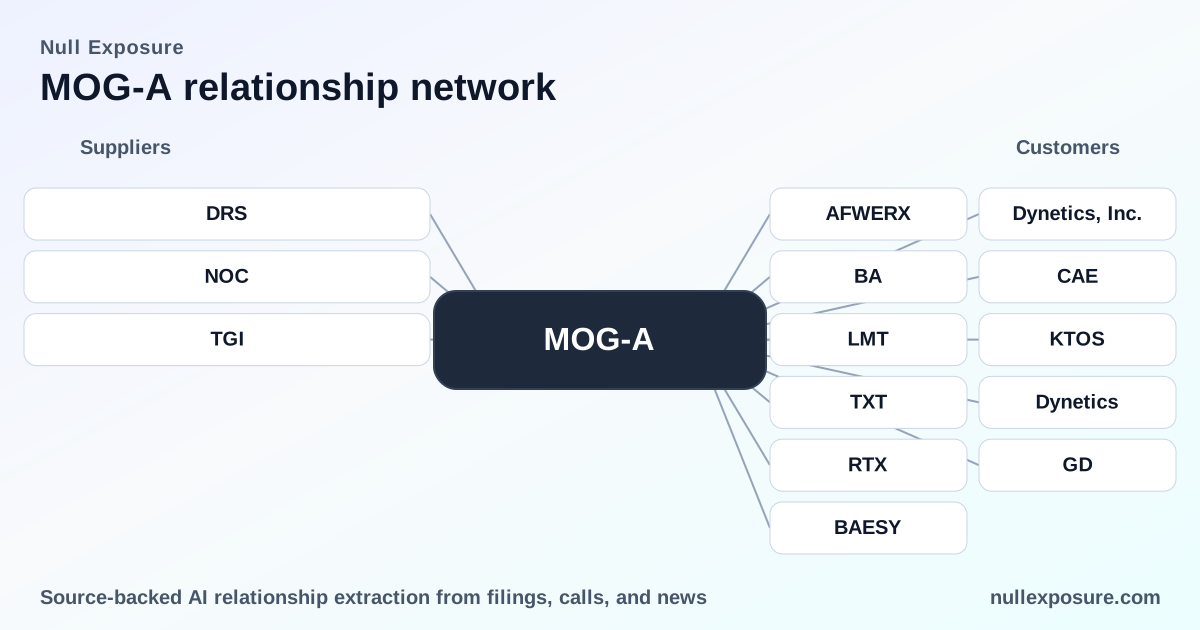
Relationship roll call: every cited customer and partner
Below are one- to two-sentence plain-English summaries for every relationship surfaced in the public record provided.
Hindustan Aeronautics Limited (HAL)
A Trak.in report dated May 3, 2026 states that Moog was found guilty of bribing Indian officials to secure contracts with Hindustan Aeronautics Limited as part of an enforcement action tied to Indian tender activity. Source: Trak.in, May 3, 2026.
South Central Railway
The same Trak.in article reports that Moog’s misconduct allegations included contracts awarded via South Central Railway in India, linking government procurement exposure to the enforcement matter. Source: Trak.in, May 3, 2026.
AFWERX
Moog’s Aircraft Controls segment executed an Other Transaction for Prototype (OTP) with AFWERX under the Agility Prime program to prototype advanced air mobility systems, establishing a direct innovation partnership with a U.S. Air Force incubator. Source: SUAS News, 2021.
Lockheed Martin
On the Q4 2025 earnings call, management noted a supplier award from Lockheed Martin for 100% on-time delivery on the PAC‑3 missile program, reflecting operational execution in high-reliability defense supply chains. Source: Moog Q4 2025 earnings call.
BA (ticker listed as BA on a results entry)
During the Q4 2025 call Moog referenced Boeing activity tied to a new assembly building (charleston) and broader commercial production commitments, indicating program-level exposure to Boeing’s fleet investments. Source: Moog Q4 2025 earnings call.
Boeing
Moog supplied commentary on Boeing’s 787 program expansion in Charleston — an example of Moog’s upstream OEM relationships with major airframe manufacturers. Source: Moog Q4 2025 earnings call.
LMT (duplicate entry for Lockheed Martin)
Moog reiterated the Lockheed Martin supplier award on the PAC‑3 program on its Q4 2025 call, underscoring repeatable performance recognition from a major defense prime. Source: Moog Q4 2025 earnings call.
Bell Helicopter
A Vertical magazine press release notes Moog provided fly‑by‑wire flight control actuators for the Bell 525, demonstrating Moog’s positioning as a systems supplier on rotary‑wing platforms. Source: Vertical Magazine press release, 2015.
TXT (duplicate Bell Helicopter entry)
The same Vertical Magazine release identifies Moog as Bell 525’s flight control actuator supplier, showing legacy aerospace OEM relationships. Source: Vertical Magazine press release, 2015.
Raytheon Integrated Defense Systems (IDS) Business Unit
Army‑Technology reported Moog’s Naval Systems unit received a Supplier Quality Award from Raytheon IDS for multiple consecutive years, signaling supplier-level recognition in missile and naval programs. Source: Army‑Technology, 2019.
RTX (duplicate Raytheon IDS)
The Army‑Technology item also highlights RTX’s award to Moog’s Naval Systems BU, another confirmation of long-term supplier performance to a major defense prime. Source: Army‑Technology, 2019.
BAE Systems
A defence‑industry.eu article describes Moog’s Reconfigurable Integrated‑weapons Platform (RIwP®) integrated into a BAE Systems prototype for the AMPV C‑UAS program, indicating platform-level collaborations on land systems. Source: Defence‑Industry.eu, 2024.
Dynetics, Inc. (FY2017)
A 2017 SUAS News report lists Moog among technology providers assembled by Dynetics for DARPA Gremlins work, reflecting participation in multi‑partner R&D and prototyping teams. Source: SUAS News, 2017.
CAE
Moog reported receiving the Crystal Excellence Award from CAE for operational performance and sustainability commitment, highlighting aftermarket and simulation partner recognition on the Q4 2025 call. Source: Moog Q4 2025 earnings call.
Dynetics (ASD News, FY2022)
ASD News covered Moog actuation systems developed collaboratively with Dynetics for DARPA Gremlins recovery missions, illustrating ongoing unmanned systems program work. Source: ASDnews, January 2022.
GD (General Dynamics Land Systems)
ArmyRecognition described a RIwP turret mounted on General Dynamics Land Systems’ TRX Defender, showing practical field applications of Moog’s modular weapons platform on robotic combat vehicles. Source: ArmyRecognition, AUSA 2024.
General Dynamics Land Systems (duplicate)
The same ArmyRecognition coverage highlights General Dynamics’ use of Moog RIwP technology on its TRX Defender demonstrator. Source: ArmyRecognition, AUSA 2024.
BAESY (duplicate BAE Systems)
Defence‑Industry.eu coverage of the AMPV C‑UAS prototype again identifies the Moog RIwP turret as part of the BAE Systems effort. Source: Defence‑Industry.eu, 2024.
KTOS (Kratos)
On the Q4 2025 call, Moog confirmed supply of flight control and actuation products to Kratos on platforms such as the XQ‑58 Valkyrie and the BQM‑177, indicating supplier exposure to tactical unmanned systems. Source: Moog Q4 2025 earnings call.
Kratos (duplicate)
The earnings commentary repeats ongoing product deliveries to Kratos and active discussions for future CCA platforms, underscoring program continuity. Source: Moog Q4 2025 earnings call.
ISSC (Innovative Aerosystems) — Finviz
Finviz reported Innovative Aerosystems completed acquisition of Moog’s S‑TEC Model 3100 autopilot product line, reflecting divestiture of a legacy commercial avionics product. Source: Finviz news, 2026.
ISSC — Intellectia.ai
A March 2026 Intellectia item says Innovative Aerosystems completed the acquisition of Moog’s S‑TEC Model 3100 line, framing the sale as strategic repositioning of Moog’s product portfolio. Source: Intellectia.ai, 2026.
ISSC — Finviz (FY2025 entry)
A separate Finviz item reiterates the S‑TEC Model 3100 sale to Innovative Aerosystems as an event shaping Moog’s avionics carve‑outs. Source: Finviz news, 2025/2026 coverage.
PRTS (CarParts.com) — Brake and Frontend
A 2021 report shows CarParts.com distribution centers stock Moog brand steering and suspension parts, indicating a retail aftermarket channel for Moog’s automotive product line. Source: Brake and Frontend, 2021.
PRTS (CarParts.com) — Jax Daily Record
Local coverage confirms CarParts.com’s distribution center inventory includes Moog branded parts, demonstrating aftermarket brand presence in the retail supply chain. Source: Jax Daily Record, 2021.
ISSC — MyChesco
MyChesco coverage repeated Innovative Aerosystems’ acquisition of the S‑TEC line from Moog, again confirming the transfer of the Model 3100 product line out of Moog’s portfolio. Source: MyChesco, 2025.
Investment implications and closing takeaways
Moog’s revenue profile is anchored in long‑term defense and OEM programs and supported by aftermarket services, giving high revenue visibility. Key risks are program execution, accounting control gaps on long‑term service contracts, and reputational/legal exposure from reported procurement misconduct in India. Key strengths include recognized supplier performance with major primes (Lockheed, Raytheon, Boeing), participation in advanced unmanned and modular systems, and a global manufacturing footprint that supports diversified program delivery. For a consolidated view of Moog’s customer relationships and to monitor updates as they hit filings and news, check https://nullexposure.com/.
Bold, program‑level customer relationships will continue to drive valuation volatility around contract awards, backlog conversion, and any remediation of the disclosed control weaknesses. Investors should price high revenue visibility alongside elevated compliance and program execution risk when assessing Moog.