Moog Inc (MOG-B) — Customer Relationships and What They Mean for Investors
Moog designs, manufactures and integrates precision motion and fluid controls and control systems for aerospace, defense and industrial customers, monetizing through a mix of long-term production contracts, government programs and aftermarket services. Revenue is driven by program ramps with major OEMs, recurring defense work under U.S. Government contracts, and spare/repair services that deepen lifecycle capture. For focused relationship analytics and comparative exposure data, see https://nullexposure.com/.
Investment thesis in one paragraph
Moog’s cash flows are concentrated in aerospace and defense: 75% of 2025 sales came from those end markets and U.S. Government work accounted for 38% of sales, giving the company both predictable backlog and revenue recognition complexity. The business combines high-margin systems and recurring aftermarket services with cyclical production risk tied to a small set of large OEMs; investors gain durable program cashflows but accept concentration and revenue-recognition sensitivity.
Key takeaways for a diligence checklist
- Concentration and criticality: Net sales to the five largest customers were approximately 31% of 2025 sales, indicating that a few large OEMs materially drive results.
- Contracting posture: The company operates a mix of long-term production and government contracts alongside short-lead industrial sales, creating both predictable backlog and short-cycle revenue.
- Revenue recognition risk and controls: Management disclosed a material weakness tied to long‑term aftermarket service contracts, highlighting accounting complexity where revenue is recognized over time.
- Operational drivers: Recent comments emphasize production ramps in Commercial Aircraft and defense-led growth, so execution on supply chain and capacity expansion drives near-term upside.
Customer relationships covered (complete list from recent references)
Below are plain-English summaries for every relationship referenced in the recent feed, each with a concise source note.
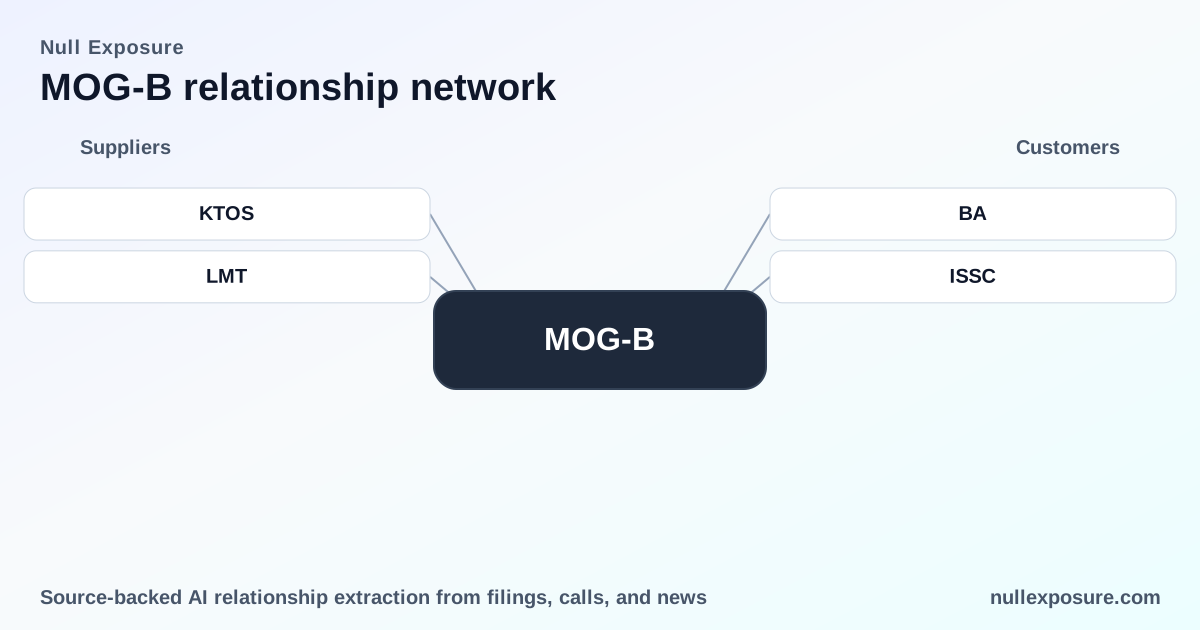
BA
Moog referenced strong customer backlogs and intent to drive production rates while noting Boeing’s investment in a second final assembly building in Charleston for the 787 program. This underscores Moog’s exposure to Boeing production ramps in commercial aircraft. According to the company’s Q4 2025 earnings call, management highlighted the Boeing development and its implications for production volume (2025Q4 earnings call).
Boeing
Moog cited Boeing explicitly in its Q4 2025 earnings call when describing customer backlogs and rising production intent; Boeing’s $1 billion commitment to the 787 and a new Charleston assembly building are driving increased program activity that benefits suppliers like Moog. The company reiterated this linkage during the same Q4 2025 earnings discussion (2025Q4 earnings call).
Innovative Aerosystems, Inc.
Market coverage reported that Innovative Aerosystems acquired Moog’s TEC® Model 3100 Autopilot Product Line, signalling selective portfolio rationalization and monetization of legacy product lines. This transaction reduces Moog’s exposure in that niche while freeing capital and engineering focus for higher-priority systems, as noted in a MarketScreener posting in March 2026 (MarketScreener, March 2026).
ISSC
A separate MarketScreener mention identifies ISSC as the acquirer of the TEC Model 3100 line from Moog, confirming the sale and indicating Moog’s strategic choice to exit certain commercial autopilot product concessions. The MarketScreener report (FY2025 coverage published March 2026) attributes the product-line transfer to Innovative Aerosystems (March 2026).
How the company-level constraints shape the commercial model
The relationships above sit inside a distinct operating model that investors must parse carefully. The following signals are company-level characteristics drawn from recent disclosures and should frame any valuation or counterparty-risk analysis.
- Contracting posture: Predominantly long-term production and government contracts govern a large share of revenue; these contracts create backlog visibility but require sophisticated cost-to-complete accounting and expose Moog to estimate risk.
- Contract variety: Short-term industrial sales represent roughly a quarter of sales and provide near-term cash flow flexibility through short lead times (typically ~90 days), balancing the long-duration program exposure.
- Counterparty profile: Customers are large enterprises and government agencies, producing high-criticality relationships where program timing and funding cycles materially affect Moog’s top line.
- Concentration and materiality: Top-five customer concentration (~31% of sales) heightens single-counterparty risk — vendor performance or OEM production shifts can produce outsized revenue variation.
- Geographic and segment breadth: Moog operates globally across manufacturing and services, combining product delivery with spare parts and repair/overhaul services that extend revenue capture through product lifecycles.
- Revenue recognition and control maturity: The firm recognizes revenue over time for many large contracts and reported a material weakness involving long-term aftermarket service contracts, which is a company-level control signal that increases the importance of audit and governance quality.
- Relationship lifecycle: Several program lines are in ramping stages, particularly in Commercial Aircraft, creating near-term growth opportunities but requiring capital and supply-chain execution.
For more granular relationship analytics and counterparty scoring, visit https://nullexposure.com/.
Risk vs. opportunity — what investors should watch next
- Execution on OEM ramps, particularly Boeing’s 787 production increase, is the primary growth lever; successful capacity expansion converts backlog into revenue and margin improvement.
- Defense and government programs offer steady, long-duration revenue but create concentration in contract performance and audit scrutiny. Moog’s exposure to U.S. Government contracts supports resilience in downturns but magnifies the importance of compliance and cost-estimating discipline.
- The sale of the TEC autopilot line to Innovative Aerosystems demonstrates selective portfolio pruning; investors should track whether proceeds are redeployed into higher-return systems or used for deleveraging.
- The disclosed material weakness around aftermarket service contracts is an immediate governance risk; resolution and remediation timelines will influence investor confidence and could affect near-term reported results.
Bottom line for investors
Moog’s model is capital-light on aftermarket services and capital-intensive on production ramps—a mix that produces durable margins if program execution holds and accounting controls are tightened. Concentration among a few large OEMs and material reliance on government contracts are both a source of predictable cash flow and a focal point for downside risk. For portfolio managers seeking aerospace/defense exposure with differentiated aftermarket economics, Moog presents a compelling, execution-dependent opportunity.
To evaluate counterparty exposure across peers or to access structured relationship intelligence, explore NullExposure’s relationship insights at https://nullexposure.com/.