Morningstar (MORN) — customer relationships and commercial footprint investors should price in
Morningstar operates a subscription- and license-driven research and data franchise, monetizing through per-user and enterprise licenses, annual and monthly subscriptions, and a smaller but meaningful tranche of transaction- or usage-based fees. The business is global, split between North America and Europe for data revenue, and it sells both standalone software (Morningstar Direct, Advisor Workstation) and services to institutional and retail channels. For investors, the key commercial characteristics are high renewal rates, diversified global reach, and a mix of sticky license revenue with some transaction exposure. For additional signal work on counterparty relationships, see https://nullexposure.com/.
How Morningstar sells value — the operating model that matters for revenue predictability
Morningstar’s contracts are predominantly license and subscription-based, which produces the company’s most reliable recurring cash flows. Morningstar’s filings classify license-based revenues as subscription services and report that license revenue grew and that the company charges monthly or annual subscription fees for retail products such as Morningstar Investor and Morningstar Premium. The firm also records usage- or transaction-based revenue in specific products (for example, PitchBook media sales was reclassified between license- and transaction-based categories), so some revenue volatility tracks customer activity. Morningstar reports an annual renewal rate of approximately 100% for license products in 2024, signaling very high customer retention and embedded switching costs from integrated research platforms.
Geographically, Morningstar is a global operator with concentrated revenue in North America and Europe; international operations span more than 30 countries, supporting both regional clients and multinational institutions. The company sells both software (desktop and cloud tools) and services, positioning itself as both a licensor and seller of research and analytics. These are the company-level commercial signals investors should use when modeling revenue durability and churn.
For direct access to relationship-level flags and source-level evidence, visit https://nullexposure.com/.
Relationship-by-relationship checklist — what the filings and press reveal
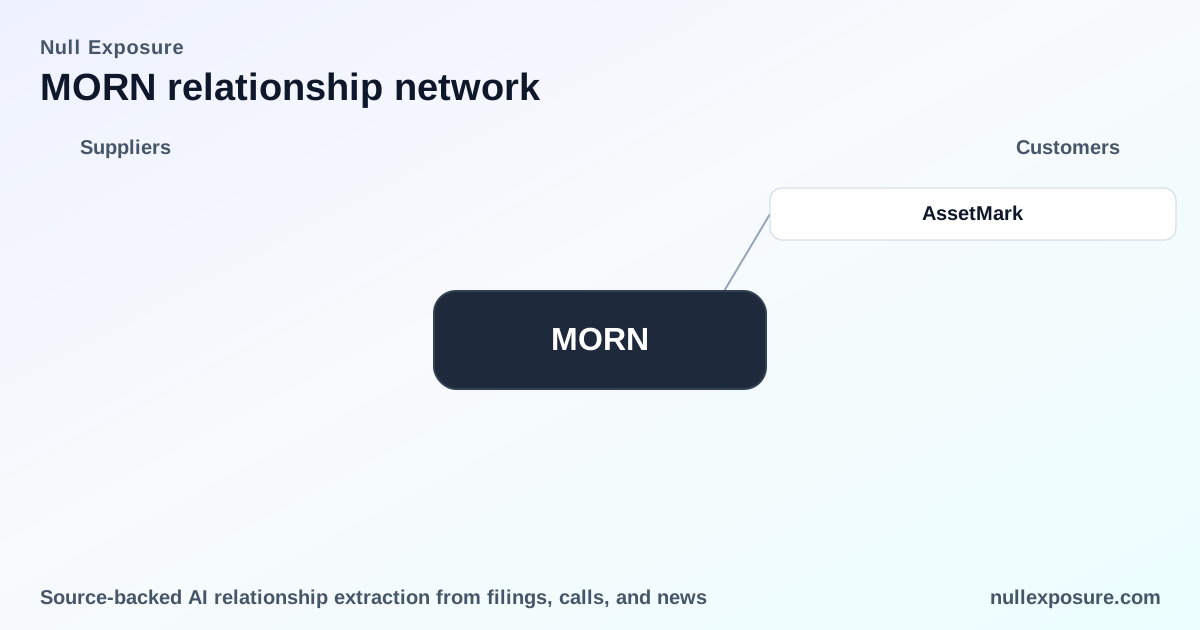
AssetMark (FY2025)
Morningstar recognized a $22.7 million contingent payment in 2025 related to the sale of US TAMP assets to AssetMark, down from a $64.0 million gain in 2024, reflecting realized proceeds tied to the transfer of customer assets from Morningstar’s TAMP business. This is recorded in Morningstar’s 2025 Form 10‑K and signals transactional monetization from asset-sales activity. (Morningstar 10‑K, FY2025)
BBHL (Q4 2025 fact sheet)
A BBH product fact sheet (Q4 2025) notes that when major agency ratings are absent, the highest ratings from DBRS and Kroll are used—an instance where Morningstar DBRS capacity is part of the ratings mix referenced by institutional fund documentation. The citation is to Brown Brothers Harriman’s published fact sheet, Q4 2025. (BBH fact sheet, Q4 2025)
SLM / Sallie Mae (FY2026 reporting)
Morningstar DBRS was cited in coverage of Sallie Mae’s ABS issuance structure—described as a pass-through using Morningstar DBRS analysis that detailed subordination and reserve mechanics—illustrating Morningstar’s role as a ratings and structured-credit analyst for securitizations. (American Banker coverage of Sallie Mae ABS, 2026)
SCHW‑P‑J / Charles Schwab (FY2026 news)
Coverage of Charles Schwab’s platform upgrades highlights that Schwab expanded access to third‑party research and provider ratings including Morningstar, concretely embedding Morningstar content into broker-dealer platforms to support advisor and client access to research and position-level data. (Investing.com report, May 2026)
Finance of America (FOA) / Finance of America Reverse (FY2022)
Finance of America Reverse was named Morningstar’s first reverse mortgage education provider, with tools made available to 150,000 financial advisors via Morningstar Advisor Workstation, showing Morningstar’s distribution reach into advisor workflows and its role as a channel for partner educational content. (National Mortgage Professional, FY2022)
SSNC / SS&C Technologies (FY2026)
SS&C’s public commentary described migrating several hundred Morningstar wealth-management platform clients onto SS&C’s Black Diamond offering following an acquisition, demonstrating that Morningstar’s wealth platform clients are a portable franchise and that client migration can generate transaction events and integration risk/opportunity for Morningstar and counterparties. (Earnings call transcript coverage, Q4 2025 / InsiderMonkey, 2026)
HCXY / Hercules Capital (FY2026)
Morningstar DBRS affirmed Hercules Capital’s corporate and credit rating at BBB (high), showing Morningstar’s active role in credit opinion issuance and highlighting the company’s DBRS arm as a ratings provider to publicly followed investment vehicles. (Press coverage, March 2026)
QQDN (FY2026)
Barchart’s ETF price-history page lists fundamental data provided by Morningstar, evidencing Morningstar’s position as a data supplier to market data aggregators and exchange-traded product reporting services. This underscores the firm’s distribution of normalized fund‑level metrics to third-party platforms. (Barchart price-history note, 2026)
NEWT / NewtekOne (FY2024)
A NewtekOne issuance disclosed Morningstar DBRS ratings on class notes—A (sf) and BBB (high) (sf) for classes A and B respectively—exposing Morningstar’s ratings business involvement in structured financings going back to disclosures around FY2024. (Press release coverage, FY2024)
What these relationships mean for investors — risk and runway
- Revenue stickiness is high: Morningstar reports ~100% renewal rates for license products, which supports predictable recurring revenue and a lower churn default assumption in models.
- Mixed contract posture: The company is fundamentally license/subscription-led with pockets of usage-based revenue; investors should not treat Morningstar as a pure SaaS business but rather a hybrid research & data services company with embedded subscription economics.
- Channel and distribution reach is material: Relationships with broker platforms, ETF data providers, ratings coverage, and advisor workstation distribution demonstrate multiple, complementary monetization pathways that protect against single-channel concentration.
- Transaction exposure and one-off gains exist: Events like the AssetMark contingent payment and client migrations to other wealth platforms introduce episodic profit and integration noise that should be modeled separately from core recurring revenue.
- Regulatory and reputation sensitivity: The DBRS/rating activity shows Morningstar operates in credit-opinion markets where regulatory and reputational risk matter, and ratings outcomes can influence fee-bearing engagements.
Investment conclusion and action points
Morningstar’s commercial profile is durable and sticky, driven by license and subscription economics with strategic, revenue-enhancing partnerships across distribution channels and ratings. Investors should model steady recurring revenue with small-to-moderate episodic items (ratings fees, asset-sale contingent payments) and account for geographic concentration in North America and Europe. For deeper counterparty-level intelligence and time‑series evidence on counterparties referenced in filings and media, consult the relationship database at https://nullexposure.com/.
Bold takeaway: Morningstar’s high renewal rates and multi-channel distribution provide durable economics, while periodic transactional items and platform migrations create episodic earnings volatility investors should separate from core subscription revenue.