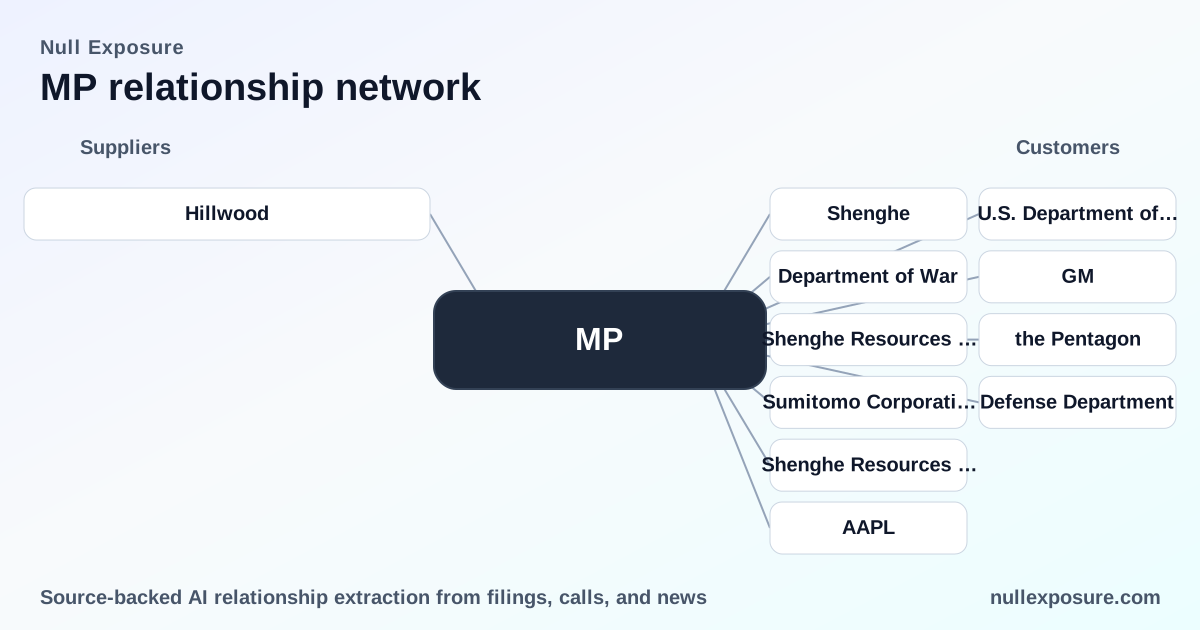
MP Materials: Customer relationships that define the mine-to-magnet thesis
MP Materials runs the Mountain Pass rare‑earth mine and an expanding set of downstream magnetics assets, monetizing across three buckets: selling rare‑earth concentrate and separated NdPr oxide/metal to Asian refiners and distributors, supplying precursor NdPr products to U.S. magnet customers as it scales its Magnetics segment, and contracted, pre‑paid long‑term supply agreements with strategic corporate and government partners that de‑risk near‑term cash flows while undergirding vertical integration. For investors, the critical question is whether MP can convert large, concentrated offtakes and government support into durable, higher‑margin magnet and recycling revenue while managing customer concentration and contract-term mismatches. For more on MP’s commercial footprint, visit https://nullexposure.com/.
Why MP’s customers determine valuation more than reserves
MP’s asset-base alone is valuable; the market premium will ultimately follow predictable, long‑term offtakes and the company’s ability to climb the value chain. Customer concentration in the Materials segment, a flurry of multi‑year agreements in Magnetics, and government price guarantees are the dominant drivers of revenue visibility and downside protection. That dynamic explains the market’s bifurcated view: captive raw‑material economics versus higher‑margin finished magnets and recycled content deals.
Customer relationships: line‑by‑line commercial map
-
Shenghe — MP sells rare‑earth concentrate under a 2024 Offtake Agreement, and Shenghe in turn distributes that material to Chinese refiners. According to MP’s FY2024 Form 10‑K, Shenghe is the operational conduit for most concentrate sales into China. (MP 2024 10‑K)
-
Shenghe Resources (Singapore) International Trading Pte. Ltd. — This Singapore affiliate is MP’s principal Materials‑segment customer, accounting for roughly 80% of consolidated revenue in 2024 and over 90% in 2023 and 2022, making it the single largest demand concentration for MP’s raw output. (MP 2024 10‑K)
-
Sumitomo Corporation of Americas — MP entered a distributorship agreement under which Sumitomo is the exclusive distributor to Japanese customers for the NdPr oxide and NdPr metal MP produces, establishing a clear commercial route into Japan. (MP 2024 10‑K)
-
General Motors (GM / GM) — GM is a foundational Magnetics customer with a long‑term magnet supply agreement; MP received substantial customer prepayments tied to precursor magnetic products and expects to begin commercial magnet recognition as production scales. The company disclosed the long‑term agreement and related prepayments and guidance on commercial timing in its earnings commentary and investor releases. (MP 2025 Q2/Q3 earnings calls; MP investor release)
-
Apple (AAPL / Apple AAPL) — MP announced a long‑term agreement with Apple to supply American‑made rare‑earth magnets made from recycled materials, including a material prepayment structure; MP reported receiving an initial $40 million prepayment under that agreement and public reporting places the deal value in the hundreds of millions. (MP 2025 Q3 earnings call; company and press releases, July 2025 reporting)
-
U.S. Department of Defense / the Pentagon / Defense Department — Multiple news reports and company communications highlight a government‑backed long‑term supply arrangement and financial support: the DoD agreed to a multi‑year purchase commitment that includes a price floor for NdPr and accompanied capital support, creating a meaningful backstop to MP’s domestic supply economics. News coverage and press reporting summarized the 10‑year purchase commitment and price guarantee. (Press coverage: Finviz/Ad‑Hoc/Intellectia and company statements, March 2026)
-
Department of War — In MP’s public earnings remarks the company referenced a “long‑term purchase price agreement…with the Department of War” which commenced on October 1, recorded in the Q3 2025 earnings call transcript; this line item reflects the company’s language in that call and corresponds to its broader government supply agreements. (MP 2025 Q3 earnings call)
Note: MP’s public filings and investor releases use multiple aliases for government relationships (Department of Defense, Pentagon, Defense Department); the commercial outcome—long‑dated offtake and price support—remains the common thread across those mentions. (MP investor materials and press coverage, 2025–2026)
Operating constraints, contract posture and what they signal for investors
MP’s customer relationships are not just commercial facts — they shape cash flow timing, margin capture, and counterparty risk.
-
Contracting posture: MP has a mix of short‑term offtakes for concentrate (notably the 2024 Offtake Agreement with Shenghe, initially two years) and multi‑year, pre‑paid supply arrangements in Magnetics (GM, Apple). The company disclosed the two‑year initial term with Shenghe in the 10‑K and separately documented the GM prepayments in its fiscal reporting. (MP 2024 10‑K; MP investor disclosures)
-
Concentration and criticality: MP’s Materials segment carries extreme revenue concentration around Shenghe/Singapore trading affiliate — a company‑level signal confirmed in the 10‑K where that counterparty represented ~80% of consolidated revenue in 2024 and more earlier. This level of concentration is material and critical to near‑term top‑line stability. (MP 2024 10‑K)
-
Maturity and term skew: Raw concentrate sales are structured with shorter contractual horizons; Magnetics revenue is tied to longer, higher‑visibility customer contracts and prepayments that accelerate margin transition as in‑house magnet production scales. MP’s disclosures show the short initial tenor of the Shenghe offtake and long‑term supply constructs for corporate and government partners. (MP 2024 10‑K; MP earnings calls)
-
Geographic split of demand: The Materials segment’s revenue flows are weighted to APAC (China, Japan, Korea) for concentrate and separated NdPr products, whereas the Magnetics segment is focused on North American customers as MP expands U.S. magnet production capacity — an explicit company signal in filings and guidance. (MP 2024 10‑K; MP investor commentary)
-
Counterparty type and credit: Several of MP’s target customers are large enterprises and sovereign actors, providing credit and demand durability; however, the company still carries counterparty concentration risk that will migrate only as Magnetics sales diversify beyond a small number of large customers. (Company filings and earnings commentary)
These constraints show a clear path: short‑tenor, high‑concentration commodity sales today; progressing to longer‑term, diversified, higher‑margin magnet supply tomorrow, but with a defined transition risk window while capacity ramps.
Key investment implications and risk checklist
-
Positive: Prepayments and government price support materially reduce short‑term cash volatility and provide a visible revenue floor for NdPr products. (Company filings and press coverage, 2025–2026)
-
Negative: Near‑term revenue remains highly concentrated in a single Materials counterparty; if Shenghe demand or terms change, MP’s consolidated revenue and bargaining power would be pressured. (MP 2024 10‑K)
-
Execution risk: The valuation premium presumes MP successfully scales magnet and recycling production to fulfill Apple and GM commitments and to diversify away from commodity concentrate sales. Execution and schedule adherence are the primary operational risks.
For investors and analysts preparing scenarios, MP’s path is explicit: monetize existing offtakes while converting advance payments and government backing into profitable magnet volumes. For a deeper look at MP’s commercial relationships and how they drive cash flow scenarios, see the MP coverage at https://nullexposure.com/.
Bottom line
MP Materials has re‑wired its commercial profile: from a single‑asset concentrate seller into an integrated mine‑to‑magnet business anchored by large corporate and government offtakes. That transition underpins the company’s upside if it executes; it also concentrates short‑term downside in a narrow set of counterparties and execution milestones. Investors should weigh the protective value of prepayments and DoD support against persistent concentration in the Materials segment when setting risk and price targets.