Marathon Petroleum (MPC) — Customer Relationships and Commercial Structure
Thesis: Marathon Petroleum monetizes its integrated refining, marketing and midstream footprint by selling refined fuels and renewable diesel through a mix of long‑term dealer supply contracts, wholesale channels and spot markets, while capturing additional cash flow from logistics and transportation services; the company’s customer relationships shift cash‑flow risk from retail operating margins to wholesale/refining margins and midstream volume exposure, underpinning a capital‑return focused balance sheet strategy.
For a concise corporate feed and relationship intelligence, visit https://nullexposure.com/.
Why customer relationships define Marathon’s earnings profile
Marathon is first and foremost a seller of transportation fuels and refined products, with a logistics arm that both supports internal operations and generates third‑party revenue. Customer contract types drive the character of cash flow: long‑term supply contracts with dealer networks produce predictability, while spot and usage‑based midstream pricing introduce volume and spread volatility. The 2021 divestiture of Speedway illustrates a deliberate tilt away from retail operating risk toward scale in refining and distribution where margins and returns on capital can be more directly managed.
Key takeaway: customer mix governs margin volatility and capital allocation — stable dealer contracts smooth revenue, spot sales expose Marathon to commodity spreads, and midstream usage fees link earnings to throughput.
The customer roster reported in recent coverage
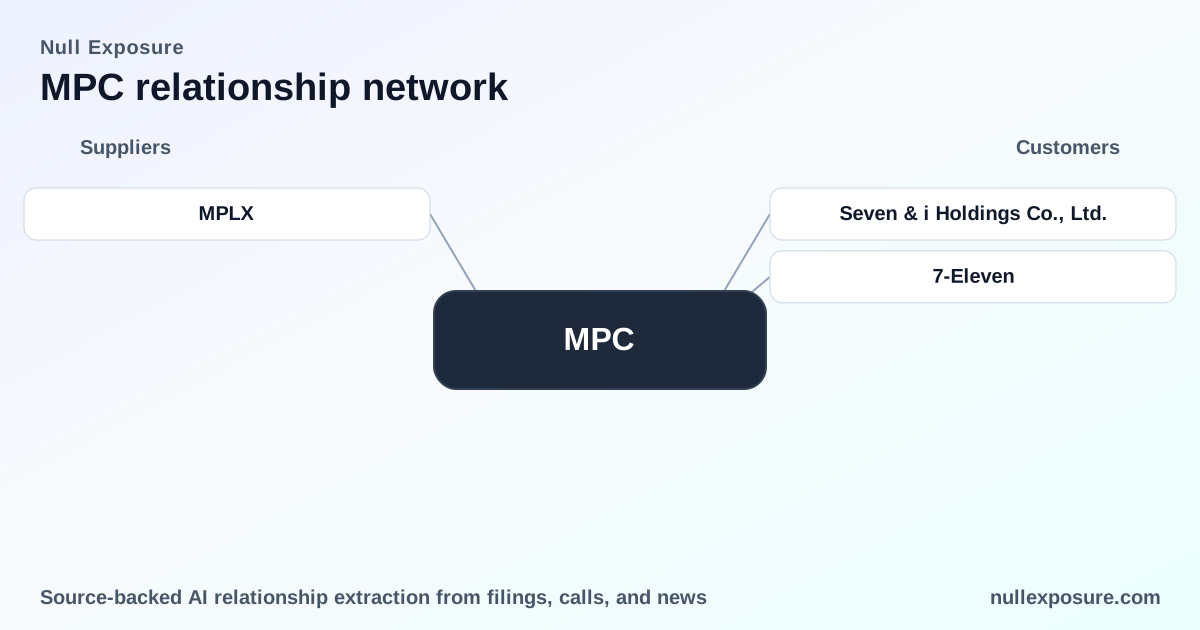
The collection of mentions in recent market coverage references two related counterparties tied to Marathon’s 2021 Speedway transaction. Each entry below is summarized plainly with source context.
Seven & i Holdings Co., Ltd. — the corporate buyer of Speedway
Marathon sold its Speedway convenience store chain to Seven & i Holdings (the Japanese parent company that owns 7‑Eleven) in 2021 for $21 billion, a transaction that materially reduced Marathon’s direct retail operating exposure and unlocked capital for dividends and buybacks. A March 2026 FinancialContent market article revisiting Marathon’s capital allocation explicitly references the 2021 sale of Speedway to Seven & i Holdings (FY2026 coverage).
Source: FinancialContent markets article, March 2026.
7‑Eleven — the operating brand linked to the Speedway purchase
Coverage also cites 7‑Eleven in the same context: the Speedway retail chain was sold to 7‑Eleven for $21 billion in 2021, reflecting the operational reality that Seven & i’s 7‑Eleven is the brand/operator associated with the purchase and subsequent retail strategy. A March 2026 FinancialContent piece names 7‑Eleven when describing the Speedway divestiture (FY2026 coverage).
Source: FinancialContent markets article, March 2026.
What Marathon’s contract and channel signals tell investors
Company filings and segment descriptions provide a clear map of how customer relationships are structured and how they translate into financial characteristics.
- Contracting posture — mixed but anchored by long‑term supply: Marathon maintains long‑term fuel supply contracts with direct dealers (notably ARCO® dealers) that provide revenue stability; filings also confirm meaningful activity on the spot market. This mix generates a baseline cash flow with episodic volatility tied to commodity spreads.
- Pricing and exposure — usage‑linked midstream remuneration: Midstream contracts include minimum volume commitments and variable, usage‑based components, aligning a portion of logistics revenue with throughput and making earnings sensitive to physical flow volumes.
- Geographic footprint — global sales, U.S. production emphasis: The company sells refined products domestically and internationally, while renewable diesel production and marketing remain concentrated in the United States; this dual geography generates diversified demand exposures but concentrates regulatory and policy risk in U.S. renewable initiatives.
- Role and criticality — seller plus service provider: Marathon is predominantly a seller of refined fuels (core product revenue) and concurrently a service provider through its midstream network (pipelines, terminals, towboats) that is critical to both internal operations and third‑party customers.
- Relationship stage and segment maturity — active, core revenue streams: Customer engagements described in filings are active and represent Marathon’s core product and distribution segments, signaling mature revenue lines rather than nascent ventures.
These signals translate into an operating model where volume consistency from dealer contracts underpins base earnings while spot sales and midstream throughput drive cyclical upside and downside.
Investment implications: risks and sources of upside
- Stable baseline with cyclical upside: Long‑term supply contracts and dealer channels create predictable minimum volumes, supporting stable refinery utilization and baseline cash flows that fund dividends and repurchases.
- Commodity and volume sensitivity: Spot market sales and usage‑based midstream fees expose EBITDA to refining spreads and throughput, producing earnings volatility that benefits investors when crack spreads widen but reduces margin in compressed cycles.
- Lower retail operating risk after Speedway sale: The 2021 Speedway divestiture to Seven & i/7‑Eleven removed a large portion of Marathon’s retail operational exposure and converted it into liquidity and capital returns; the transaction changes counterparty concentration and improves return on capital dynamics.
- Regulatory and regional concentration: Renewable diesel production is U.S.‑centric, concentrating regulatory, incentive and feedstock risk domestically even as product distribution sells into global and domestic wholesale markets.
- Midstream strategically important: Marathon’s logistics assets are both commercially valuable and operationally critical, creating optionality to monetize third‑party flows but also exposing the company to counterparty throughput risk.
Bold strategic point: MPC’s customer model is deliberately structured to trade retail operating volatility for refining and logistics scale — a trade that supports aggressive capital returns but leaves the company exposed to commodity and throughput cycles.
For deeper relationship analytics and tailored monitoring, visit https://nullexposure.com/.
Practical signals to watch in quarterly diligence
- Contract renewals and pricing terms with ARCO and other direct dealers.
- Spot sales volumes and refinery utilization rates that drive crack spreads.
- Midstream throughput and minimum volume commitments — monitor changes that shift usage‑based revenue.
- Renewable diesel sales volumes and feedstock costs, given U.S. policy drivers.
- Any disclosure of new wholesale distribution agreements or re‑entry into retail operations.
Conclusion
Marathon’s customer relationships are a foundation of a capital‑return focused strategy: long‑term dealer contracts provide stability; spot market activity and usage‑based midstream fees create cyclicality; and the Speedway sale to Seven & i/7‑Eleven materially reshaped counterparty risk and capital deployment. Investors should evaluate MPC through the lens of volume‑driven sensitivity to refining spreads and midstream throughput, while rewarding management for maintaining durable dealer contracts and disciplined allocation of proceeds from strategic divestitures.