MPLX LP: Customer Relationships Power a Fee-Based Midstream Cash Machine
MPLX LP operates and monetizes a diversified midstream platform by charging fees and tariffs for gathering, processing, transportation, storage and distribution of hydrocarbons and renewables across U.S. infrastructure assets. The business converts long-term minimum volume commitments and fee-based contracts into stable, through-cycle cash flow, with a concentrated revenue profile anchored by a controlling sponsor relationship. For deeper relationship analytics visit https://nullexposure.com/.
Why this matters to investors: MPLX’s valuation and distribution profile trades off contract tenure, counterparty concentration, and the operational criticality of its pipelines and terminals. The interplay of these factors determines cash-flow resilience and capital return capacity.
How MPLX’s operating and commercial model drives cash flow
MPLX monetizes through a mix of tariffs, storage and terminal fees, and processing/gathering charges: fee-for-service economics dominate, reducing direct commodity exposure and stabilizing EBITDA. Contracts generally span multi-year horizons—agreements range from one to ten years and often automatically renew, which supports predictability in the midstream cash stream. MPLX also participates in tolling and distribution arrangements where it takes fees for movement and storage rather than commodity positions.
Concentration and sponsor dynamics are central to the risk profile. A single sponsor-related counterparty supplies material volumes and owns a controlling equity stake, creating both economic alignment and concentration risk. MPLX’s footprint is U.S.-centric, and the firm segments its revenue across distribution, infrastructure and services, with commercial relationships that are often structured as long-term, minimum-volume commitments.
Key operational constraints as company-level signals:
- Contracting posture: Long-term, renewable contracts underpin through-cycle cash stability and are a deliberate strategic focus.
- Geography: Assets and economic exposure are primarily North America / United States.
- Segment mix: Revenue is concentrated in distribution and infrastructure services, reinforcing a fee-based model.
- Materiality signal: Company disclosures identify single-customer exposures within segment-level revenue that are material in the aggregate.
For a full commercial mapping and actionable relationship intelligence, see https://nullexposure.com/ (homepage).
Customer map: the commercial relationships that underpin revenue
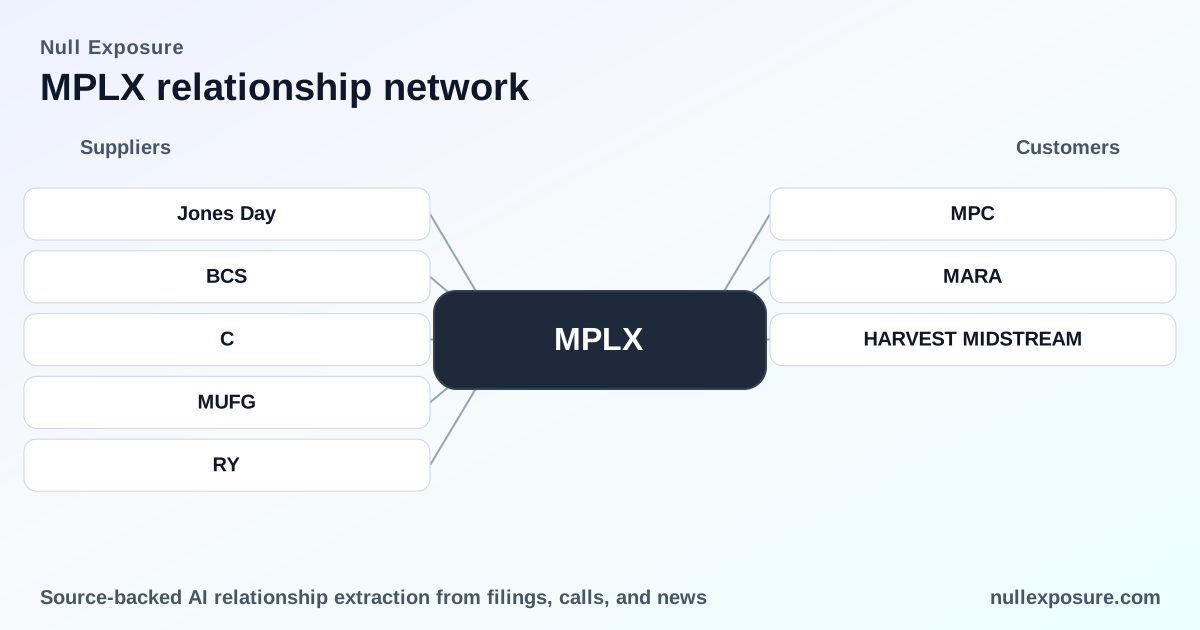
Below are the primary customer and counterparty relationships surfaced in public reporting and market coverage. Each entry includes a concise plain-English summary and the source context.
MPC (ticker: MPC)
MPC functions as MPLX’s strategic sponsor and the largest commercial counterparty, accounting for roughly half of MPLX’s total revenues and owning approximately 64% of MPLX’s outstanding common units as of December 31, 2025. Long-term minimum-volume commitments to MPC drive a significant share of crude pipeline and terminal throughput and are a principal source of fee revenue. Source: TradingView summary of MPLX’s FY2026 10‑K filing (reported Mar 2026).
Marathon Petroleum / Marathon Petroleum Corporation
Marathon Petroleum, frequently referenced interchangeably with MPC in public coverage, supplies the majority of crude pipeline volumes and terminal throughput under long-term contracts—public commentary puts figures like ~58% of crude pipeline volumes and ~69% of terminal throughput tied to the Marathon relationship. Analysts and coverage highlight MPLX’s role as a stable EBITDA generator for Marathon’s refining system. Source: GuruFocus/TradingView commentary summarizing FY2026 coverage and industry press (Mar 2026) and sector analyst notes (InsiderMonkey, Sahm Capital, FY2026).
(Notes: multiple news items and analyst write-ups refer to Marathon Petroleum and MPC interchangeably; the financial disclosures and market reports treat the sponsor and its operating company as the dominant customer.)
Harvest Midstream Company / HARVEST MIDSTREAM
Harvest Midstream closed a purchase of Rockies gathering and processing assets from MPLX in a transaction reported as roughly $1 billion, reflecting MPLX’s active portfolio management and occasional asset divestitures that reshape customer and asset exposure. The transaction reduces MPLX’s Rockies presence while crystallizing proceeds that can redeploy into fee-based infrastructure. Source: PR and market reporting summarized on Finviz and SimplyWallSt (FY2026).
MARA / MARA Holdings
MPLX has engaged MARA Holdings in commercial talks and a letter of intent to supply natural gas from the Delaware Basin for gas-fired power generation and data center campuses in West Texas; the discussion outlined initial capacity around 400 MW with potential scalability to 1.5 GW, subject to definitive agreements and approvals. This LOI signals MPLX’s strategic pursuit of growing demand from power and data-center loads as a new long-term commercial channel. Source: Regional business report and coverage summarized on TS2.Tech and InsiderMonkey referencing Nov 2025–Mar 2026 LOI reporting.
Contract characteristics and relationship maturity — what investors should focus on
- Long-term, auto-renewing tenor is the default: MPLX emphasizes multi-year fee contracts that automatically renew unless terminated, providing structural cash-flow visibility. This contracting posture supports distribution coverage and capital planning. (Company disclosure excerpts summarized in FY2026 reporting.)
- Maturity and renewal behavior are mixed: The company reports a blend of mature, long-standing relationships with producers and integrated buyers alongside contracts that renew on shorter cycles; overall the portfolio skews toward mature, renewing commercial ties across major U.S. basins.
- Role diversity reduces single-mode exposure: MPLX functions as seller of services, buyer of certain feedstocks under commercial arrangements, distributor and service provider—revenue is derived from logistical and service fees rather than speculative commodity positions, which enhances margin stability.
Risk vector synthesis for investors
- Counterparty concentration is the prime operational risk. The sponsor-related relationship supplies a large portion of volumes and ties distribution policy to sponsor economics; if volumes decline the impact to distributions will be material. (Company statements in FY2026 filings identify this exposure explicitly.)
- Contract length reduces volatility but locks in volume profiles. Long-term minimum-volume commitments protect throughput but limit upside if regional production shifts or demand patterns change rapidly.
- Asset divestitures and commercial diversification are active levers. The Rockies sale to Harvest and LOI work with MARA indicate management is both monetizing non-core assets and pursuing new demand channels (e.g., data centers), which rebalances long-term cash flow composition.
Investment takeaway
MPLX offers a high-yield, fee-based midstream exposure with stable cash flow driven by long-term contracts and a dominant sponsor relationship. That same sponsor concentration is the firm’s principal single-point risk—investors should underwrite distribution durability against scenarios of reduced sponsor volumes. For analysts and operators evaluating counterparty risk and contract tenure, MPLX’s public filings and multiple market reports provide consistent confirmation of both the revenue concentration and the long-dated nature of key agreements.
For further relationship-level diligence and benchmark comparisons, visit https://nullexposure.com/ to explore structured coverage and source-level references.