Mega Matrix Corp. (MPU) — Customer Relationship Briefing for Investors
Thesis: Mega Matrix Corp. operates as a small, Web3-focused entertainment and fintech integrator that monetizes through advisory services, token treasury management, and RWA (real-world asset) product development; the company is building commercial relationships with stablecoin issuers, DeFi platforms, and a Middle East RWA partner to support treasury diversification and fee-bearing advisory work. Investors should view MPU as an early-stage, treasury-centric operator whose commercial ties are strategic inputs to liquidity management and fee generation rather than large, recurring enterprise contracts. For more coverage of MPU’s partner footprint, visit https://nullexposure.com/.
Market context and company health Mega Matrix is a micro-cap issuer headquartered in Palo Alto with a market capitalization around $41.6 million and trailing revenue of roughly $26.1 million (TTM). The company is operating at a loss — negative EBITDA and operating margins indicate early-stage scaling and capital deployment into product and treasury strategies — which frames its partner relationships as critical execution levers for both balance-sheet optimization and future revenue streams (company financials, FY2025-FY2026).
What investors need to know about MPU’s business model and contracting posture Mega Matrix’s recent public disclosures and press coverage show a hybrid monetization model:
- Advisory and structuring fees tied to RWA launches and Shariah-compliant financial products.
- Treasury optimization via multi-stablecoin holdings and selective DeFi yield strategies that generate realized returns or reduce funding costs.
- Strategic partnerships that support go-to-market for tokenized assets and exchanges, which create potential fee pools but require execution and regulatory navigation.
From these signals, infer the following operating characteristics: low institutional share and concentrated insider ownership suggest a founder/investor-driven governance posture; partnerships are tactical and project-based rather than long-term enterprise contracts; commercial maturity is early — counterparty criticality is moderate-to-high for short-term liquidity and product launches but not yet core to large recurring revenue. There are no recorded contractual constraints in the relationship dataset that change that assessment.
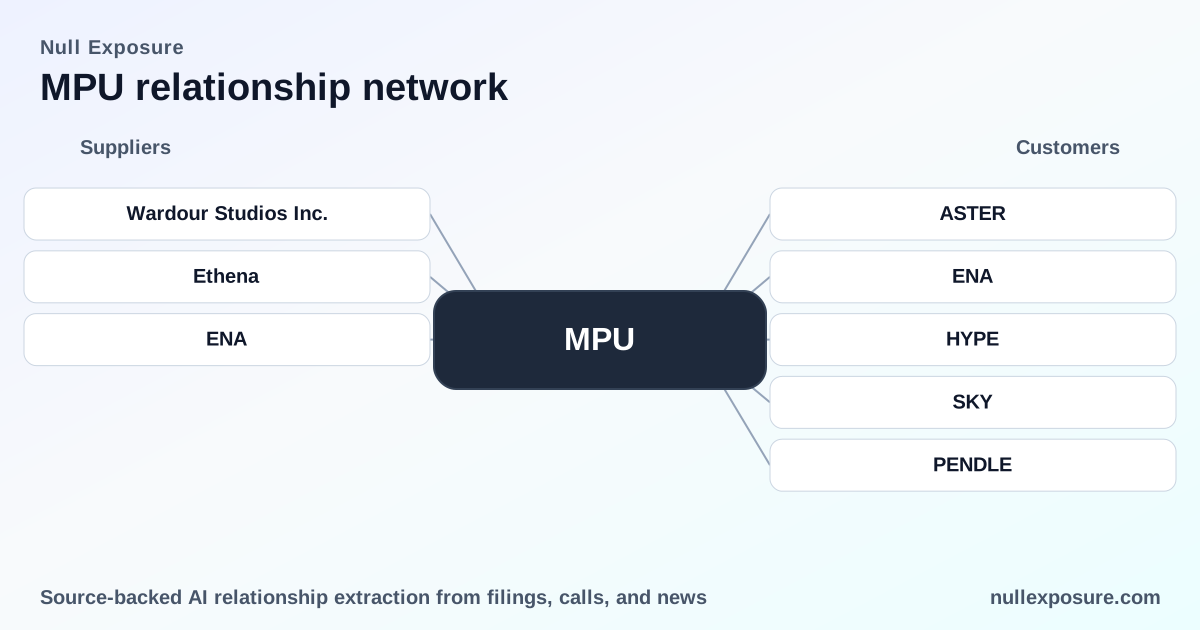
Why the partner list matters Mega Matrix’s partner set splits into two functional groups: (1) stablecoin issuers and DeFi platforms used for treasury allocation and yield; and (2) a strategic RWA partner in the Middle East for product development and capital-raising advisory. These relationships signal MPU’s effort to simultaneously manage liquidity risk and seed future fee-bearing business lines tied to tokenized commodities and compliant finance.
Relationship snapshots — what each partner contributes Below are concise investor-ready summaries of every named relationship in the results, with source context.
Sky Protocol (SKY)
Mega Matrix added SKY (Sky Protocol) to an expanded multi-stablecoin treasury allocation as part of a broader diversification strategy announced in March 2026. This positions SKY tokens as one component of MPU’s liquidity mix for treasury stabilization and potential on-chain yield. Source: CryptoNews report, March 10, 2026 (https://cryptonews.com/news/mega-matrix-expands-2b-multi-stablecoin-treasury/).
Ethena (ENA)
ENA from the Ethena ecosystem is listed among stablecoins Mega Matrix will hold under its revised treasury strategy, indicating MPU allocates a portion of liquidity to algorithmic or protocol-backed USD-pegged instruments. This is a treasury-management placement rather than a commercial-offtake contract. Source: CryptoNews report, March 10, 2026 (https://cryptonews.com/news/mega-matrix-expands-2b-multi-stablecoin-treasury/).
Hyperliquid / HYPE
Mega Matrix disclosed holding USDH and HYPE from Hyperliquid as part of the same treasury expansion, signaling exposure to a market-making / liquidity-focused platform token in pursuit of yield and market access. Inclusion of HYPE suggests MPU is balancing custody and on-chain liquidity objectives. Source: CryptoNews report, March 10, 2026 (https://cryptonews.com/news/mega-matrix-expands-2b-multi-stablecoin-treasury/).
Aster (ASTER)
Aster’s token is specified in MPU’s expanded multi-stablecoin holdings, consistent with a diversified approach that includes protocol-native stablecoins and tokenized USD alternatives to optimize treasury composition. This allocation supports short-duration yield strategies and reduces single-provider concentration in the treasury. Source: CryptoNews report, March 10, 2026 (https://cryptonews.com/news/mega-matrix-expands-2b-multi-stablecoin-treasury/).
Pendle (PENDLE)
Mega Matrix will allocate a portion of its stablecoin portfolio to low-risk DeFi activities such as staking and yield locking on platforms including Pendle, indicating direct operational use of DeFi composability to generate incremental returns on idle liquidity. This is a treasury yield tactic rather than a customer-supplier revenue partnership. Source: CryptoNews report, March 10, 2026 (https://cryptonews.com/news/mega-matrix-expands-2b-multi-stablecoin-treasury/).
Ihsan Dhahab Sdn Bhd
On January 7, 2026, MPU entered a memorandum of understanding with Ihsan Dhahab Sdn Bhd to finance and operate a precious-metals special economic zone in Saudi Arabia, develop Shariah-compliant gold-backed tokens and stablecoins, and provide advisory support for capital raising and financing. This is a strategic RWA and product-development relationship positioned to create fee-bearing advisory work and potential equity or financing opportunities. Source: MarketScreener and Barchart reports, May 3, 2026 (https://www.marketscreener.com/news/mega-matrix-partners-with-ihsan-dhahab-sdn-bhd-to-develop-an-islamic-precious-metals-real-world-asse-ce7e59d2d98df123; https://www.barchart.com/story/news/36960371/mega-matrix-partners-with-ihsan-dhahab-to-develop-an-islamic-precious-metals-real-world-asset-ecosystem).
What this relationship map implies for valuation and risk
- Revenue optionality vs. execution risk: The Ihsan Dhahab MOU is the highest-potential commercial tie because it targets RWA product fees and capital formation; however, MOUs require regulatory and commercial execution before they convert to meaningful revenue. The stablecoin and DeFi relationships are liquidity and yield tools that improve treasury efficiency but do not on their own guarantee durable top-line growth.
- Concentration and counterparty risk: The treasury approach deliberately diversifies across multiple token issuers and platforms, which reduces single-counterparty concentration but increases operational complexity and custodial risk. Investors should treat token holdings as part of balance-sheet strategy rather than sales contracts.
- Contracting posture and maturity: Partnerships are largely project/MOU-based or treasury allocations — projected to be tactical, modular, and short- to medium-term in horizon. The company’s negative operating margins and small market cap underscore the need for successful monetization of the Ihsan Dhahab initiative and disciplined treasury returns to improve fundamentals.
Key takeaways for operators and research teams
- MPU is executing a two-track strategy: (1) optimize treasury with multi-stablecoin holdings and low-risk DeFi yield, and (2) build fee-bearing RWA products through regional partners. Both tracks are necessary to move the company from balance-sheet management to revenue maturity.
- Partnerships are strategic but early-stage; the Ihsan Dhahab MOU is the most material business-development event for future revenues, while the DeFi/tokens are liquidity levers.
- Risk profile centers on execution and custody: regulatory, counterparty, and custody risks are paramount given token holdings and planned RWA deployments.
For a quick overview of MPU’s partner footprint and to track updates to these commercial links, see our central coverage at https://nullexposure.com/. For a deeper briefing or custom diligence on MPU’s counterparty arrangements, contact our research desk through the homepage.