Marqeta (MQ): Customer Relationships Drive Valuation and Risk
Marqeta operates a cloud-based card issuing and transaction processing platform that signs and operates payment programs for fintechs and merchants, monetizing through card issuance fees, transaction processing revenue, and platform services. Revenue is concentrated in a small set of large customers whose programs Marqeta both issues and operates, so contract renewals and program stability directly determine growth visibility and margin expansion. Explore deeper customer signals at https://nullexposure.com/.
The investor thesis in one line
Marqeta is a platform-as-a-service for modern card programs: it sells issuer-processor capabilities and program management to fintechs and merchants, and its economics are driven by payment volume on customer programs and the holding power of a few large partners.
Why customer relationships determine MQ’s upside and downside
Marqeta’s growth profile is not generalized product-market penetration — it is program-driven. The company signs multi-year commercial arrangements that can be large, granular, and operationally deep: Marqeta runs issuing programs on behalf of partners and therefore revenue scales with partner transaction volume but is also highly sensitive to contract structure and renewal terms.
- Concentration is the defining risk. Public reporting and market coverage show Block/Square accounts for a material share of revenue (reported as 45% of net revenue in 2025), making Marqeta economically dependent on one core partner. (TradingView summary of Marqeta SEC filing, FY2026).
- Operational criticality is high for major partners. For large customers Marqeta is issuer, processor, and program manager — a role that increases switching friction but also exposes Marqeta to negotiation pressure on pricing and concessions. (Marqeta FY2024 10‑K).
- Global service footprint and product positioning. Marqeta presents itself as a single global platform delivering card issuing and transaction processing services — a company-level signal supporting cross-border scale but also regulatory and integration complexity. (Company reporting, FY disclosures).
If you are modeling MQ, treat new program wins as high-value optionality but stress-test gross retention, renewal concessions, and the sensitivity of margins to volume mix.
Explore customer contract intelligence and filings at https://nullexposure.com/ for a commercial view of concentration dynamics.
Customer roll call: what every relationship on file tells investors
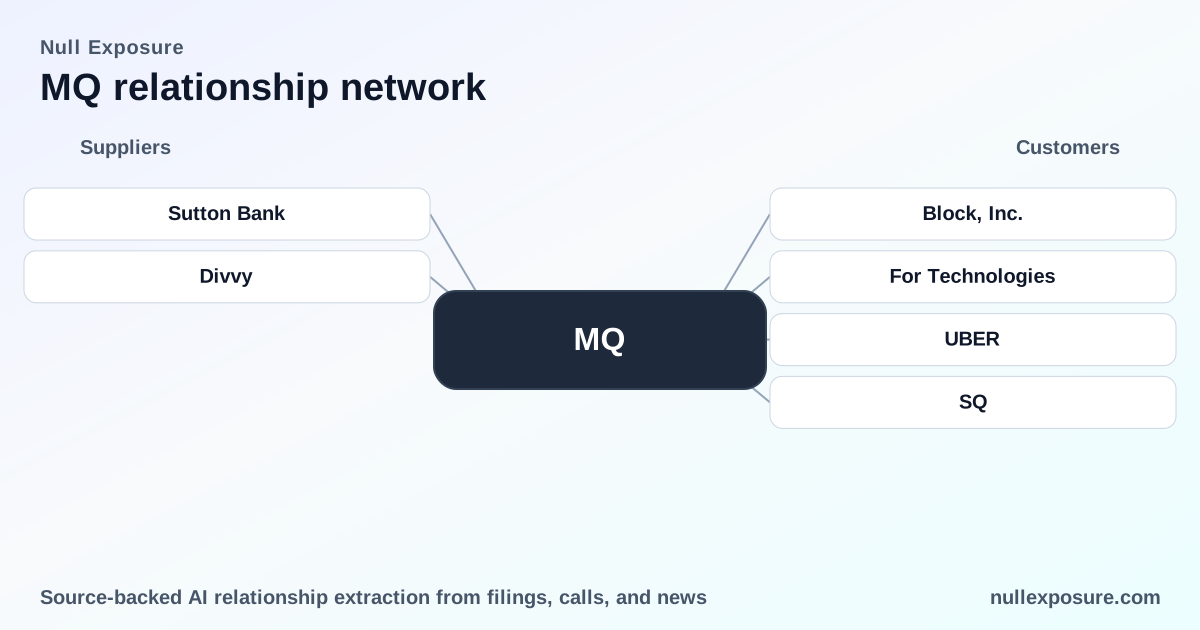
Below are every customer relationship surfaced in the coverage set, with a concise, source-linked note for each.
For Technologies
Marqeta announced on its Q4 2025 earnings call that For Technologies, a BNPL provider split-pay product, is moving its business to Marqeta as it seeks a technology partner to support growth ambitions. (MQ Q4 2025 earnings call, first mentioned 2026-03-07).
Block, Inc. (and Square/Cash App programs)
Marqeta’s FY2024 10‑K states the company manages Block’s Cash App, Square Debit Card, and Square Card Canada issuing programs, underscoring a deep operational relationship where Marqeta acts as issuer and program manager. (Marqeta 10‑K, filed for FY2024).
SQ (market coverage referring to Block)
Market analysts and news reports reiterate that Block/SQ remains Marqeta’s largest customer and that renewals materially affect Marqeta’s near-term revenue outlook; one coverage note cites renewals that reduced immediate downside risk while also reflecting prior concessions. (Morningstar coverage; TradingView summary of Marqeta SEC filing, FY2023–FY2026 commentary).
Uber / UBER
On the company’s Q4 2025 earnings call Marqeta identified Uber as a long‑standing customer, illustrating a cohort of large-scale, established programs that provide recurring transaction volume. (MQ Q4 2025 earnings call, 2026-03-07).
SEZL (Sezzle)
Multiple press releases in 2026 report that Sezzle launched a virtual Visa card in Canada that is powered by Marqeta’s card-issuing platform, extending Sezzle’s BNPL product into in‑store and wallet-based payments. This is a concrete program win in the BNPL segment. (Sezzle press release via GlobeNewswire and related coverage, April–May 2026; Investing.com report, FY2026).
Cash App (separate market mention)
Market commentary noted analyst concern about Cash App’s potential issuer transition and the implications for Marqeta, a signal investors should treat as execution and renewal risk given Cash App’s importance within the Block relationship. (Investing.com coverage referencing Wolfe Research commentary, FY2026).
Operational and business-model constraints that matter to financial modeling
Present company-level signals from filings and corporate messaging that shape contract dynamics and valuation assumptions:
- Global platform posture: Marqeta frames its offering as a single, global card issuing and transaction processing platform — this implies revenue potential from multi-jurisdiction scaling but requires product and compliance investment. (Company filings).
- Service-provider role: Marqeta routinely serves as issuer‑processor and card program manager for most customers; that contracting posture increases client stickiness but also concentrates operational risk. (Company disclosures).
- Hybrid software + services revenue mix: The business combines platform software economics with services and program operations, so margin profile depends on the mix of high-volume program processing versus one-off integration or support revenues. (Company statements).
- Concentration and maturity signals: Public filings and market reports highlight that a single partner generated a very large share of revenue in 2025 (45%); simultaneously, marquee, long-term customers like Uber demonstrate program maturity that supports stable volume outside the largest account. (SEC filing summaries, FY2025–FY2026; Q4 2025 earnings call).
- Historical spend signal: Filings indicate discrete non‑material revenue lines (for example, $2.7 million earned from a private company in a prior year), a reminder that Marqeta’s customer base contains both enterprise-scale programs and smaller pilot or regional customers. (Company FY disclosures).
Investment takeaways
- Primary value driver: retention and volume growth on large issuing programs (Block, Uber, Sezzle, and new BNPL partners).
- Primary risk: customer concentration and renewal concessions that compress near-term growth and margins.
- Operational leverage: converting pilot and regional program wins into higher-volume, globally scaled programs is the path to margin expansion.
For investors and operators modeling MQ, focus on customer-specific volume trajectories, contract tenure and termination terms, and evidence of program diversification. For a structured customer intelligence package and filing-backed analysis, visit https://nullexposure.com/.
Bold bets on program growth will pay off only if Marqeta sustains high retention at scale — the company’s future is the sum of its customer programs.