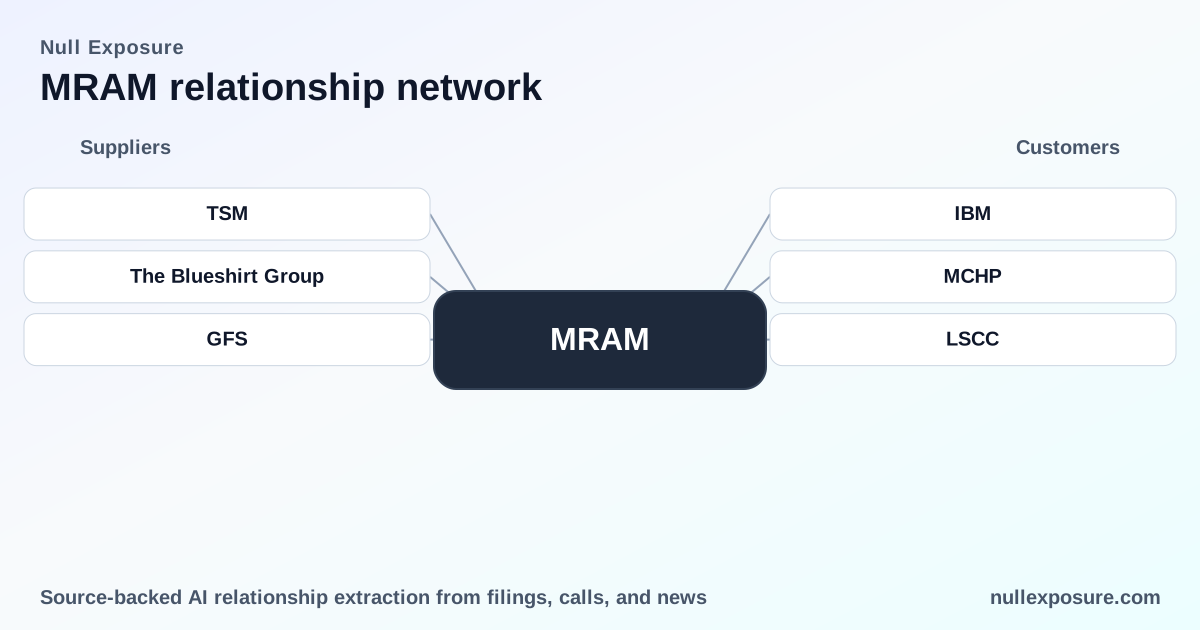
Everspin (MRAM) — Customer relationships that underpin persistent-memory commercialization
Everspin Technologies manufactures and sells MRAM components and captures revenue through product sales, licensing/royalties and design/backend services to OEMs, ODMs, and large systems integrators. The company’s commercial strategy combines short‑cycle discrete-component sales through distributors with strategic design‑wins at hyperscalers and tier‑one customers that convert into higher‑value, recurring license and module opportunities. For deeper counterparty intelligence on this coverage, visit https://nullexposure.com/.
What investors should focus on: commercial drivers and contract posture
Everspin operates as a hybrid components-and‑IP business. Product sales are the revenue foundation—discrete MRAM units distributed globally—while licensing and royalties provide a complementary, higher-margin stream tied to the firm’s IP estate. Public disclosures show that product contracts are generally short‑term (under one year) and revenue recognition for OEM/ODM shipments occurs at a point in time upon shipment, which creates a sales cadence that tracks design‑wins rather than long multi‑year supply contracts.
- Concentration and go‑to‑market: The company sells directly and through distributors; distributor channels account for a material portion of reported revenue, signaling dependence on channel execution for volume.
- Geographic footprint: Revenue is distributed across APAC, EMEA and North America, with APAC historically the largest region, making global customer wins essential to scale.
- Criticality and maturity: Relationships with hyperscalers and storage OEMs elevate MRAM from component to system‑level criticality when Everspin’s parts are integrated into storage modules and RAID references, supporting stickier downstream engagements.
- Contracting posture: Short product contracts coexist with licensing deals and R&D subcontracting for government programs—this mix produces revenue volatility but preserves upside when design‑wins convert to module or licensed solutions.
Key customer relationships (what the transcripts and press reveal)
Below are concise, investor‑oriented descriptions of every customer relationship captured in the public signals, with source context.
Microchip Technology (MCHP)
Everspin has qualified its PERSYST 64‑Mbit xSPI STT‑MRAM for Microchip’s PIC64‑HPSC series, indicating a design‑win into Microchip’s 64‑bit MPU ecosystem and active support for component qualification. This qualification positions Everspin to gain volume via Microchip’s customer base. Source: Everspin Q4 2025 earnings call (referenced March 7, 2026) and subsequent press coverage (Motley Fool/Globe and Mail, March 2026).
IBM
IBM is a strategic systems partner: Everspin’s ST‑DDR products are shipping to IBM and the PERSYST 1Gb STT‑MRAM was selected for IBM’s FlashCore Module 4, while ongoing work with IBM on FCM4 and FCM5 modules is cited as a driver of data‑center revenue. These module integrations embed Everspin components at the storage‑system level, increasing stickiness and potential volume. Source: Everspin Q4 2025 and Q1 2026 earnings commentary (March–May 2026) and a 2024 press release noting IBM’s selection of the PERSYST EMD4E001G (Markets/FinancialContent, April 2024).
Lattice Semiconductor (LSCC) / Lattice
Everspin reports two partner programs of focus, one with Lattice, where management describes steady progress toward qualification and integration of MRAM into Lattice’s standard offering—an outcome that would embed MRAM into FPGA and edge‑compute platforms. Source: Q4 2025 earnings discussion and related March 2026 press coverage (Motley Fool/InsiderMonkey).
Amentum Services Inc.
Everspin signed on as a subcontractor with Amentum to support a U.S. government Microelectronics RDT&E program at the Naval Surface Warfare Center, Crane Division, effectively positioning the company within funded government R&D and testing work. The engagement is presented in regulatory filings and press reporting as part of a larger contract structure. Source: Regulatory filing and press reports (Investing.com coverage of SEC filing and TS2.Tech, May 2026).
Schneider Electric
Schneider Electric selected Everspin MRAM for its Modicon M580 ePAC platform, signaling adoption in industrial control systems and programmable automation controllers—an end‑market that values non‑volatile memory reliability. This placement supports Everspin’s push into industrial OEMs. Source: NewElectronics product announcement (May 2026).
What these relationships mean for valuation and risk
- Upside: System integrations (IBM’s FlashCore modules, Schneider industrial controllers) create pathways from discrete sales to module‑level revenues and licensing, improving margins and customer stickiness. Design‑win momentum with Microchip and Lattice opens broader TAM access if qualifications convert to volume.
- Revenue volatility: The predominant short‑term nature of product contracts limits revenue visibility; sales depend on the cadence of design wins and distributor execution. Distributor sales are material, so channel health is a key risk factor for near‑term revenue.
- Customer mix: Public signals show a mix of large enterprise customers and government subcontracting, diversifying end markets but preserving reliance on a handful of strategic partners for outsized growth.
Operating constraints and company‑level signals for investors
Everspin’s public documentation and transcripts collectively reveal the following operational characteristics that affect partner risk and commercial scaling:
- Contracting posture: Product contracts are generally short‑term and recognized at shipment; licensing and royalties supplement product sales.
- Channel dependence: A significant share of revenue flows through distributors; distribution concentration is a material company‑level signal.
- Geographic distribution: Revenue is materially present in APAC, EMEA and North America, with APAC historically leading—global market coverage is required to sustain growth.
- Relationship lifecycle: The company tracks leads through prospect → design‑in → design‑win → production, indicating a pipeline sales model where many partnerships are in mid‑to‑late development stages.
- Segment mix: Core product sales dominate, with services and backend foundry/design services providing incremental revenue and customer‑specific engineering engagement.
Bottom line: where investor attention should land
Everspin’s near‑term performance is a function of converting current design‑wins into production volume (Microchip, Lattice) and deepening system‑level relationships (IBM, Schneider) that convert discrete sales into module and licensing economics. Monitor qualification milestones at Microchip and Lattice, module adoption at IBM, and government program deliverables through Amentum for visibility into revenue trajectory and margin expansion. For a more detailed counterparty map and monitoring of these partnerships, see https://nullexposure.com/.
Bold takeaways: Everspin monetizes via both high‑frequency product sales and higher‑margin IP/service channels; major customer integrations (IBM, Microchip, Schneider) materially improve the path to repeatable, higher‑value revenue, but the short‑term contract profile and distributor reliance keep near‑term visibility constrained.