MRCC Customer Relationships: Monroe Capital, HRZN, QRHC and what investors should price in
Monroe Capital Corporation (MRCC) operates as a specialty finance vehicle that originates and holds long-duration loans to lower middle-market companies, monetizing primarily through interest income, origination and management fees, and leverage on credit facilities. Its business model is built around multi-year lending relationships with service-oriented mid-market borrowers in North America, and the company’s recent corporate actions (asset sale/merger activity) materially reshape the cadence and support structure behind that lending platform. For a concise, signal-driven view of MRCC counterparties and implications for credit and revenue stability, visit https://nullexposure.com/.
Why these relationships matter to equity and credit investors
MRCC’s value is driven by three interlinked dynamics: contract tenor (3–7 year loan maturities), borrower profile (lower middle-market borrowers in services industries), and platform support and consolidation (Monroe and related vehicle activity). The relationships described below are not peripheral — they collectively show a lender that is consolidating adviser support, restructuring asset ownership, and directly managing borrower covenants and credit extensions. These are operationally critical items for valuation and downside protection.
Customer relationships: concise, verifiable summaries
HTFC — Adviser support post-merger
Horizon Technology Finance Management (HTFC) is referenced as receiving ongoing support from Monroe Capital following a merger, indicating continued platform-level backing for the business that managed Horizon’s lending activities. According to HTFC’s Q4 2025 earnings call transcript (filed March 7, 2026), “Monroe Capital, which is the parent company of Horizon Technology Finance Management, will be continuing to provide ongoing support to the post-merger company.” (HTFC earnings call, March 7, 2026)
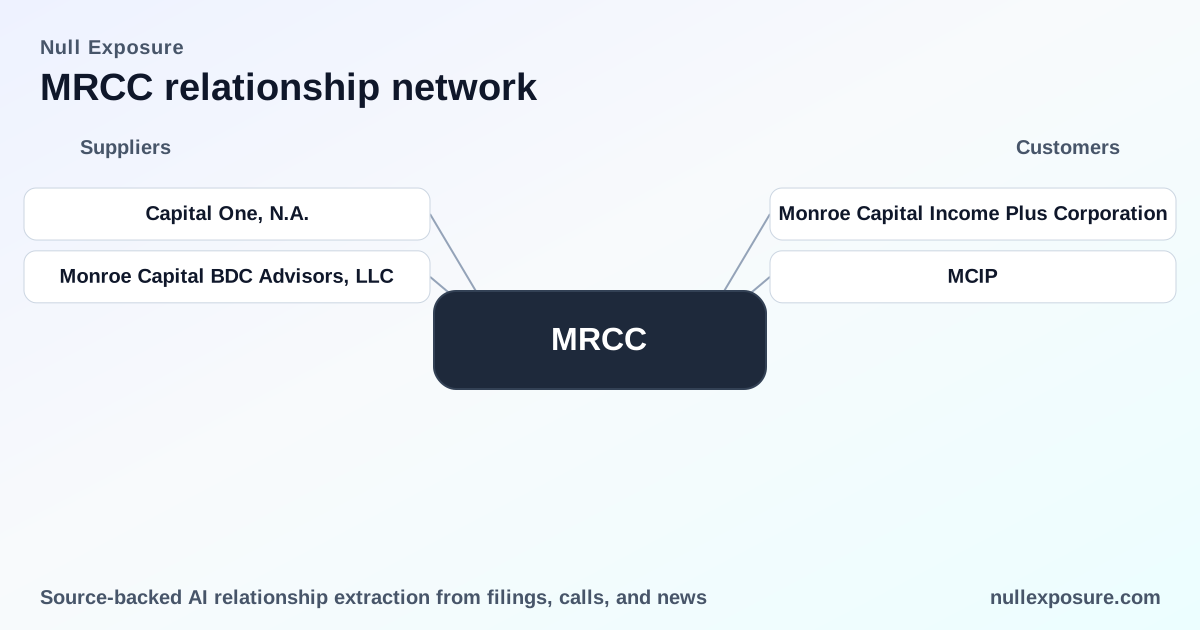
Monroe Capital Income Plus Corporation (MCIP) — Asset-sale counterparty and merger vehicle
MRCC has a proposed asset sale to MCIP that is linked to a subsequent merger with HRZN; completion of each transaction is contingent on the other, demonstrating corporate-level interdependence that will reallocate assets and advisory relationships. This is documented in a GlobeNewswire release and corroborated by secondary coverage noting the joint proxy and conditional nature of the transactions (GlobeNewswire release, March 5, 2026; Bitget news note, March 10, 2026).
HRZN (Horizon Technology Finance Corporation) — Strategic adviser and merger partner
Horizon Technology Finance (HRZN) is cited as being externally managed by Horizon Technology Finance Management LLC, now an affiliate of Monroe, giving MRCC indirect exposure to venture-debt origination capability and platform synergies following adviser consolidation. Investing.com and related press coverage note that the adviser’s sale to Monroe expands origination capacity and platform access for HRZN (Investing.com earnings coverage, May 3, 2026; Yahoo Finance press release, May 3, 2026).
QRHC (Quest Resource Holding Corporation) — Direct borrower with covenant negotiations
Quest Resource has borrower-level interactions with Monroe Capital as the lender: QRHC negotiated covenant and leverage easements with Monroe across 2026–2027, and prior agreements increased borrowing capacity under Monroe’s facility. A Motley Markets/Globe and Mail transcript reports the negotiated covenant easements (May 3, 2026), while earlier disclosure (GlobeNewswire, 2021) documents an amended lending agreement that increased facilities up to $75 million and improved terms. These items together indicate a borrowing relationship where Monroe exercises active covenant and facility management (Globe and Mail/Motley transcript, May 3, 2026; GlobeNewswire release, Dec 8, 2021).
How these relationships inform MRCC’s operating posture
The relationship set reveals a lender that operates as a long-term financier to mid-market service companies in North America and that uses adviser and subsidiary transactions to concentrate or reallocate origination and management capabilities. Key operating signals:
- Contracting posture: MRCC’s investments are structured with multi-year maturities (typically three to seven years), implying predictable interest income and credit duration that support NAV stability under normal conditions. Evidence for multi-year tenors is explicit in MRCC’s documented investment structure language.
- Counterparty profile and credit concentration: MRCC targets lower middle-market counterparties, which concentrates idiosyncratic credit risk but can sustain higher yields relative to larger corporate credits.
- Geographic concentration: The book is materially North American-centric (United States and Canada), which concentrates macro and regulatory exposure to those jurisdictions.
- Relationship role and segment: MRCC functions as a buyer/lender in the services segment, positioning it as a direct credit provider rather than a marketplace or broker, which raises counterparty monitoring and workout execution importance.
Implications for investors — risk and opportunity
- Opportunity: Long-term loan maturities and platform consolidation under Monroe potentially create scale benefits in origination and credit underwriting, improving future earnings visibility and fee capture.
- Risk: The conditional asset sale/merger structure with MCIP and HRZN concentrates execution risk into a two-step corporate transaction; failure or delay would create near-term strategic uncertainty. Active covenant negotiations with borrowers such as QRHC show that MRCC is willing to extend tailored relief, which supports portfolio preservation but can compress yields or delay recoveries in stressed credits.
- Credit management: Monroe’s visible role in providing ongoing support to HRZN/HTFC suggests operational backstops for the adviser platform, but also increases interconnectedness across MRCC’s managed assets.
Bottom line and investor action points
MRCC presents a structured, long-tenor lending profile to mid-market North American services companies, with recent corporate transactions concentrating platform control under Monroe and related vehicles. Investors should weigh the stability provided by multi-year contracts and platform support against transaction execution risk and concentrated borrower credit profiles.
For a structured signal view and deeper tracking of MRCC counterparties, visit https://nullexposure.com/.
Bold takeaway: MRCC’s earnings and NAV trajectory will be driven by loan performance across mid-market borrowers and the successful execution of the MCIP/HRZN asset sale/merger pathway.