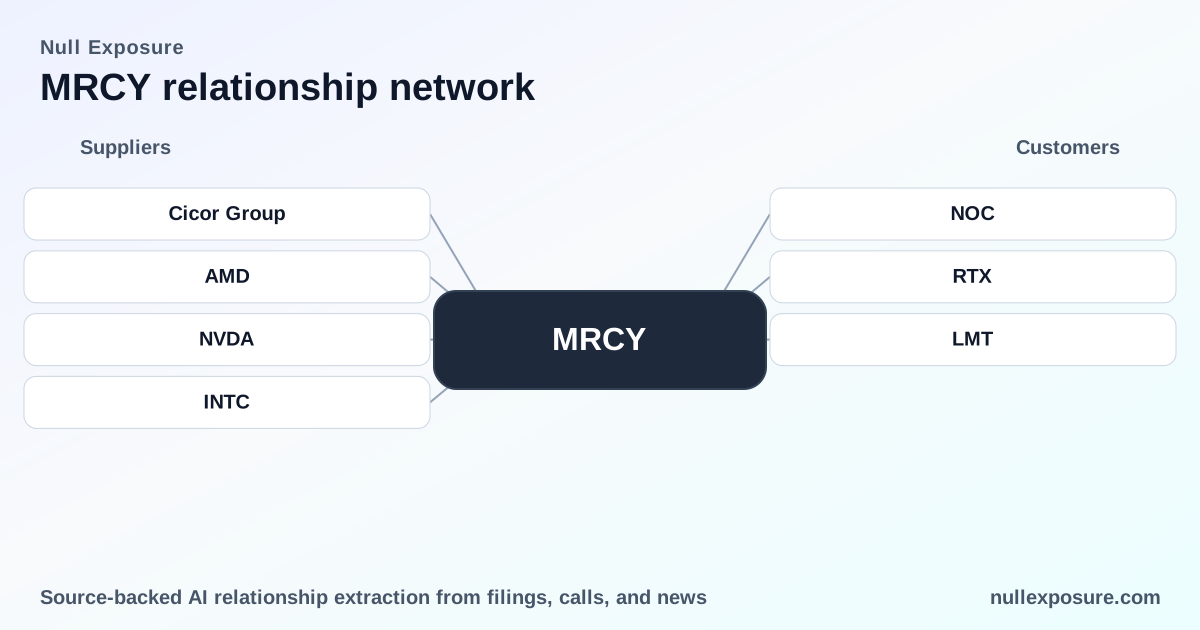
Mercury Systems (MRCY) — Customer Relationships and What They Mean for Returns
Mercury Systems manufactures mission‑critical hardware — high‑reliability components, modules and subsystems — and monetizes by selling those products and related engineering services primarily to U.S. defense prime contractors and the U.S. government. Revenue is concentrated in hardware sales as a subcontractor to the largest defense primes and through direct government programs, with multi‑year backlog and remaining performance obligations supporting near‑term visibility. For deeper company relationship analytics visit https://nullexposure.com/.
How Mercury operates today: primes, programs, and product economics
Mercury is a supplier of radiation‑tolerant, high‑performance processing and storage hardware used in aerospace, space and defense systems. The company’s operating posture is that of a specialized subcontractor to very large enterprise primes and government agencies, supplying components and subsystems that are difficult to re‑source quickly. This drives a business model with:
- High customer concentration: a small number of prime contractors and DoD programs account for a disproportionate share of revenue.
- Critical product positioning: components are integral to mission systems (e.g., solid‑state data recorders), elevating technical stickiness and long replacement cycles.
- Predictable near‑term revenue: backlog and remaining performance obligations provide revenue visibility, with the company reporting material amounts of deliverables on the books as of late FY2025.
- North American centricity with selective global footprints: operations and revenues are primarily U.S.‑based, supported by foreign subsidiaries and program deployments across allies.
These operational characteristics create a mix of defensive demand under government budgets and sensitivity to prime procurement cycles and program awards.
Operating constraints and company‑level signals
The company data and filings point to a clear set of constraints and strengths for investors:
- Contracting posture — subcontractor to primes and direct government sales: Mercury explicitly sells to “top U.S. and European defense prime contractors, the U.S. government and OEM aerospace companies,” reflecting a supplier relationship to the largest defense integrators.
- Customer concentration and materiality: Mercury derives roughly 95–97% of revenues from DoD programs and prime contractors across fiscal 2023–2025, signaling revenue concentration that magnifies program wins and losses.
- Geography and reach: Operations are primarily U.S.‑centric (North America) while products are deployed across more than 35 countries and 300 programs, supporting global strategic customers.
- Product mix and margin profile: The business is hardware‑led; services are less than 10% of revenues, meaning margins and working capital are tied to manufacturing scale and production rates.
- Revenue visibility and maturity: Aggregate remaining performance obligations reported as of June 27, 2025, provide near‑term revenue recognition visibility, with about half expected to convert within 12 months.
(These points derive from Mercury’s public disclosures and filings summarizing customer segments, international sales, and remaining performance obligations in FY2023–FY2025.)
Customer relationships: wins, primes, and partners
Below are the named customer/partner relationships surfaced in recent reporting and market commentary, with concise summaries and source citations.
L3Harris Technologies (LHX)
Mercury was awarded a contract to supply radiation‑tolerant solid‑state data recorders (SSDRs) for the U.S. Space Development Agency’s Tranche 3 Tracking Layer, extending its role across multiple SDA tranches and reinforcing space‑qualified product leadership. Source: Mercury press release and multiple coverage including GlobeNewswire and FinViz (Apr 2026 / Mar–Apr 2026) — https://www.globenewswire.com/news-release/2026/04/02/3267213/18849/en/l3harris-selects-mercury-to-provide-solid-state-data-recorders-for-sda-s-tranche-3-tracking-layer-satellites.html
L3Harris Technologies Inc. (variant listing)
Market reports repeated the L3Harris award in April 2026, highlighting Mercury’s SSDR deliveries for SDA Tranche 3 and noting prior tranche deliveries that support recurring program scope. Source: Sahm Capital coverage on the contract announcement (Apr 2026) — https://www.sahmcapital.com/news/content/l3harris-taps-mercury-for-critical-satellite-hardware-2026-04-02
L3Harris / press aggregates (multiple stories)
Financial and investor outlets tracked the L3Harris win as a material program award that catalyzed investor attention in early 2026; coverage emphasized Mercury’s role in the Proliferated Warfighter Space Architecture. Source: Simply Wall St and Trading outlets (Apr–May 2026) — https://simplywall.st/stocks/us/capital-goods/nasdaq-mrcy/mercury-systems/news/a-look-at-mercury-systems-mrcy-valuation-after-new-sda-tranc
FEIM (Frequency Electronics)
Industry commentary linked Mercury’s AI‑driven sensor processing units to precise timing components provided by Frequency Electronics, noting renewed adoption in electronic warfare suites where timing is critical. This highlights supplier interdependence in signal timing for Mercury’s systems. Source: MarketMinute / FinancialContent (Mar 2026) — https://markets.financialcontent.com/franklincredit/article/marketminute-2026-1-8-precision-timing-in-the-crosshairs-frequency-electronics-hits-new-1-year-high-on-defense-surge
Lockheed Martin (LMT / Lockheed Martin Corporation)
Lockheed Martin is cited as both a long‑standing customer and an occasional competitor when prime contractors internalize subsystem work; Lockheed is named among Mercury’s key prime customers. Source: Coverage of Mercury’s SEC filings via TradingView summarizing the 10‑Q (FY2026) — https://www.tradingview.com/news/tradingview:5215b9cbcd746:0-mercury-systems-inc-sec-10-q-report/
Raytheon / RTX (RTX / RTX Corporation)
Raytheon (RTX) is similarly listed among the prime contractors that buy Mercury hardware but also represents a competitive dynamic when primes perform subsystem work internally; Mercury identifies primes like Raytheon as key counterparties. Source: Market commentary and SEC filing summaries (FY2026) — https://www.tradingview.com/news/tradingview:5215b9cbcd746:0-mercury-systems-inc-sec-10-q-report/
Northrop Grumman (NOC)
Northrop Grumman appears in Mercury’s customer segmentation alongside other top primes, reflecting the company’s role as a supplier to major defense integrators across avionics, electronic warfare and space programs. Source: TradingView summary of Mercury’s SEC disclosures (FY2026) — https://www.tradingview.com/news/tradingview:5215b9cbcd746:0-mercury-systems-inc-sec-10-q-report/
(Collectively, the trading and news coverage show Mercury’s customer base is concentrated among the defense “primes” and that program awards such as the SDA Tranche 3 contract materially affect near‑term revenue expectations.)
If you want a consolidated dashboard of Mercury’s prime contracts and program timing, see our platform: https://nullexposure.com/.
Investment implications — where upside and risk concentrate
- Upside drivers: Program wins with primes (L3Harris, Lockheed, Raytheon, Northrop) and SDA participation signal high‑value, repeatable revenue — SSDR awards are a direct revenue lever and validate Mercury’s space‑qualified product roadmap. Backlog and RPO give short‑term revenue visibility.
- Concentration and budget risk: ~95–97% revenue exposure to defense primes/DoD concentrates execution risk — delays, prime re‑scopes, or DoD funding shifts translate quickly to quarter‑to‑quarter revenue variability.
- Operational leverage: Hardware production scale and manufacturing throughput determine gross margins; the company’s recent capacity acquisitions and production investments matter materially to margin recovery.
- Competitive dynamics: Primes can be both customers and competitors; that duality compresses pricing power on some programs and increases the value of differentiated, space‑qualified components.
Bottom line
Mercury is a specialized hardware supplier with high program relevance and concentrated customer exposure. Recent contract awards — most notably the L3Harris SDA Tranche 3 SSDR win — reinforce the company’s strategic position in space and defense electronics, but investor returns hinge on program execution, production scale‑up and DoD/primes procurement cadence. For a curated view of Mercury’s partner and contract timeline, explore our relationship tracking at https://nullexposure.com/.