Mereo BioPharma (MREO): Licensing-led commercial strategy anchored in partnership economics
Mereo BioPharma operates as an acquirer and developer of late-stage therapeutics for oncology and rare diseases and monetizes primarily through out-licensing, milestone payments, and targeted regional commercialization rather than broad-scale direct sales. For investors and operators evaluating Mereo’s customer relationships, the thesis is simple: value is realized through strategic partner deals that transfer development, regulatory and commercial risk, while Mereo retains regionally important rights or upside where it can. Learn more background and relationship analytics at https://nullexposure.com/.
The company model in plain terms: a licensing platform with development upside
Mereo is not a traditional commercial biopharma with a large sales force; it is a small-cap, licensing-first specialist. Its balance of metrics underscores that posture: market capitalization around $45.8 million, trailing revenue of roughly $0.5 million, and negative EBITDA (about -$37.9 million). These figures signal a company that relies on milestone and licensing inflows to fund operations rather than product cash flow. Operational characteristics that flow from that model:
- Contracting posture: partner-centric—Mereo structures deals that transfer late-stage development and ex-U.S. commercialization risks to third parties while preserving value via retained regional rights or royalties.
- Concentration: high counterparty concentration risk, because a small number of partner contracts generate material cash events.
- Criticality: partner relationships are highly critical to near-term liquidity and valuation; a single licensing payment or milestone can materially change the cash runway.
- Maturity: Mereo’s asset portfolio is at late preclinical to late clinical stages, where commercial outcomes depend more on regulatory and payer acceptance than on scaling a sales organization.
These features make Mereo a classic bet on deal flow execution—success depends on negotiating and realizing high-value partner agreements, managing royalties and retained rights, and defending pricing against payors.
What the disclosed customer relationships reveal about strategy and execution
Below I cover every customer/partner relationship surfaced in public signals and financial disclosures. Each relationship is summarized in plain English with its source.
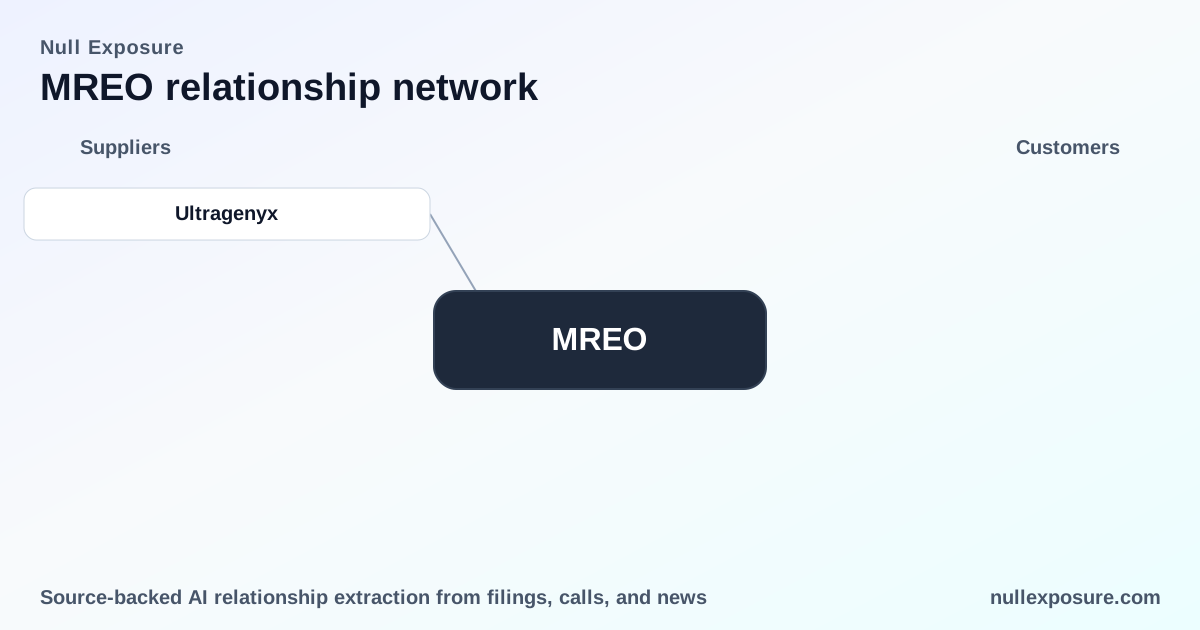
Ultragenyx (RARE) — Transfer of ex-Europe rights in a $50M deal
Mereo previously sold ex-Europe rights to a bone-density therapy to Ultragenyx in a deal that delivered $50 million upfront based on clinical evidence of increased bone formation and density. This transaction illustrates Mereo’s strategy of monetizing assets through geographic carve-outs and upfront payments. According to a FierceBiotech article dated March 10, 2026, Ultragenyx paid Mereo $50 million for ex-Europe rights in 2020. (FierceBiotech, March 10, 2026)
Takeaway: this is a prototypical Mereo exit architecture—realize material near-term cash by selling non-core territories while preserving other regional rights when advantageous.
āshibio, Inc. — Outlicense of vantictumab with retained European rights
Mereo outlicensed vantictumab for autosomal dominant osteopetrosis Type 2 (ADO2) to āshibio while explicitly retaining European rights, reflecting a hybrid deal structure where Mereo keeps regional optionality and potential commercial upside in Europe. This was disclosed in Mereo’s FY2025 results and corporate highlights published on May 3, 2026. (GlobeNewswire, May 3, 2026)
Takeaway: Mereo executes selective out-licenses that free up near-term resources while preserving strategic regional control, consistent with a portfolio company that values optionality in higher-probability markets.
How regulatory and payer constraints shape the commercial runway
There are company-level signals in public materials that should shape investor and operator expectations around contracting and pricing.
- Government and third-party payors exert pricing pressure. Public disclosures indicate that government authorities and payors have tried to control cost by limiting coverage and reimbursement for new medical products. This is a structural constraint on revenue realization and heightens the importance of partner expertise in reimbursement strategies.
- Mereo faces buyer-like scrutiny from payors. Documentation shows third-party payors increasingly challenge price and medical necessity, pressuring companies to justify cost-effectiveness. This is a company-level signal that successful commercialization will require robust health economics evidence and partner relationships that can absorb market access risk.
These constraints are not tied to a single partner in the public excerpts; they are company-wide commercial realities that influence deal terms (royalty rates, milestone structures, retained rights) and explain why Mereo often prefers out-licensing or regional splits.
Investor implications: risk, optionality, and what to watch next
For investors and operators evaluating Mereo, the operating reality is straightforward and actionable.
- Risk profile: High dependency on a small number of partner deals creates binary valuation moves—positive deal execution or milestone receipts can sharply re-rate the stock, while failed asset progression or partner disputes produce downside. Financial signals (low revenue, negative EBITDA) confirm limited internal cash generation.
- Value drivers: Successful realization of milestone payments, successful retention and commercialization of European rights, and improved payer acceptance for launched products.
- Operational priorities for management: Win additional high-value out-licensing deals while negotiating favorable retained-rights and royalty terms; build a targeted market-access playbook to support retained European commercialization; and diversify counterparties to reduce concentration risk.
- What to watch: upcoming partnership announcements, milestone payment receipts, clinical data readouts tied to licensed assets, and any changes in payer coverage language that could affect realized royalties.
Bottom line: Mereo is a licensing and asset-management vehicle whose valuation hinges on deal execution and partner-led commercialization. Its model delivers significant upside if it continues to close material out-licenses and milestone-triggered payments, but it also concentrates commercial and liquidity risk into a small number of counterparties and payer decisions.
For a deeper dive into partner-level analytics and a comparison of similar licensing-first biopharmas, visit https://nullexposure.com/.
Final practical notes for operators negotiating with Mereo
Operators evaluating deals with Mereo should expect geographic carve-outs, milestone-heavy payment schedules, and retained regional rights as standard negotiating levers. Prepare a reimbursement and health-economics plan early: payor constraints are a decisive factor in price realization, and Mereo’s commercial strategy requires partners that can execute market access in assigned territories.
Bold, partner-driven execution defines Mereo’s value creation path—investors should calibrate exposure accordingly.