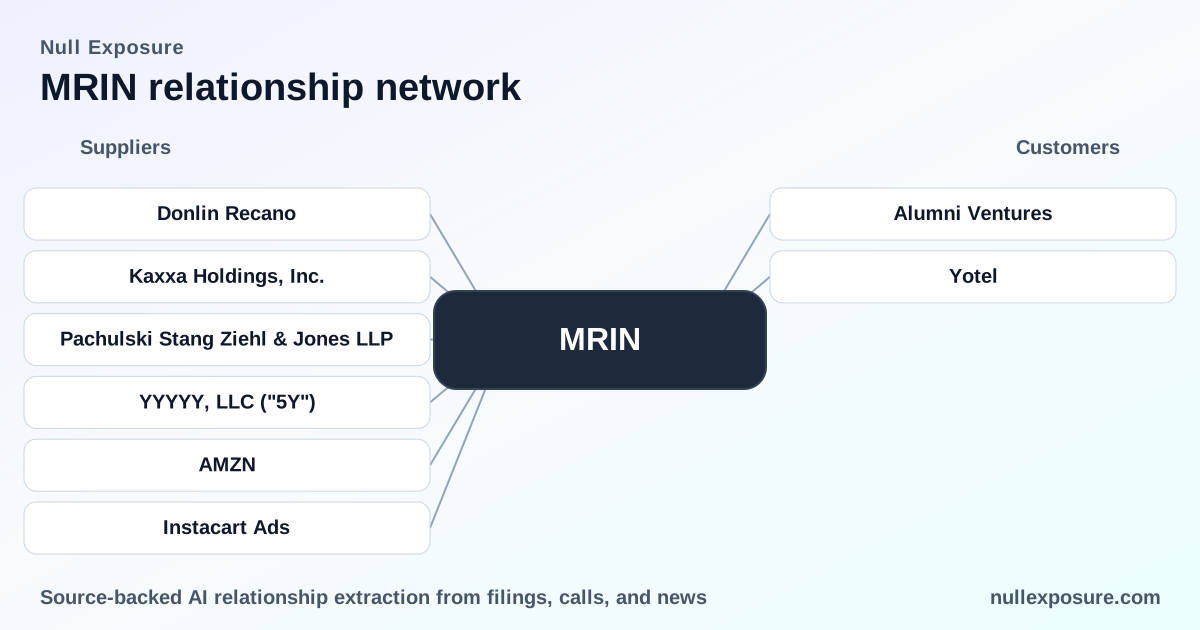
Marin Software (MRIN) — Customer Relationships That Drive a Small, Specialist Ad-Tech Franchise
Marin Software operates a performance marketing platform sold to advertisers and agencies; it monetizes primarily through subscription and platform fees for MarinOne plus ancillary optimization and services tied to ad spend management. Revenue is modest (Revenue TTM $16.7M) and the business operates as a niche SaaS-like vendor to marketing teams that require measurable ROI improvements across search and social channels. For a focused view on customer signals and relationship quality, see NullExposure’s coverage: https://nullexposure.com/
Why customers matter for MRIN: concentrated, outcome-driven relationships
Marin’s commercial value proposition is outcome-driven: the product is positioned to reduce cost-per-lead and increase conversion revenue for advertisers. This shapes the company’s operating model along four dimensions:
- Contracting posture: Marin sells recurrent platform access with optimization services that are tied to campaign performance and budgeting controls — a relationship structure that favors renewal if ROI is delivered.
- Concentration: Given the company’s small revenue base, each major client represents a material share of revenue and product success stories are used as high-leverage reference accounts for new sales.
- Criticality: For customers that treat ad spend as a primary acquisition channel, Marin’s tools are operationally important because they directly affect media ROI and budget allocation.
- Maturity: The company markets a modernized offering (MarinOne) positioned as a next-generation upgrade, signaling product evolution from legacy tooling toward a consolidated platform.
These are company-level operating signals derived from Marin’s positioning and public customer highlights; they describe how customer relationships drive both revenue stability and growth potential for MRIN.
Relationship-by-relationship: what the customer mentions reveal
Nordstrom Rack — retail endorsement of MarinOne’s UX and speed
Nordstrom Rack is cited as a customer praising the new look, speed, and intuitiveness of MarinOne, indicating enterprise retail adoption of Marin’s platform as a front-line marketing tool. According to Marin’s PR Newswire release around the MarinOne launch (FY2018), a Nordstrom Rack digital marketing specialist emphasized the product’s usability and readiness for active deployment. (PR Newswire, MarinOne release, FY2018)
Alumni Ventures — double the lead volume and lower acquisition cost
Marin reported doubling lead volume for Alumni Ventures while reducing cost per lead by 33% through its budgeting optimization features, signaling that Marin’s platform delivers measurable lead-generation improvements for investment-vehicle marketers. This claim comes from Marin’s Q4 2023 earnings call transcript as published on InsiderMonkey and was presented as a client outcome during FY2024 commentary. (InsiderMonkey, Marin Q4 2023 earnings call transcript / FY2024)
Yotel — a dramatic revenue uplift from channel sync functionality
Yotel is presented as a case where revenue increased by 323% after using Marin’s Google-to-Microsoft sync, demonstrating the platform’s ability to convert cross-channel synchronization into outsized revenue gains for specific clients. This example was cited in Marin’s Q4 2023 earnings call transcript that was reproduced on InsiderMonkey during FY2024 discussions. (InsiderMonkey, Marin Q4 2023 earnings call transcript / FY2024)
What these relationships imply about product-market fit and sales motion
The customer examples are explicit proof points of performance marketing outcomes: reduced cost per lead, higher lead volume, faster revenue via channel sync, and positive UX feedback from a major retail brand. For investors, that translates into two straightforward investor signals:
- Sales leverage: The product’s demonstrated ROI provides a clear case for upsell and renewals; success stories like Alumni Ventures and Yotel are sales multipliers in a sector that values quantifiable performance gains.
- Revenue concentration risk: The company’s total revenue is small at scale, so each named customer is disproportionately valuable to the topline and references are critical to securing new enterprise deals.
For deeper customer intelligence on MRIN relationships, NullExposure maintains expanded profiles and signal tracking: https://nullexposure.com/
Financial and risk context that flows from the customer base
The customer evidence is positive on outcomes, but company-level financial metrics moderate the investment case:
- Small market capitalization and scale: Market cap is reported at roughly $2.86M with Revenue TTM $16.7M. This is a micro-cap operator where revenue volatility or client churn will quickly impact financials.
- Profitability pressure: Operating margin TTM is negative at -49.8% and diluted EPS is -3.93, indicating ongoing losses despite positive client anecdotes.
- Ownership and liquidity considerations: Institutional ownership is low (around 4.8%) and insider ownership is modest (~8%), which creates limited sell-side coverage and reduced institutional support in the stock.
- Valuation multiples are non-standard: Traditional PE ratios are not meaningful; price-to-sales is low at 0.171 but reflects the small public float and constrained investor interest.
Together, these metrics frame a high-reward/higher-risk profile where customer success stories are necessary but not sufficient for a durable recovery or re-rating.
Key takeaways for investors and operators
- Customer outcomes are a real growth lever: Measured client wins (Alumni Ventures, Yotel, Nordstrom Rack) validate Marin’s product effectiveness in performance marketing.
- Business is small and concentrated: Positive customer case studies improve sales traction but do not offset the macro risk inherent in a thin revenue base and ongoing operating losses.
- Execution is paramount: Retention, the ability to scale sales using reference accounts, and continued product modernization (MarinOne) determine whether these customer outcomes can support sustainable growth.
- Catalysts and risks are clear: Catalysts include expanding platform adoption and repeatable case studies across verticals; risks include customer churn, limited liquidity, and persistent negative margins.
If you want a deeper, customer-level signal map and ongoing relationship monitoring for MRIN, review NullExposure’s customer analytics at https://nullexposure.com/
Conclusion: an outcomes-led product in a fragile financial shell
Marin Software presents convincing operational anecdotes where customers achieved material improvements in lead volume and revenue, and a major retailer publicly endorsed the MarinOne experience. Those wins are strategically valuable for an ad-tech vendor, but the company’s small scale, negative margins, and thin institutional interest constrain the valuation upside absent clear evidence of expanding contract scale and retention. For investors, the routing decisions are straightforward: bet on execution and repeatability of these success stories, or treat MRIN as a speculative play until revenue scale and profitability show sustained improvement.