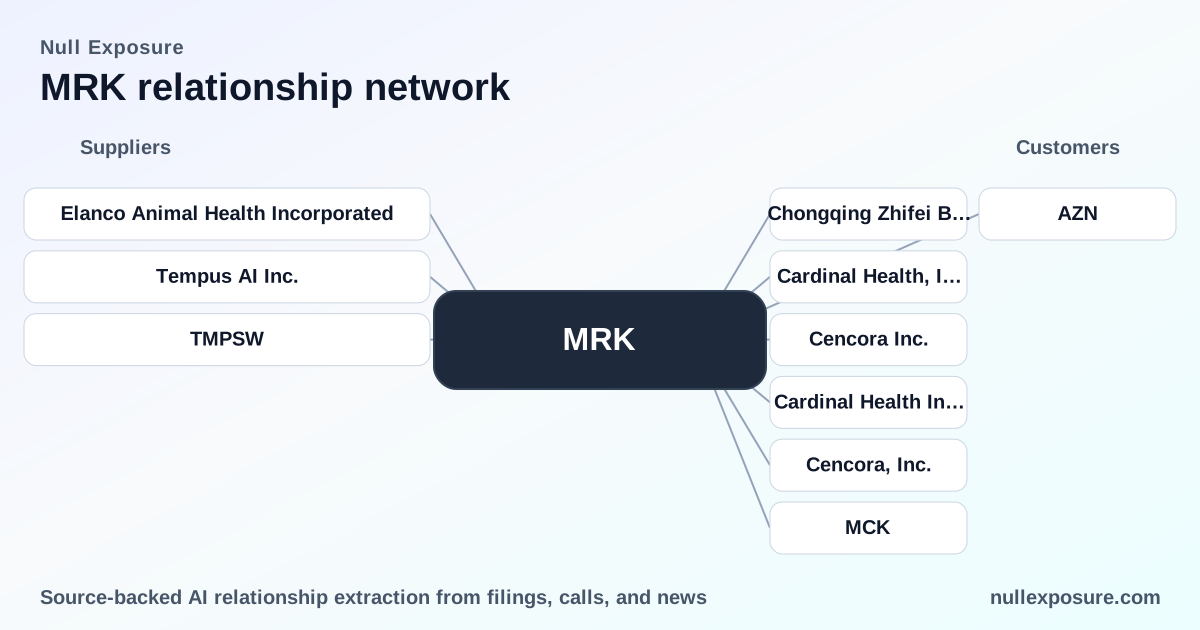
Merck (MRK) — Customer Relationships and Commercial Risk Map
Thesis — Merck monetizes a broad, global commercial platform by selling prescription medicines, biologics, vaccines and animal health products primarily as the principal to wholesalers, distributors, hospitals, governments and health systems, while also supporting R&D partners through drug-supply and license arrangements. Revenue is driven by a small set of large wholesale customers for receivables and a wide network of clinical collaborators that rely on Merck’s marketed products (notably KEYTRUDA) for combination trials, creating simultaneous concentration risk on the trade side and strategic leverage on the partnership side. Learn more at https://nullexposure.com/.
What the customer footprint tells investors
Merck’s operating model blends high-volume commercial distribution with selective strategic supply/clinical collaborations. The 2024 Form 10‑K shows Merck acts as principal in most customer arrangements, selling to wholesalers and large intermediaries; at the same time it supplies KEYTRUDA and other products directly to biotech partners as part of clinical collaborations, a recurring source of non‑traditional commercial exposure. The company discloses material accounts‑receivable concentration (McKesson, Cencora, Cardinal Health together representing a large share of AR), and company filings describe a factoring program for certain international receivables—an operational lever that reduces balance‑sheet receivable risk but signals dependence on distributor cash flows.
- Contracting posture: Merck records gross revenue in most customer arrangements and sells through wholesalers and distributors, indicating principal seller status (10‑K).
- Concentration: Top wholesalers account for a meaningful share of receivables (see the customer list below).
- Criticality: KEYTRUDA and other marketed products are strategically critical to many clinical partners, who often receive supply rather than traditional purchase contracts (press releases and clinical updates).
- Maturity spectrum: Relationships range from long‑standing license exits to short‑term clinical supply agreements and recent collaboration signings (10‑K and news items).
If you want a guided extract of these relationships for modeling or due diligence, visit https://nullexposure.com/ for tailored reports.
Relationship map — compact investor summaries
Below are one‑line, source‑anchored summaries of each counterparty Merck is shown partnering with or selling to in the collected results.
- Chongqing Zhifei Biological Products Co., Ltd. — China distributor and commercialization partner for vaccines; shipments declined mid‑2024 and nearly all Zhifei accounts receivable were factored as of December 31, 2024 (Merck 2024 Form 10‑K, FY2024).
- Cardinal Health, Inc. — One of Merck’s largest customers by accounts receivable, representing a material percentage of total AR at year‑end 2024 (Merck 2024 Form 10‑K, FY2024).
- Cencora, Inc. — Listed among the customers with the largest AR balances, roughly on par with other major wholesalers at year‑end 2024 (Merck 2024 Form 10‑K, FY2024).
- McKesson Corporation (MCK) — A top trade customer accounting for roughly one‑fifth of Merck’s accounts receivable at December 31, 2024 (Merck 2024 Form 10‑K, FY2024).
- CDXS (Codexis) — Sells enzymes to Merck for manufacture of sitagliptin (active ingredient in JANUVIA), indicating a supplier‑customer manufacturing relationship (Codexis 2024 10‑K).
- SCYX (Scynexis) — Holds royalty obligations to Merck following an earlier research collaboration; Scynexis owes royalties on ibrexafungerp sales under the historic agreement (MedCityNews coverage, 2021 / company disclosures).
- BYSI (BeyondSpring Inc.) — Received financial support and provision of study drug from Merck’s Investigator Studies Program for a Phase 2 oncology study presented at ESMO 2024 (company press release, Sept 2024).
- PRLD (Prelude Therapeutics) — Merck supplied KEYTRUDA for a Prelude Phase 2 clinical combination trial under a clinical collaboration (Contract Pharma report, FY2024).
- ABOS (Acumen Pharmaceuticals / Acumen references) — Surviving provisions from an old collaboration grant Acumen exclusive perpetual license to certain Merck IP; disclosed in Acumen filings (SEC reports, FY2026 filings referencing original 2003 agreement).
- OGN (Organon) — Organon cited costs related to exiting manufacturing and supply agreements with Merck, indicating prior supply arrangements are being unwound (Organon press release, Q1 2026).
- IOBT (IO Biotech) — Clinical trials sponsored by IO Biotech are conducted in collaboration with Merck, which is supplying pembrolizumab for those trials (company statements, FY2024–FY2025).
- EVAX (Evaxion) — Merck supplied KEYTRUDA for Evaxion’s Phase 2 cancer vaccine trial as part of a clinical supply collaboration (FierceBiotech, FY2024–FY2025 coverage).
- AVIR (Atea Pharmaceuticals) — Atea licensed ruzasvir under a Merck agreement and reports milestone and royalty obligations to Merck tied to commercialization (earnings call coverage and company filings, FY2025–FY2026).
- PYXS (Pyxis Oncology) — Pyxis is running a clinical trial that combines MICVO with Merck’s KEYTRUDA under a Clinical Trial Collaboration Agreement (multiple Pyxis press releases, FY2025–FY2026).
- NEUP (Neuphoria) — Maintains a strategic partnership with Merck for two early‑stage CNS programs, per company disclosures (GlobeNewswire, FY2025).
- SLGL (Sol‑Gel Technologies) — Sold sun‑protection technology to Merck in 2008 for $10 million, a historical IP transaction disclosed in business reporting (Globes, FY2014 retrospective).
- EIKN (Eikon Therapeutics) — Lists clinical supply collaborations with MSD (Merck) for pembrolizumab alongside other partnerships (news coverage in IPO filings, FY2026).
- IMMP (Immutep Limited) — Reports enrollment progress in a Phase III trial combining its candidate with Merck’s KEYTRUDA (company announcement, FY2026).
- IBRX (ImmunityBio) — Noted a global shortage of BCG with Merck as the lone global supplier in media reporting (market commentary, FY2026).
- ADAG (Adagene) — FDA Fast Track for muzastotug was granted for the product in combination with Merck’s KEYTRUDA, implying clinical supply/collaboration (GlobeNewswire, Dec 2025).
- ANIP (ANI Pharmaceuticals) — Discloses a blended royalty payment obligation to Merck on Cortrophin Gel net sales, with royalty rates stepping into the high‑20% range (company earnings call/transcripts, FY2026).
- EFTR (Effector Therapeutics) — Running a randomized Phase II study combining tomivosertib with Merck’s KEYTRUDA, per press reports (Yahoo Finance coverage, FY2024).
- ANRO (Anro Pharmaceuticals / related) — In‑licensed a U.S. patent originated with Merck, showing legacy IP licensing connections (ANRO 2024 10‑K).
- RAPT (RAPT Therapeutics) — Entered a clinical trial collaboration and supply agreement with a Merck affiliate involving a combination with pembrolizumab (RAPT 2024 10‑K).
- CTMX (CytomX Therapeutics) — Running a Phase 1 dose escalation trial of CX‑801 in combination with Merck’s KEYTRUDA (industry press, FY2026).
- ATON (AlphaTON Capital / iOx program) — Merck provided pembrolizumab under a clinical trial collaboration originating from a university program; referenced in transaction press releases (GlobeNewswire, FY2026).
- PLRX (Pliant Therapeutics) — Trial data show PLN‑101095 evaluated in combination with Merck’s KEYTRUDA in refractory solid tumors (Sahm Capital writeup, FY2025).
- KZIA (Kazia Therapeutics) — Reported early Phase 1b data for a regimen that includes Merck’s KEYTRUDA in combination with Paxalisib and chemotherapy (Yahoo Finance, FY2025).
- INBX (Inhibrx / INBX) — Inhibrx trials include INBRX‑106 being evaluated in combination with KEYTRUDA across indications (TradingView press, FY2026).
- AstraZeneca PLC / AZN — Uses Merck’s KEYTRUDA plus chemotherapy as the control regimen in at least one large oncology trial, cited in analyst commentary (Proactive Investors, FY2026).
Key takeaways for investors
- Wholesale concentration is real and measurable: McKesson, Cencora and Cardinal Health represent a concentrated receivables base that can amplify cash‑flow exposure if distributor dynamics change (Merck 2024 10‑K).
- Factoring and receivables management are active: The company factors large receivables (explicitly noted for Zhifei accounts in China), reducing balance‑sheet AR but introducing counterparty and program execution risk (Merck 2024 10‑K).
- Strategic product leverage via KEYTRUDA: Merck’s willingness to supply KEYTRUDA across a broad set of clinical collaborations creates high strategic value and optionality, but also operational commitments around supply. Numerous small biotech partners rely on Merck supply rather than commercial purchase (multiple press releases, FY2024–FY2026).
- Business model mix: The company operates as a global seller to wholesalers and as a strategic supplier/licensee to smaller biotechs; investors should model both concentrated trade receivables risk and recurrent collaboration/supply exposures when assessing MRK.
For a deeper extraction and modeling package of Merck’s counterparty exposures, visit https://nullexposure.com/ for customized reports and datasets.