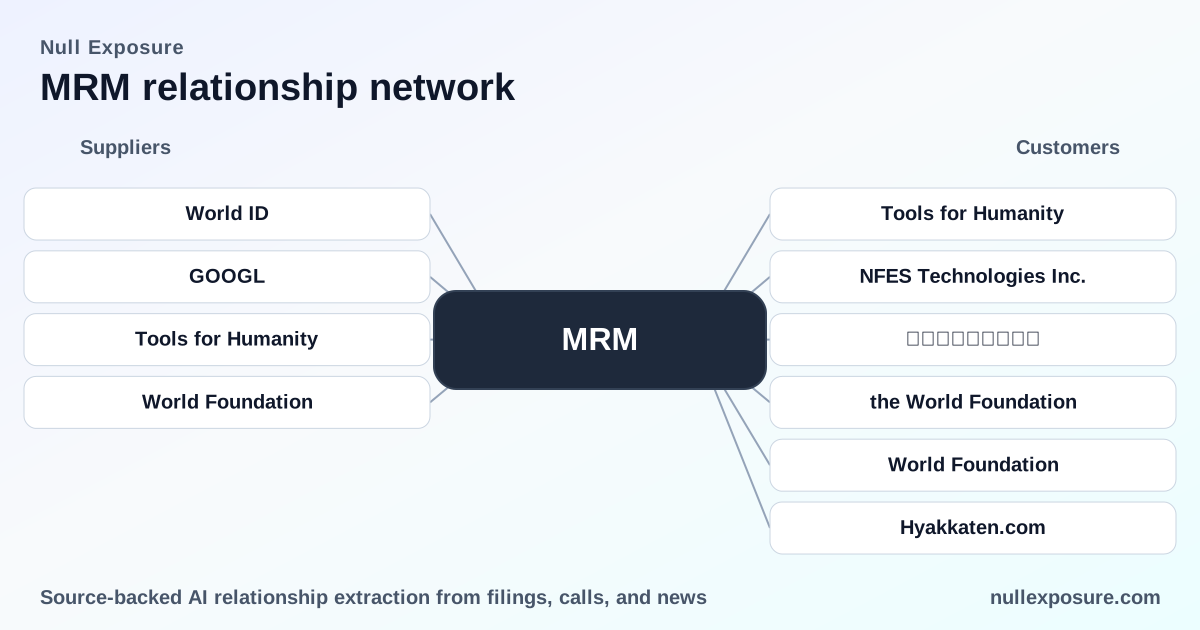
Medirom Healthcare: Partnership-driven growth and platform monetization
Medirom Healthcare Technologies Inc. operates as a Japan-focused health‑tech and services company that monetizes through device sales (MOTHER Bracelet, REMONY systems), distribution agreements, and service contracts to operate verification and biometric networks. Revenue derives from hardware sales, distributor margins and recurring service fees under Master Service Agreements (MSAs)—a hybrid model that converts product invention into channel-led commercialization and outsourced operations revenue. For a concise, single-source briefing on partner exposures and strategic implications, visit https://nullexposure.com/.
How partnerships convert R&D into scalable revenue
Medirom’s recent announcements reveal a deliberate go‑to‑market structure: the company retains product development via its MOTHER Labs subsidiary while outsourcing distribution and large‑scale operations to established channel partners and institutional clients. That contracting posture reduces upfront go‑to‑market cost but raises execution and partner‑dependency risks—success depends on distributor performance and the company’s ability to deliver service SLAs at scale.
- Contracting posture: MSAs for service delivery (biometric/World ID network) and distributor agreements for retail and B2B channels.
- Concentration: Several headline partners (Tools for Humanity / World Foundation; TD SYNNEX; NFES Group and subsidiaries) represent a mix of national-scale contracts and channel diversification—concentration risk is material for headline projects but balanced by multiple retail and distribution relationships.
- Criticality: The World ID Orb rollout (3,000 sites) is operationally critical—execution will drive near-term service revenue and reputation.
- Maturity: Many relationships are early commercial deployments or initial distributor arrangements; revenue streams are nascent but scalable if execution holds.
For more on how we track partner exposure across public notices and filings, see https://nullexposure.com/ (company homepage).
Detailed relationship log: every reported customer relationship
-
Tools for Humanity — StockTwits reports that Medirom signed a master service agreement to operate World’s “Proof of Human” verification locations across Japan, recorded in FY2025 coverage. According to the StockTwits item, Medirom will operate verification locations under the Tools for Humanity program (news item first seen March 10, 2026). (Source: StockTwits / markets news, FY2025)
-
NFES Technologies Inc. — A FinancialContent release (FY2024) states the NFES Group formed NFES Technologies Inc. to act as the designated main distributor for the MOTHER Bracelet and expand sales domestically and internationally. (Source: FinancialContent press release, FY2024)
-
北日本紡績株式会社 (North Japan Spinning Co., Ltd.) — A PR Times announcement (FY2024) reports that Medirom’s MOTHER Labs has entered store sales and strategic sales discussions with North Japan Spinning to distribute the MOTHER Bracelet through their retail channels. (Source: PR Times release, FY2024)
-
TD SYNNEX K.K. (SNX) — A December 5, 2025 press release documents that MEDIROM MOTHER Labs signed a distributor agreement with TD SYNNEX K.K., establishing TD SYNNEX as a channel to accelerate national adoption of the MOTHER Bracelet and REMONY systems (FY2025 disclosure). (Source: Company announcement via SahmCapital, FY2025)
-
the World Foundation — StockTwits coverage (FY2025) notes the MSA also names the World Foundation as a co‑party alongside Tools for Humanity to operate Proof of Human verification locations in Japan. (Source: StockTwits / markets news, FY2025)
-
World Foundation — TipRanks reported that on January 23, 2026, MEDIROM signed an MSA with Tools for Humanity and the World Foundation to install Orb biometric authentication devices at roughly 3,000 locations nationwide, expanding an initial plan of about 100 sites (FY2026 reporting). (Source: TipRanks company announcement, FY2026)
-
Hyakkaten.com — A FinancialContent writeup (FY2024) indicates MOTHER Labs will collaborate with Hyakkaten.com, the NFES Group’s regional department‑store e‑commerce mall, to sell the MOTHER Bracelet through department stores and e‑commerce sites nationwide. (Source: FinancialContent press release, FY2024)
-
Tools for Humanity — A GlobeNewswire release (Dec 26, 2025; reported FY2025) confirms MEDIROM entered an MSA with Tools for Humanity and World Foundation for the Proof‑of‑Human verification network. (Source: GlobeNewswire press release, Dec 26, 2025)
-
World Foundation — The same GlobeNewswire (Dec 26, 2025) confirms the World Foundation is a co‑counterparty in the MSA announced by MEDIROM. (Source: GlobeNewswire press release, Dec 26, 2025)
-
Tools for Humanity — TipRanks coverage (FY2026) reiterates the January 23, 2026 MSA with Tools for Humanity to roll out Orb devices at scale across Japan. (Source: TipRanks, FY2026)
-
Japan Ground Self‑Defense Force — A Finviz news item (FY2025) reports Medirom secured a contract to provide the REMONY system to the Japan Ground Self‑Defense Force, indicating institutional/government channel traction for MEDIROM’s REMONY product line. (Source: Finviz news summary, FY2025)
-
Tools for Humanity — The Globe and Mail reported on December 29, 2025 that MEDIROM would build and operate the Proof of Human verification network in Japan under the new service pact with Tools for Humanity and the World Foundation (FY2025 press release coverage). (Source: The Globe and Mail press release, Dec 29, 2025)
-
World Foundation — The Globe and Mail item (Dec 29, 2025) also names the World Foundation as part of the new service pact for Japan operations. (Source: The Globe and Mail press release, Dec 29, 2025)
-
World Foundation — A GlobeNewswire release dated February 27, 2026 states the MSA with Tools for Humanity and World Foundation became effective on February 2, 2026 and projects approximately 39 million in income before taxes over two years following the expansion to 3,000 national sites (FY2026 disclosure). (Source: GlobeNewswire press release, Feb 27, 2026)
-
Tools for Humanity — The same GlobeNewswire (Feb 27, 2026) confirms Tools for Humanity as counterparty and reaffirms the effective date of the MSA and projected near‑term income from the national rollout (FY2026 disclosure). (Source: GlobeNewswire press release, Feb 27, 2026)
-
Tools for Humanity — Additional StockTwits coverage (duplicate reporting on March 10, 2026 tied to the FY2025 announcement) restates MEDIROM’s operative role in the World’s Proof of Human verification locations across Japan. (Source: StockTwits / markets news, FY2025)
Investment implications: revenue upside and operational risk
Medirom’s arrangement with Tools for Humanity and the World Foundation to install Orb biometric devices across ~3,000 locations is a potential inflection point, converting R&D and pilot work into recurring operations revenue and service fees. The February 2026 GlobeNewswire projection of ~39 million in income before taxes over two years is material for a company of Medirom’s scale and signals near‑term monetization of the World ID opportunity (GlobeNewswire, Feb 27, 2026).
At the same time, concentrated reliance on large national rollouts and a small public float (Shares Outstanding: 7.9M; Shares Float: 5.822M; Percent Institutions: 0.18%) elevates execution and liquidity risk. Key risks for investors are execution on large‑scale deployments, partner performance (distributors and retail partners), and regulatory/privacy scrutiny tied to biometric identity services.
Bottom line: a distribution‑led scaling thesis, conditional on delivery
Medirom’s partner set reflects a clear strategic pattern: product development retained in‑house, market access outsourced to distributors and institutional service contracts. If Medirom executes the World ID rollout and converts distributor agreements into consistent retail sales, the company will shift materially from R&D expense toward recurring service and product revenue. Conversely, failed execution or regulatory pushback on biometric services would compress the upside quickly.
For a follow‑up briefing on partner exposure, timelines and public‑filing cross‑checks, visit https://nullexposure.com/.