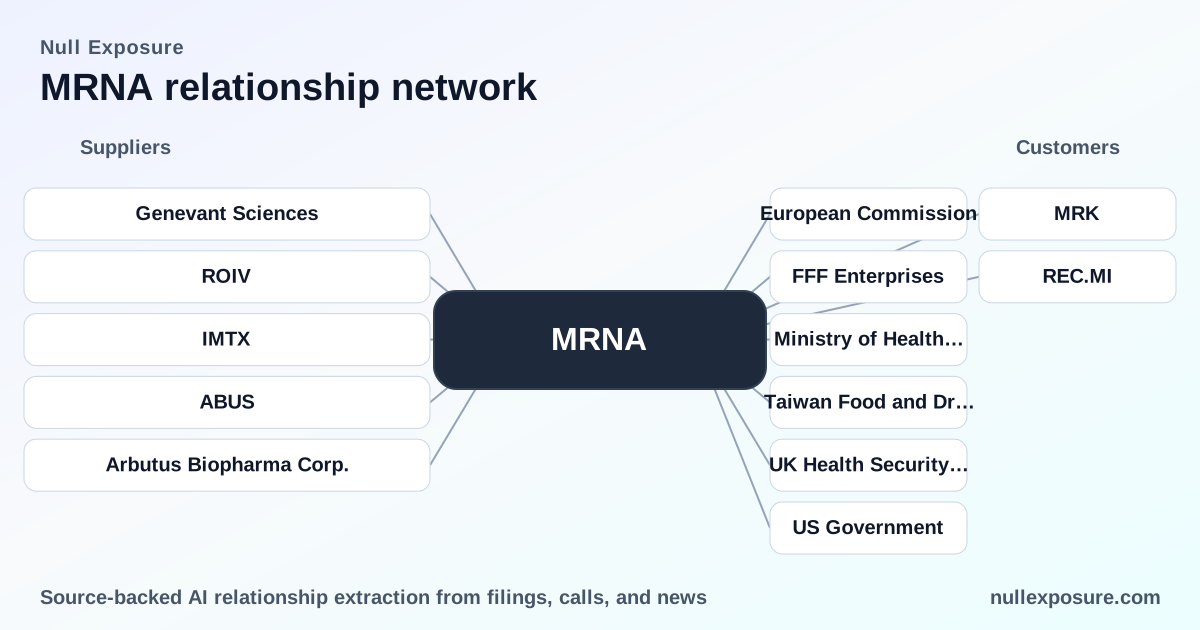
Moderna (MRNA) customer map: who pays, who partners, and what that means for revenue stability
Moderna monetizes by selling mRNA-based vaccines and therapeutics to a mix of governments, health agencies, wholesalers and commercial partners, while also licensing and co-developing next‑generation therapeutics with biopharma peers. Revenue is concentrated in a handful of large institutional customers and public health buyers for respiratory vaccines, with commercial distribution channels (wholesalers/distributors) handling U.S. retail flows; product sales thus oscillate with government purchasing cycles and vaccine demand. For direct access to the underlying source links and a consolidated customer view, visit https://nullexposure.com/.
What drives Moderna’s customer economics today
Moderna’s model is built on three commercial levers: (1) large, multi‑year government procurement and immunization programs, (2) commercial rollout through wholesalers and retail channels in developed markets, and (3) strategic partnerships and licensing for pipeline assets that convert R&D into non‑vaccine revenue streams. These levers create high counterparty concentration, a global footprint across NA/EMEA/ROW, and a mix of procurement contracting and commercial resale — positioning Moderna as both a vendor to public health programs and a partner to private biopharma developers.
Key operating signals summarized:
- Government counterparty bias: a material share of revenue historically comes from government purchases and international organizations.
- Global distribution: revenue and manufacturing commitments spread across United States, Europe and Rest of World, with explicit plans to localize production in Australia, Canada and the UK.
- Concentration and materiality: primary revenue still tied to respiratory vaccines, creating revenue volatility when public demand or procurement shifts.
- Customer roles: Moderna sells directly to governments and agencies, and sells through wholesalers/distributors and resellers in commercial markets.
- Active commercial stage: product sales are ongoing and formed the large majority of recent revenues.
These are company‑level signals drawn from Moderna’s FY2024 disclosures and recent corporate commentary.
Customer relationships that matter — short, sourced summaries
FFF Enterprises
Moderna identifies FFF Enterprises among its customers in its FY2024 Form 10‑K, signaling FFF’s role as a commercial buyer/distributor in Moderna’s U.S. channel mix. (Source: Moderna FY2024 Form 10‑K)
Ministry of Health, Labour and Welfare of Japan
Japan’s Ministry of Health, Labour and Welfare is listed in Moderna’s FY2024 filing as a customer, reflecting direct government procurement and the firm’s reliance on national immunization tenders. (Source: Moderna FY2024 Form 10‑K)
European Commission
The European Commission appears in Moderna’s FY2024 disclosures as a customer, consistent with EU‑level purchase agreements and centralized vaccine procurement. (Source: Moderna FY2024 Form 10‑K)
Taiwan Food and Drug Administration
Taiwan’s FDA is named in the FY2024 filing in the context of receivables/customer concentration, indicating regulated government purchasing and formalized contracting in that market. (Source: Moderna FY2024 Form 10‑K)
UK Health Security Agency
The UK Health Security Agency is included among Moderna’s FY2024 customers, underlining Moderna’s commercial and public‑health engagements in the U.K. (Source: Moderna FY2024 Form 10‑K)
US Government
The U.S. Government is explicitly listed in Moderna’s FY2024 disclosures as a major customer historically and currently, reflecting both past large pandemic procurements and ongoing government agreements. (Source: Moderna FY2024 Form 10‑K)
Merck (MRK)
Moderna disclosed on its 2025 Q4 earnings call that the individualized cancer therapy (INT) is developed in partnership with Merck, with five‑year Phase 2 data recently reported in adjuvant melanoma — a co‑development/commercial relationship tied to oncology pipeline value. (Source: Moderna 2025 Q4 earnings call)
Immatics (IMTX)
Multiple press reports in late 2025–early 2026 describe combination studies where Immatics’ PRAME cell therapies are being developed in combination with Moderna’s PRAME mRNA enhancer, indicating an active collaboration to augment cell therapy efficacy. (Sources: GlobeNewswire press release Dec 11, 2025; InvestingNews coverage; QuiverQuant news items)
Recordati / REC.MI
On the 2025 Q4 earnings call Moderna announced an agreement with Recordati for the global commercialization of its propionic acidemia rare disease candidates — a commercialization partnership intended to scale rare‑disease launches beyond Moderna’s direct sales footprint. (Source: Moderna 2025 Q4 earnings call)
Allbirds (BIRD)
Press coverage cited by Moderna’s news landscape notes Allbirds’ use of INNOVERA, a bio‑designed material developed by Moderna’s materials unit, reflecting a non‑core commercial relationship where Moderna supplies or licenses bio‑materials to consumer brands. (Source: GlobeNewswire Allbirds release, Mar 11, 2025)
What the relationship map implies for investors
- Revenue concentration risk is real. Moderna’s top customers include sovereign buyers and supranational purchasers; when those contracts reprice or volumes drop, product sales can swing materially from year to year. Moderna’s FY2024 commentary explicitly frames COVID vaccine sales and respiratory products as its primary revenue drivers. (Source: Moderna FY2024 Form 10‑K)
- Government contracting creates revenue durability but procurement timing creates volatility. Multi‑year government commitments (including planned local manufacturing commitments in Australia/Canada/UK) provide backbone demand, but timing and policy changes affect near‑term recognition. (Source: Moderna FY2024 Form 10‑K)
- Partnerships broaden optionality beyond vaccines. Collaborations with Merck (oncology) and Recordati (rare disease commercialization) refract Moderna from pure‑play vaccine seller toward a partnered developer monetizing mRNA IP and co‑commercial arrangements. These deals increase potential non‑vaccine revenue streams but require successful clinical progression. (Sources: Moderna 2025 Q4 earnings call; company press coverage)
- Commercial channel complexity matters operationally. The U.S. sales cadence goes through wholesalers and distributors; international procurement runs through agencies and governments — this duality affects working capital, collections and margin profile. (Source: Moderna FY2024 Form 10‑K)
Risk checklist for operators and investors
- Concentration: heavy reliance on large institutional buyers increases bargaining leverage against Moderna.
- Geographic exposure: revenue is global but uneven; EU and U.S. swings materially affect top line.
- Contract stage and counterparty type: many relationships are active government purchases or distribution agreements; monitoring policy and public health guidance is essential.
- Maturity: core product sales remain the dominant, mature revenue stream; pipeline and partnership revenues are earlier stage but strategically important.
For a consolidated, interactive view of Moderna’s customer relationships and primary source references, see our platform at https://nullexposure.com/.
Bottom line
Moderna is monetizing a hybrid model of large public‑health contracts, commercial distribution, and strategic biotech partnerships. That mix delivers strong upside when public demand and procurement are favorable, but it also concentrates revenue risk in a small set of powerful buyers. Investors should evaluate near‑term cash flows against the company’s pipeline partnerships and the cadence of government tenders when assessing valuation and operational resilience.