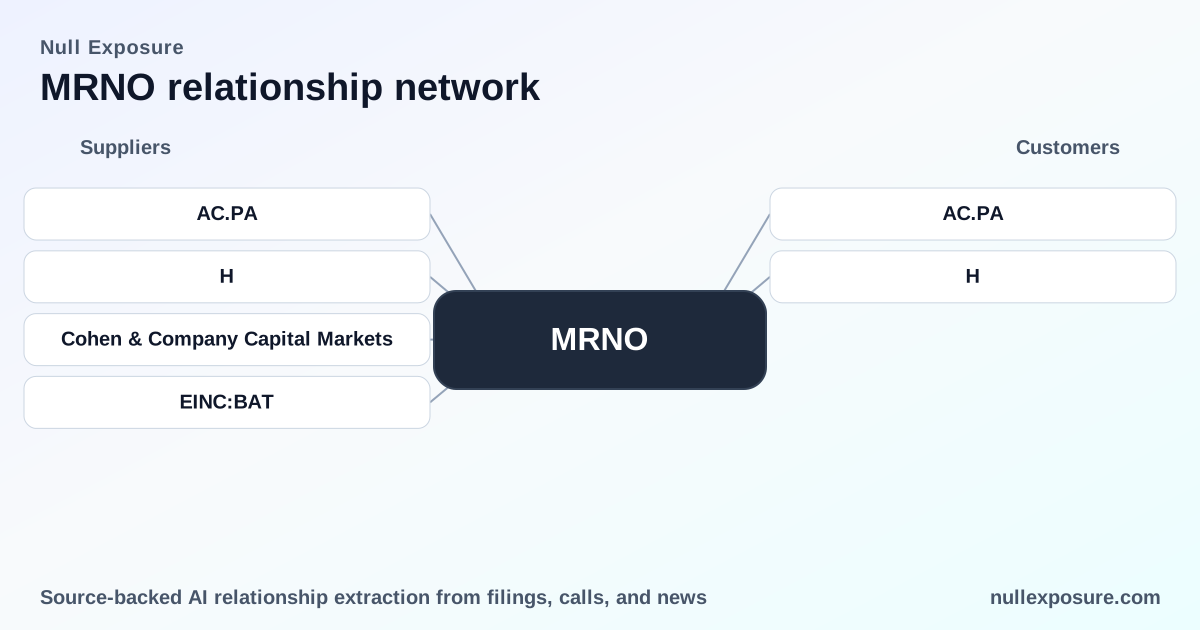
Murano Global Investments (MRNO): Operator Partnerships Drive Hotel Income; concentration and insider control are material
Murano Global Investments monetizes a real-estate portfolio through ownership of branded hotel assets that are commercially operated by global hospitality firms; revenue is driven by asset-level room and ancillary income while hotel operators deliver day-to-day revenue capture and brand value under management or franchise agreements. For investors, MRNO is best evaluated as an owner-operator hybrid where third-party management contracts drive cash flow volatility and brand affiliation determines asset-level pricing power. Explore MRNO coverage and data at https://nullexposure.com/ for a concise investor-facing dossier.
What the portfolio looks like and how cash flows are generated
Murano’s public profile identifies branded hotel holdings in Mexico that are operated under franchise or management relationships with large hospitality companies. The company recognizes revenue from the properties it owns, while operators such as Hyatt and Accor collect fees and execute the hotel P&L on the ground, making operator performance a direct driver of Murano’s top-line and margin realization. According to the company overview for the quarter ended 2025-06-30, Murano reported approximately $1.20 billion in trailing revenue, with negative EBITDA of roughly $299 million, highlighting a capital-intensive portfolio with operational leverage dependent on occupancy, ADR and operator execution.
Operators and customer relationships: who runs the hotels
Murano’s reported customer/partner mentions identify the major hospitality companies associated with its branded assets. Each relationship below is presented as described in the source.
Accor — Mondrian hotel operator
The portfolio includes the Hotel Mondrian in Mexico, which is identified as operated by Accor, linking Murano’s asset cash flows directly to Accor’s management/brand platform and distribution channels. This relationship is recorded in a Simply Wall St. report (March 10, 2026) that lists the Mondrian as part of Murano’s portfolio.
Source: Simply Wall St., company profile for Murano Global Investments (reported March 10, 2026).
H — included as a named relationship in the report
The same Simply Wall St. reference also lists an entry labeled “H” in connection with the portfolio mention of the Andaz and Mondrian hotels in Mexico; the label is present in the March 10, 2026 report alongside the other operator references and links to the same asset-level note.
Source: Simply Wall St., company profile for Murano Global Investments (reported March 10, 2026).
Hyatt — Andaz hotel operator
Murano’s assets include the Hotel Andaz in Mexico, which is operated by Hyatt, establishing a direct commercial link between Murano’s owner returns and Hyatt’s hotel operating economics and global distribution. This operator relationship is cited in the Simply Wall St. report dated March 10, 2026.
Source: Simply Wall St., company profile for Murano Global Investments (reported March 10, 2026).
For further context on MRNO’s paired operator model and how that affects investor outcomes, visit https://nullexposure.com/ to see our investor workflow and coverage.
Operating model constraints and what they signal for investors
With no constraint excerpts returned in the relationship payload, the following attributes are presented as company-level operating signals derived from Murano’s public profile and financials:
-
Contracting posture: Murano operates through branded management/franchise relationships rather than direct self-operation, which means contracting is oriented toward standard hotel management agreements—fees, incentive structures and brand standards govern economic sharing between owner and operator. This posture places negotiation leverage and operational risk partially with the operator.
-
Concentration: The cited portfolio references are limited to two named branded assets (Andaz and Mondrian). Limited operator diversity elevates counterparty concentration risk because a small set of operator relationships disproportionately influences occupancy, distribution and RevPAR capture.
-
Criticality: Operator partnerships are critical to revenue generation; brands supply loyalty channels, corporate contracts and revenue management systems that materially affect cash flow realization from the assets Murano owns.
-
Maturity and capital profile: Financial metrics through the quarter ended 2025-06-30 show meaningful negative EBITDA and negative EPS, and a Market Capitalization of approximately $20.5 million versus trailing revenue of roughly $1.20 billion, indicating a capital structure and return profile that require careful scrutiny of leverage, asset-level profitability and insider control.
-
Ownership and governance: Insider ownership is extremely high (reported at 98.3%) while institutional ownership is minimal (around 1.2%), a corporate governance signal that concentrates control and reduces public float, with implications for minority investor rights and liquidity.
Investment implications — what investors should weigh
-
Operator performance is the primary value lever. The Andaz/Hyatt and Mondrian/Accor linkages mean brand distribution and management effectiveness will determine near-term cash flow and thus valuation realization. Investors should prioritize operator-level KPIs (occupancy, ADR, RevPAR) and the specific terms of management agreements when modeling returns.
-
Concentration and insider control are material risks. With few publicized operator relationships and extremely high insider ownership, investors face governance and liquidity risks that can widen downside outcomes if asset performance deteriorates or if corporate decisions favor controlling stakeholders.
-
Capital intensity amid negative EBITDA increases refinancing and cash-demand risk. Recent financials through 2025-06-30 show negative operating profitability; asset performance improvements must outpace capital servicing needs to drive equity returns.
-
Valuation disconnects require asset-level analysis. Market capitalization and enterprise multiples point to potential disconnects relative to book value and revenue; investors should reconcile asset-level earnings power with corporate-level leverage and insider dispositions.
Final takeaways and recommended next steps
- Core thesis: Murano is an asset-owner whose returns are heavily dependent on the execution and commercial distribution of branded operators—Hyatt and Accor are explicit operator relationships driving hotel-level economics.
- Key risks: operator concentration, high insider control, and currently negative EBITDA that stresses capital needs.
- Actionable investor step: obtain the underlying management agreement terms and recent property-level operating statements to model break-even RevPAR and sensitivity to ADR/occupancy swings.
For a concise investor packet and data-driven summaries tailored to portfolio managers and analysts, visit https://nullexposure.com/ to access Murano coverage and related operator-risk frameworks.