Millrose Properties (MRP): Customer relationships define value and risk
Millrose Properties operates a capital-enabled services model that finances and sells homesites to builders through its Homesite Option Purchase Platform (HOPP’R). The company monetizes by providing upfront capital and development services to large homebuilders, recording revenue when purchase options are exercised and capturing financing yields and option fees while expanding third‑party funding relationships. Investors should value Millrose as a land‑finance operator whose earnings and cash flow profile are tightly coupled to a small set of counterparties and the pace at which option packages convert to land sales. For a concise corporate and market view visit https://nullexposure.com/.
Market narrative and headline takeaways
- Lennar is the structural anchor. Millrose’s original capital and asset contributions and the Master Program Agreement make Lennar the company’s primary customer and principal revenue driver, giving Millrose scale and predictable deal flow while concentrating counterparty risk.
- Diversification is underway but still early. Management has grown third‑party deployable assets materially since 2024, expanding the builder roster and establishing the Yardly partnership for built‑to‑rent deals, yet Lennar remains the critical source of volume.
- Business model characteristics are explicit: long‑dated framework agreements, a service+sales role (provider of the HOPP’R and seller of homesites), active contractual engagement, U.S. geographic focus, and material single‑counterparty exposure at transaction scale.
A clearer look at operating mechanics
Millrose delivers an operational and capital solution to homebuilders: it funds land acquisitions and construction through option deposits and structured take‑down schedules, operates the properties until exercise, and records revenues on land sales at the Takedown Price when builders exercise purchase options. Revenue levers are therefore option fees, financing yield on deployed capital, and realized gains on homesite sales; cash flow timing depends on builders’ takedown schedules. That model scales with counterparty trust and capital availability; it also concentrates commercial risk where one or a few builders dominate activity.
Call-to-action: for comparative counterparty mapping and deeper relationship analytics, see https://nullexposure.com/.
Counterparty roll‑call — every relationship in the filings and coverage
-
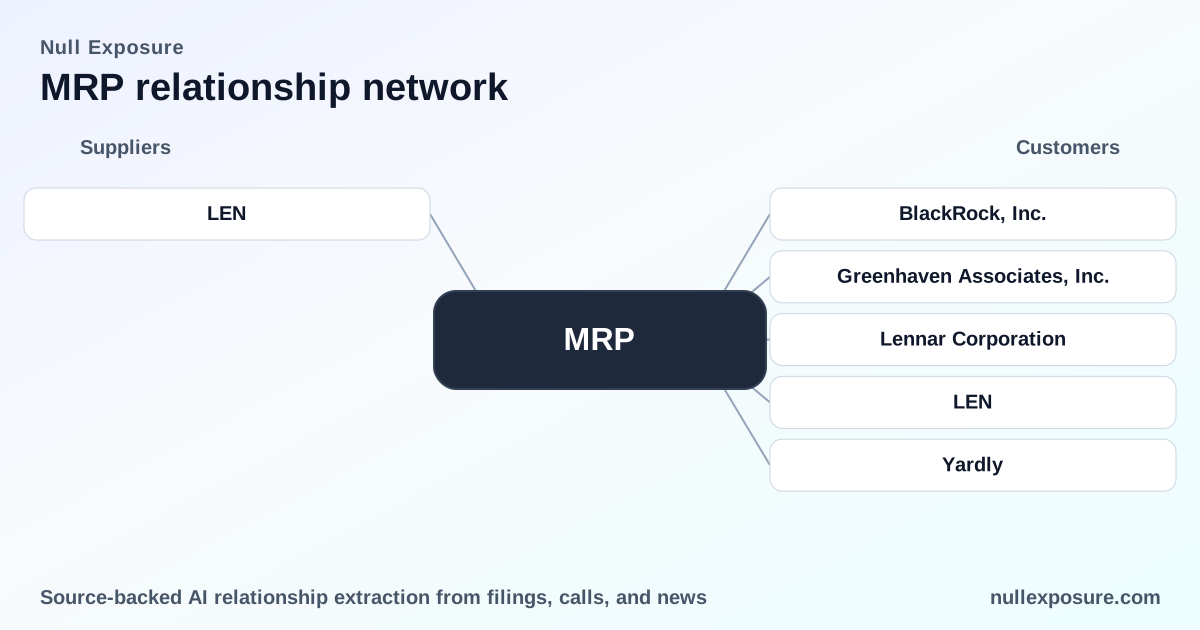
Lennar Corporation / Lennar (LEN) — Foundational customer, program counterparty and largest source of revenue under the Master Program Agreement. Millrose’s FY2024 Form 10‑K states Lennar is its primary customer and that Millrose’s financial results are currently entirely dependent on Lennar exercising Purchase Options; earnings calls and investor slides further report that the company continues to scale outside the Lennar program while Lennar remains central. Source: Millrose 2024 Form 10‑K (FY2024) and 2025 Q4 earnings call / FY2026 press highlights.
-
Greenhaven Associates, Inc. — Significant institutional shareholder or related party located at Millrose’s Brickell address holding roughly 5.11% of Class A shares as disclosed in the 10‑K. This local investor presence is reported in Millrose’s FY2024 shareholder tables. Source: Millrose 2024 Form 10‑K (FY2024).
-
BlackRock, Inc. — Large institutional investor with a double‑digit share position reported in the 10‑K, representing meaningful passive ownership and index/asset manager exposure. BlackRock’s ownership position is disclosed in the FY2024 filings. Source: Millrose 2024 Form 10‑K (FY2024).
-
Yardly — A strategic built‑to‑rent platform that Millrose uses to diversify revenue via option‑fee income and funded JV opportunities; Yardly relationships are positioned to support recurring option fees and yield generation. Media coverage and analyst notes reference Yardly as a channel to expand build‑to‑rent financing and fee income. Source: Sahm Capital coverage and company disclosures (FY2026 commentary).
-
Taylor Morrison — Counterparty to the Yardly financing framework where Kennedy Lewis and Taylor Morrison established a $3 billion built‑to‑rent financing facility, with Millrose holding right‑of‑first‑refusal for funding during an exclusivity period. This arrangement supports Millrose’s ability to access Yardly pipeline opportunities. Source: Investing.com coverage of Q2 2025 slides (FY2025).
-
New Home Co. — One of the third‑party builder counterparties included in Millrose’s expanded portfolio, part of deployments that drove $813 million of third‑party funding at a reported weighted average yield of 11.2%. This transaction-level disclosure signals the company’s ability to deploy capital beyond Lennar. Source: Investing.com Q2 2025 coverage (FY2025).
-
Landsea — Participant in the third‑party deployment mix connected to the New Home Co. transaction and third‑party funding milestones as reported in investor slides. This reflects Millrose’s expanding set of builder counterparties. Source: Investing.com Q2 2025 coverage (FY2025).
Notes on duplicate reporting and media signals: multiple news outlets and the company’s earnings call reiterate Lennar’s role and the pace of third‑party growth (e.g., investment balance outside the Lennar program surpassing management targets); those items are summarized above under Lennar. Sources include The Globe and Mail, Investing.com and company earnings call transcripts (Q4 2025/FY2026 reporting).
Operating model constraints and what they mean for investors
-
Contracting posture: long‑term, framework agreements govern the relationship with Lennar. The Master Program Agreement sets the terms for future property acquisitions and grants ongoing capital priority rights; while agreements have no set expiration, Lennar is under no obligation to commit future transactions, which creates structural concentration risk explicitly documented in the 10‑K.
-
Contract architecture: framework + exercised options. The Master Option Agreement and Project Addenda constitute a framework that translates into revenue only as purchase options are exercised and taken down per schedule.
-
Counterparty scale and criticality: very large enterprise counterparty exposure coupled with critical dependence. Lennar is both a publicly traded builder and Millrose’s primary revenue source; the 10‑K frames this as a core feature of the initial business model and a material dependency.
-
Geography and segment concentration: U.S. focus and an operations‑centric services segment. Properties are located across 29 states and Millrose reports a single operating segment, Homesite Revenue, highlighting concentrated service delivery within the U.S. market.
-
Relationship roles and maturity: Millrose is simultaneously service provider, capital provider, and seller. The company funds development (service_provider), provides homesite options and accepts takedowns (seller), and structures exclusive buyer options for builders (buyer role under the option arrangements). Relationships are active and governed by option schedules that define maturity timings.
-
Spend and scale signal: transaction magnitude is large — $100m+ spend bands and multi‑billion initial asset contributions. Lennar contributed $5.5 billion in land assets and approximately $1 billion in cash at the spin; early option deposits and contributions exceed the $100 million band, establishing scale economics and capital intensity.
Risk and opportunity synthesis
- Risk: High counterparty concentration creates earnings volatility if Lennar slows takedowns or reallocates capital; the master framework grants no guaranteed future volume despite long‑standing economic alignment.
- Opportunity: Proven execution with Lennar establishes a repeatable model and institutional credibility, enabling faster onboarding of additional builders and third‑party capital that expand yields and reduce single‑counterparty dependency over time.
Conclusion and where to look next
Millrose’s investor case is built on a capital‑efficient homesite platform anchored by a large strategic customer and transitioning toward broader third‑party financing. The investment thesis rests on converting option inventories into predictable takedowns while scaling non‑Lennar relationships to dilute concentration risk. For comparative relationship scoring, counterparty concentration dashboards, and continued monitoring, visit https://nullexposure.com/.