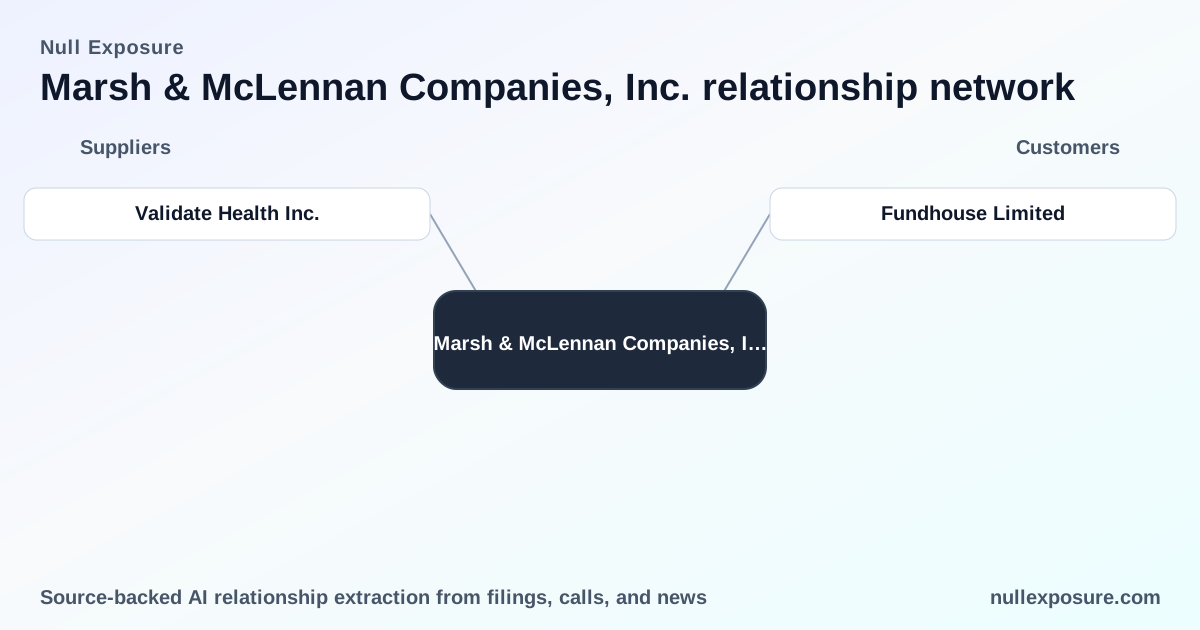
Marsh & McLennan (MRSH): customer relationships that shape an advice-driven franchise
Marsh & McLennan monetizes advice and distribution: the company sells insurance broking, risk advisory, and consulting services to corporations, governments, and individuals around the world, earning fee income and transaction-based commissions across a diversified client base. With roughly $27.5 billion in trailing revenue and a high-margin consulting mix supporting a 24.3% operating margin, MRSH’s growth and risk profile are driven less by capital-intensive underwriting and more by client relationships, channel partnerships, and the stickiness of advisory engagements. For investors and operators evaluating MRSH’s customer-facing posture, the recent additions and partnerships highlighted below illustrate both the firm’s sector reach and its commercial strategy. For a quick overview of how we source relationship signals, visit https://nullexposure.com/.
What to watch in MRSH customer activity
MRSH’s customer and partner disclosures show a dual approach: acquisitive expansion into wealth and advisory niches (to capture recurring advisory fees) and high-visibility sponsorships and strategic partnerships (to broaden brand and referral channels). These moves align with a services-first revenue model where scale in client relationships converts into predictable fee income and cross-sell opportunities across Marsh, Mercer and Oliver Wyman franchises. The two relationships disclosed in the latest documents—an acquisition in the UK wealth-advice space and a high-profile sports partnership—are complementary signals: one strengthens product depth and recurring advisory cash flows; the other amplifies brand and distribution reach.
Notable customer and partner relationships (complete list)
Fundhouse Limited — Mercer acquisition (FY2025)
Mercer acquired Fundhouse Limited and Fundhouse Bespoke Limited, a U.K.-based provider of investment advisory and model portfolio services directed at financial advisors and institutional wealth investors. This purchase expands Mercer’s wealth and model portfolio capabilities, reinforcing its position in recurring advisory fees and platform-based wealth solutions. According to MRSH’s FY2025 10‑K disclosure, the acquisition was presented as part of Mercer’s strategy to bolster its investment advisory product set and distribution to financial advisors.
Formula 1 — Official Risk Partner and Insurance Brokering Partner (announced April 28, 2026)
Marsh, the broking arm of MRSH, announced a multi‑year partnership with Formula 1 naming Marsh as Official Risk Partner and Insurance Brokering Partner. The agreement places Marsh on a global commercial stage and creates bespoke risk advisory and insurance broking exposure across Formula 1’s corporate operations, events and sponsorship ecosystem. A news report published on April 28, 2026, documented the partnership and emphasized its strategic role in raising Marsh’s brand visibility across premium global commercial clients.
How these relationships fit the business model
Both items underscore two persistent characteristics of MRSH’s operating model:
- Services-led monetization with recurring and fee-based drivers. The Fundhouse deal strengthens Mercer’s recurring advisory pipeline—an earnings driver that scales with assets under advisory and product distribution to financial advisors.
- Brand and distribution investments that convert into high-quality client flow. The Formula 1 partnership is a brand-amplification play designed to generate inbound business from global corporates, sponsors, and high-net-worth individuals exposed to the sport.
Together they demonstrate MRSH’s dual path to growth: deepen advisory product lines (to raise lifetime value per client) and broaden global reach (to increase top-line opportunity and cross-sell).
Operating-model constraints and what they mean for investors
MRSH’s disclosures and relationship signals produce a set of company-level operational constraints that should inform diligence:
- Counterparty mix is broad and institutionally diverse. Filings identify government entities, individuals, mid-market firms and large corporates as clients. This breadth supports revenue stability but requires segmented go-to-market strategies and regulatory compliance across client types.
- Global geographic reach is material and dispersed. The firm reports meaningful operations and revenue across North America, EMEA, APAC and Latin America. Geographic diversification lowers single-market concentration risk but increases operational complexity and local regulatory exposure.
- Service-provider posture, not underwriting concentration. MRSH operates primarily as an advisor/broker rather than a principal risk carrier. This translates into revenue volatility that is lower in capital draw but more sensitive to client demand, fee compression and consultative headcount productivity.
- Segment orientation toward services. The company’s organization and revenue drivers are anchored in professional services—risk consulting, insurance broking and human capital advisory—implying higher margin potential but also human-capital intensity and the need to retain technical talent.
These constraints imply that MRSH’s success relies on relationship durability, cross-sell execution, and global scaled delivery rather than capital allocation into underwriting portfolios.
Risk and concentration considerations for operators and investors
- Concentration by client type and region matters more than headline numbers. Although revenue is geographically diversified, a meaningful share derives from North America and corporate clients; product or regulatory shocks in those segments would have outsized earnings impact.
- Talent and retention are core operational risks. A services-led model converts human capital into revenue; acquisition-led growth (like Fundhouse) requires smooth integration to avoid earnings dilution.
- Brand partnerships are marketing tools, not guaranteed revenue drivers. High-profile deals such as the Formula 1 partnership accelerate visibility but require disciplined conversion tracking to translate sponsorship exposure into profitable client relationships.
Investment implications and what to monitor next
- Monitor integration outcomes from the Fundhouse acquisition: asset migration to Mercer platforms, retention of advisor relationships, and the pace at which advisory fees scale into Mercer’s recurring revenue base.
- Track activation and lead-generation metrics from the Formula 1 partnership: inbound enterprise leads, bespoke event-related broking revenues, and any bespoke product launches tied to the relationship.
- Watch quarterly regional revenue trends and consulting utilization rates; given MRSH’s 24.3% operating margin and significant consulting mix, margin expansion depends on utilization and cross-sell rather than underwriting tailwinds.
For a concise, relationship-focused feed on MRSH and peer exposures, visit https://nullexposure.com/ for more structured signal coverage.
Bottom line
Marsh & McLennan’s disclosed customer activity reinforces a services-first growth strategy: targeted acquisitions that deepen advisory recurring fees, coupled with high-visibility partnerships to widen distribution and brand reach. Investors should value MRSH on its ability to convert those relationships into durable, cross-sellable revenue streams while managing the human-capital and regional execution risks inherent to a global professional services franchise.