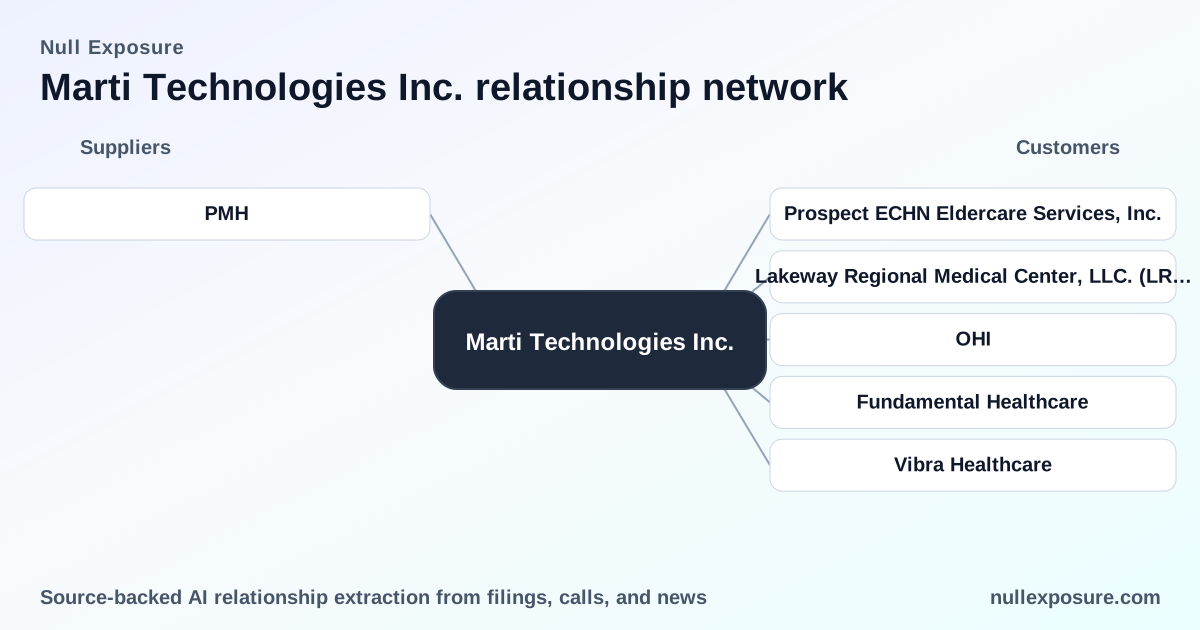
MRT customer map: how MedEquities Realty Trust converts healthcare real estate into recurring rent
MedEquities Realty Trust (ticker: MRT) acquires, finances and leases healthcare properties—using sale-leasebacks, long-term triple-net leases and joint-venture structures—to generate predictable rental income and capital recycling. The business monetizes through long-duration lease cash flows, strategic JV and sale-leaseback transactions with operators, and occasional securities financings that feed acquisition activity. Investors should view MRT as a real-estate operator whose earnings profile is driven more by lease duration, counterparty credit and portfolio turnover than by same-store healthcare revenue growth. For a detailed counterparty and contract map, visit https://nullexposure.com/.
Quick read: what matters to investors
MedEquities’ revenue stream depends on a handful of operator relationships that are typically long-term and contractually insulated (triple-net leases), but the company’s cashflow and valuation are exposed to operator credit risk, regulatory events, and capital-market access. The combination of sale-leaseback transactions and JV purchases creates both steady rent rolls and episodic capital requirements. Key investor focus areas: lease tenure, counterparty concentration, and the company’s ability to finance large, $1m–$100m transactions.
Customer relationships — the counterparties you should know
Prospect ECHN Eldercare Services, Inc.
MedEquities executed a long-term real-estate transaction with Prospect ECHN to support a 130-bed skilled nursing facility under a 12‑year triple-net lease, reflecting the firm’s use of extended lease terms to lock in rental cash flow. According to Skilled Nursing News (June 2017), the transaction involved a 12‑year triple-net lease for the 65,000‑square‑foot facility (https://skillednursingnews.com/2017/06/transactions-medequities-makes-10-million-skilled-nursing-play-connecticut/).
Takeaway: long-duration lease; stable rental profile but tied to operator performance.
Lakeway Regional Medical Center, LLC (LRMC)
MedEquities structured a joint-venture real‑estate investment (MRT‑Lakeway) used to purchase a hospital and lease it back to LRMC, with physicians offered equity in Lakeway Realty as part of the capital structure. A whistleblower-related press summary (FY2022) described MRT’s role in forming the JV and offering physicians investment rights in Lakeway Realty (https://whistleblowersblog.org/false-claims-qui-tam-news/two-whistleblowers-disclosures-led-to-3-million-healthcare-industry-settlement/).
Takeaway: MRT leverages JV structures and equity partnerships to secure asset-backed leases and distribute risk.
OHI
MRT was party to an acquisition agreement whose terms granted shareholders a mix of cash and Omega Healthcare Investors (OHI) shares—0.235 OHI shares plus $2.00 in cash per MRT share—underscoring the strategic consolidation activity in the sector. WeissLaw / BioSpace covered the proposed acquisition terms in FY2019 (https://www.biospace.com/weisslaw-llp-medequities-realty-trust-inc-acquisition-may-not-be-in-the-best-interests-of-mrt-shareholders).
Takeaway: Transaction-level outcomes can materially alter shareholder value; M&A terms tied to peer equity create exposure to acquiror valuation.
Omega Healthcare Investors Inc.
The same FY2019 disclosure described the acquisition terms in full, listing Omega Healthcare Investors as the acquiror offering the share-and-cash consideration (FY2019 coverage at BioSpace). The filing noted the specific exchange ratio and cash consideration per MRT share (https://www.biospace.com/weisslaw-llp-medequities-realty-trust-inc-acquisition-may-not-be-in-the-best-interests-of-mrt-shareholders).
Takeaway: Repeats the OHI transaction detail—useful for triangulating deal economics and counterparty strategic intent.
Fundamental Healthcare
MedEquities completed a purchase-and-leaseback with Fundamental Healthcare that included a 39‑bed long‑term acute care hospital acquisition for $20 million, illustrating MRT’s willingness to deploy $10m–$100m capital into single-asset transactions. PR Newswire reported the transaction as part of a broader FY2014 financing and investment announcement (https://www.prnewswire.com/news-releases/medequities-realty-trust-completes-1639-million-common-stock-offering-and-119-million-of-investments-273007711.html).
Takeaway: Typical deal size sits in the multi‑million dollar band, supporting the company’s recurring rent base.
Vibra Healthcare
MedEquities purchased and leased back a 60‑bed long‑term acute care hospital from Vibra Healthcare for approximately $51 million, reinforcing a pattern of large single-asset sale-leasebacks with major operators. The transaction was disclosed in PR Newswire’s FY2014 release (https://www.prnewswire.com/news-releases/medequities-realty-trust-completes-1639-million-common-stock-offering-and-119-million-of-investments-273007711.html).
Takeaway: Large-ticket leasebacks drive significant incremental rent and require sustained capital access.
Company-level contract signals and constraints
MRT’s public disclosures and transaction language produce several actionable signals about the operating model and capital posture:
- Long-term contracting posture: evidence of extended lease tenors and instrument maturities points to a business that emphasizes durable cash flows over short-cycle revenue. (Company filings reference multi-year lease structures and convertible instrument maturities.)
- Use of subscription/PIPE financing: the company has used convertible note subscriptions and PIPE-style financing to fund growth and acquisitions, indicating reliance on equity-linked instruments when scaling the portfolio.
- Buyer/investor role in private placements: MRT has executed private placements and warrant sales to sponsors, signaling active capital markets management and sponsor-aligned financing.
- Deal-size profile: transactions fall in the $1m–$100m range, with multiple examples in the $10m–$100m band, showing the firm transacts both mid-size and larger single-asset deals.
These are company-level operating characteristics rather than relationship-specific assertions.
Investment implications: what drives upside and what erodes value
MedEquities’ model creates stable, contract-heavy cash flows but embeds several risk vectors: counterparty credit (operator solvency), regulatory exposure in healthcare services, and dependence on capital markets to finance large acquisitions or refinance JV commitments. The FY2019 acquisition talks with OHI and the FY2022 whistleblower-related settlement narrative underscore governance and transaction risk as active components of investor due diligence. Positive catalysts include successful roll-up M&A or refinancing at lower yields; risks include lease defaults that can depress occupancy and require capital-intensive remediation.
For a curated breakdown of counterparties and contractual exposure, explore our counterparty intelligence at https://nullexposure.com/.
Bottom line for investors
MedEquities (MRT) operates as a real-estate-first platform: long-duration, operator-backed leases generate most cash flow, while JV and sale‑leaseback activity dictate capital needs and growth cadence. Monitor operator credit, lease tenors, and the company’s access to convertible and private-placement capital to assess mid-term earnings stability and valuation upside.