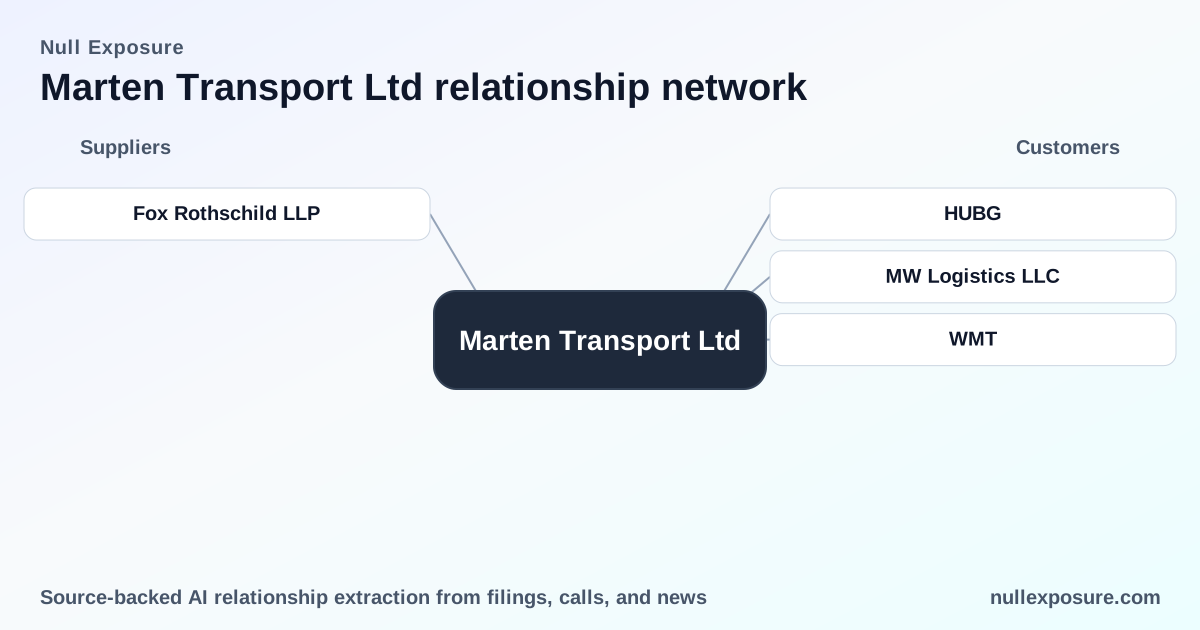
Marten Transport (MRTN): Customer Relationships and Commercial Positioning
Marten Transport operates a temperature-sensitive and dry truckload business across multiple platforms—Temperature-Sensitive and Dry Truckload, Dedicated, Intermodal, Brokerage and MRTN de Mexico—and monetizes by contracting carriage services (both short-term spot and longer-term dedicated agreements), asset-backed intermodal leases and brokerage fees. Revenue is concentrated in the U.S., generated through a mix of one-year customer contracts and multi-year dedicated relationships, with significant dependence on a small set of large customers. For deeper analysis of how these customer relationships affect credit and revenue risk, see Null Exposure’s coverage at https://nullexposure.com/.
How Marten’s customer model translates into cash flow and risk
Marten’s commercial posture is a hybrid of transactional and contractual revenue: the company operates short-duration (typical one-year) customer agreements for many accounts while maintaining three- to five-year dedicated contracts that provide predictable volumes and annual rate reviews. Geographically, Marten is essentially a U.S.-centric carrier — roughly 99% of revenue is generated within the United States, making U.S. freight markets the dominant driver of top-line performance.
Concentration is material: Marten discloses that its top customers and top 30 customer cohort contribute a large share of revenue excluding fuel surcharges, so customer loss or rate pressure among a few large accounts can have a materially adverse effect on results. The company reports revenue and freight it controls on a gross basis because it acts as the principal service provider for most of its segments; that accounting posture underscores operational control but also amplifies top-line volatility when volumes shift.
For background detail and signal coverage, visit https://nullexposure.com/ for our data-driven briefs.
Every customer relationship reported in public sources
Below I cover every customer-related relationship in the file set, with a concise plain-English summary and a source reference.
-
Hub Group, Inc. (HUBG) — Marten executed and closed an asset sale of its intermodal business to Hub Group; the deal transferred over 1,200 refrigerated containers plus intermodal contracts and delivered $51.8 million in cash, with the transaction effective September 30, 2025. According to a GlobeNewswire release and Marten’s third-quarter 2025 results, the asset sale completed as announced in July 2025 and closed October 1, 2025. (GlobeNewswire July 22, 2025; Marten Q3 2025 earnings release, Oct 23, 2025)
-
Hub Group (alternate references: HUBG / Hub Group) — Industry commentary and post-transaction coverage identify the divestiture as closed on October 1, 2025, and note Marten’s subsequent operating reports were the first since that divestiture. Indexbox and other freight-industry reporting reiterated the completion date and integration context. (Indexbox reporting and Marten releases, Oct 2025 / Q4–FY2025 coverage)
-
MW Logistics LLC / MW Logistics, LLC — Marten reports revenue from MW Logistics, a 45% owned affiliate, categorized as non-freight and brokerage revenue in recent periods; the company disclosed affiliate revenue contributions in multiple quarterly reports (millions of dollars in single-digit ranges across recent quarters and years). These disclosures show Marten recognizes affiliate-related revenue and that MW Logistics contributes incremental non-freight revenue to consolidated results. (TruckingInfo coverage of Marten quarterly releases, FY2026 reporting)
-
Walmart (WMT) — Marten’s 2024 Form 10-K explicitly states that Walmart was the company’s largest customer in 2024. The 10‑K establishes Walmart’s scale as a named top customer and serves as the definitive public acknowledgment of that commercial relationship. (Marten Form 10‑K, FY2024)
What the constraints tell investors about the operating model
The textual constraints drawn from company disclosures form a coherent company-level signal about how Marten runs its customer book:
-
Contracting posture: Marten runs a mixed-duration contracting strategy. Most customer agreements are typically one year, while Dedicated contracts extend three to five years with annual rate reviews, providing a balance between revenue flexibility and secured volume. This mix reduces headline volatility from some customers while leaving a sizable portion of revenue exposed to annual renegotiation.
-
Geography and market sensitivity: Marten is effectively a North American carrier operating predominantly in the United States; approximately 99% of revenue is U.S.-based, so U.S. freight cycles and regional temperature-sensitive demand are the primary macro exposures.
-
Concentration and criticality: Company-level disclosures show top customers account for a large share of revenue excluding fuel surcharges (top 30 ≈ 69%, top 10 ≈ 48% as reported), flagging customer concentration as a central credit and revenue risk for investors.
-
Role and accounting posture: Marten reports revenue on a gross basis in segments where it controls the promised service (Intermodal, Brokerage and freight transported under its Truckload and Dedicated segments), which means revenue swings map directly to operational performance rather than pass-through activity.
-
Maturity of relationships: Marten notes longevity among its biggest accounts — eight of its top ten customers have been significant for the last ten years — signaling durable commercial ties with certain large shippers even as overall concentration remains high.
-
Segment diversification: The company has intentionally diversified across six business platforms (temperature-sensitive, dry truckload, dedicated, intermodal, brokerage and Mexico operations), which provides multiple revenue channels but does not eliminate the concentration risk tied to a small number of large shippers.
(These are company-level signals extracted from the public filings and earnings commentary; where a constraint quotes a named customer, that name is used directly.)
Risk highlights and what to monitor
- Customer concentration is the dominant operational risk: large customers drive a material portion of revenue; monitor any public disclosures about contract renewals or volume changes among top accounts.
- Contract-term mix creates asymmetric exposure: dedicated contracts provide runway and rate protection, while the typical one-year terms leave a substantial share of revenue exposed to spot market pressures.
- Strategic asset changes: the intermodal asset sale to Hub Group is cash-generative and reduces Marten’s asset footprint and intermodal exposure, but it also transfers recurring contract revenue and assets off Marten’s balance sheet — investors should watch how the company redeploys proceeds and whether margin and utilization improve post-sale. (GlobeNewswire and Q3 2025 earnings release)
Bottom line: a concentrated, contracted carrier with clearer capital posture after the Hub Group sale
Marten is a U.S.-focused, freight-concentrated carrier that blends short-term and multi-year dedicated contracts to monetize temperature-sensitive and dry freight. The October 2025 intermodal asset sale to Hub Group materially reshapes the company’s asset base and simplifies one line of business while affiliate revenues (MW Logistics) and a small roster of large customers (largest named customer: Walmart) continue to drive results. Investors should weigh durable customer tenure against material concentration and the company’s ongoing ability to convert confined asset proceeds into margin-accretive deployment.
For structured exposure analysis and ongoing relationship tracking, visit Null Exposure at https://nullexposure.com/.