Maravai LifeSciences (MRVI): Customer Relationships That Underpin a Nucleic-Acid Specialty Play
Maravai Lifesciences operates as a specialty manufacturing and services company for the life‑sciences industry, generating revenue by selling nucleic acid production reagents and biologics safety testing services to biopharmaceutical, academic and diagnostic customers worldwide. The firm monetizes through product sales (including high‑volume cap analogs used in mRNA vaccines) and customized testing/service engagements across two segments—Nucleic Acid Production and Biologics Safety Testing—with a mix of direct sales in North America and distributor channels internationally. For deeper platform-level context, visit https://nullexposure.com/.
How Maravai’s commercial model translates to cash flow
Maravai’s economics are driven by two revenue vectors: commodity-like, high-volume reagents (notably CleanCap and other cap analogs) and higher-margin, bespoke testing and assay services. The 2024 Form 10‑K documents the company’s dual-segment structure and global footprint, with roughly half of revenue (49.0% in 2024) generated in North America and the remainder split across Europe, Asia Pacific and other regions. The company reported total revenue of about $185.7 million TTM and discloses that CleanCap-related sales represented ~25.4% of total revenues in 2024, signaling significant product concentration around a single product family.
- Business model characteristics: direct and distributor sales channels, a mix of recurring high-volume reagent demand and project-based service revenue, and customers that range from top global pharma to academic labs.
- Key operating constraints for investors: geographic diversification is real but revenue concentration by product is material; customer base includes government, academic and very large enterprises; distributor resales are part of the go‑to‑market strategy. These are company-level signals drawn from the 2024 Form 10‑K.
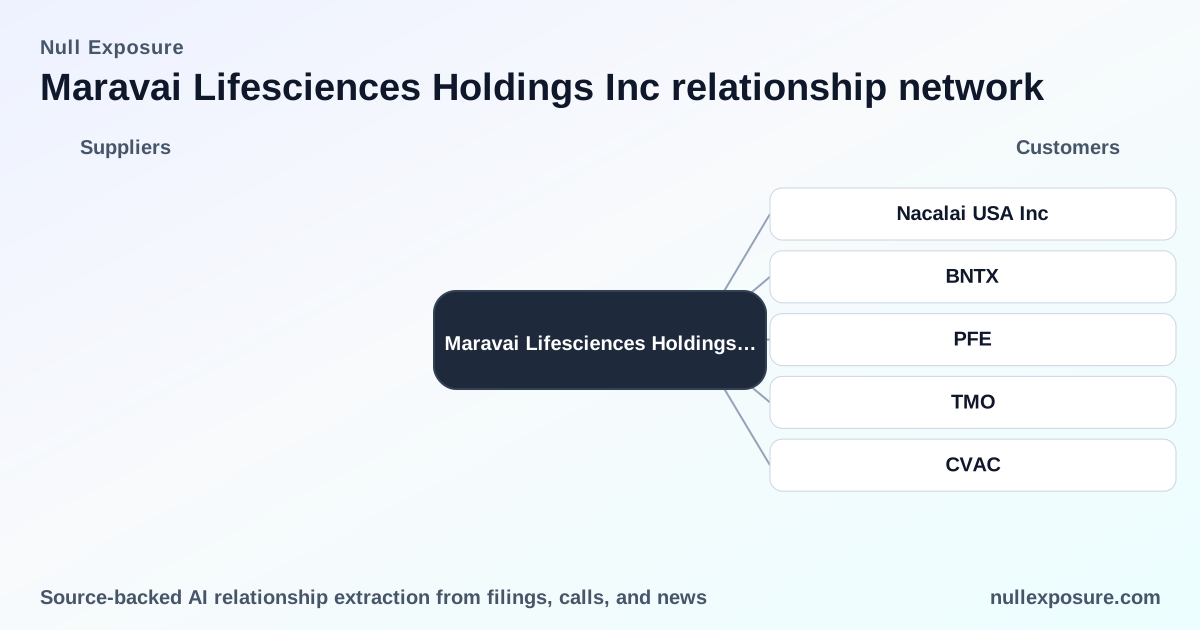
Customer roster and what each relationship means for investors
Nacalai USA Inc
Nacalai USA is listed in Maravai’s 2024 Form 10‑K customer concentration disclosures for both 2023 and 2024, indicating a recurring commercial relationship referenced in the company’s customer concentration risk discussion for those years. (Source: Maravai 2024 Form 10‑K, customer concentration disclosures, FY2023–FY2024.)
BioNTech SE (BNTX)
BioNTech is named in Maravai’s 10‑K under customer concentration for FY2022; this reflects BioNTech’s prior role as a material customer during the pandemic-era vaccine programs. (Source: Maravai 2024 Form 10‑K, customer concentration disclosure referencing FY2022.)
Pfizer Inc (PFE)
Pfizer similarly appears in the 10‑K’s customer concentration disclosures for FY2022, documenting Pfizer as a historically important commercial counterparty within vaccine and therapeutic supply chains. (Source: Maravai 2024 Form 10‑K, customer concentration disclosure referencing FY2022.)
CureVac (CVAC)
CureVac is included in the 10‑K customer concentration and accounts‑receivable benchmark disclosures for FY2023, registering as a named customer in Maravai’s regulatory reporting. (Source: Maravai 2024 Form 10‑K, customer concentration and accounts receivable benchmark, FY2023.)
Thermo Fisher Scientific (TMO)
Maravai expanded its CDMO enablement strategy with a license and supply agreement for CleanCap with Thermo Fisher Scientific, according to Maravai’s August 11, 2025 press release reported on GlobeNewswire and reiterated in industry news. This is a strategic commercial relationship that combines a proprietary reagent license with large-scale supply, underscoring CleanCap’s role as a commercial core product. (Source: Maravai press release published on GlobeNewswire, August 11, 2025; echoed in QuiverQuant coverage.)
DYAI (Dyadic-linked news)
A March 28, 2024 news release tracked in MRVI’s coverage referenced Dyadic’s partnership to develop and supply a C1 Host Cell Protein ELISA assay kit for batch release testing; this item is associated with Maravai’s biologics testing ecosystem in news monitoring and indicates overlapping industry activity in host‑cell protein assays and batch release services. (Source: GlobeNewswire de news release, March 28, 2024.)
What these relationships signal about risk and concentration
The mix of customers named in Maravai’s filings and press mentions reveals several concrete investor signals:
- Customer concentration is real and product-driven. CleanCap and cap analog sales accounted for ~25.4% of revenue in 2024, which creates both a growth lever and a concentration risk tied to a small set of high‑volume programs (Source: 2024 Form 10‑K disclosure).
- Counterparty profile skews large and institutional. The company explicitly serves top global biopharma companies, academic institutions and government entities—this delivers credit quality benefits but increases exposure to program discontinuations among a small number of large accounts (Source: 2024 Form 10‑K customer descriptions).
- Global geographic exposure cushions single‑market cycles. Roughly 51% of revenue came from outside the U.S. in 2024, with material shares in North America, EMEA and APAC, supporting diversified demand dynamics (Source: 2024 Form 10‑K revenue geography table).
- Channel mix introduces resale dynamics. Maravai sells through distributors for portions of its business; distributors resell to end customers, adding intermediary credit and margin dynamics to revenue realization (Source: 2024 Form 10‑K revenue channel disclosures).
For investors evaluating MRVI customer risk, these bullets translate into a balancing act: high-margin, specialty reagent exposure (CleanCap) drives revenue and valuation sensitivity, while the Biologics Safety Testing business provides a steadier, services-oriented revenue stream that mitigates some volatility.
Learn more about how we surface customer relationships and monitor concentration risk at https://nullexposure.com/.
Practical investor takeaways
- Concentration, not opacity, is the main risk: Maravai discloses key customer names and quantifies CleanCap’s revenue share, so downside is measurable rather than hidden.
- Counterparty quality is strong but program dependent: Large pharma and institutional customers reduce credit risk but increase dependency on a handful of programs and product cycles.
- Strategic partnerships diversify go‑to‑market: The CleanCap license and supply agreement with Thermo Fisher scales manufacturing reach while locking in a commercial partner for a core product.
Bottom line: Maravai’s revenue profile is anchored by a material single-product exposure (CleanCap) embedded in a broader set of institutional customer relationships and global demand channels. That structure rewards careful monitoring of a few large counterparties and product program trajectories when modeling revenue and downside scenarios.
For ongoing coverage of customer concentration and counterparty exposure across life‑sciences suppliers, visit https://nullexposure.com/.