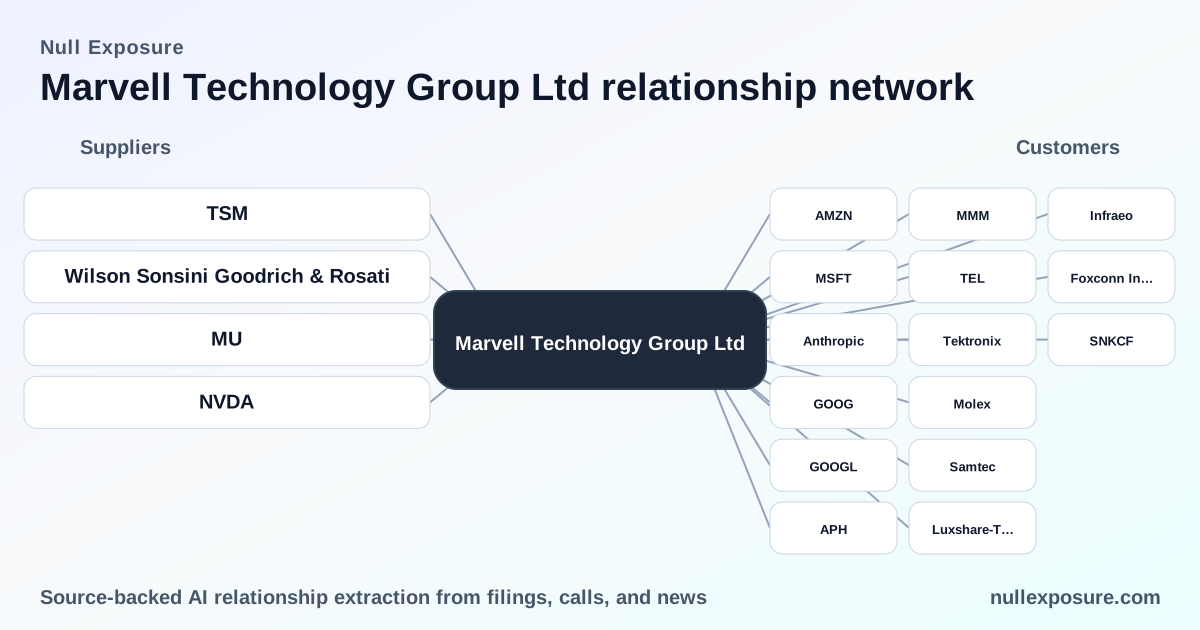
Marvell’s customer map: hyperscalers, partners and the commercial constraints that drive valuation
Marvell Technology is a fabless semiconductor designer that monetizes by selling integrated circuits and bespoke “co‑design” services to data‑center customers and networking ecosystems — from off‑the‑shelf SerDes and memory controllers to custom XPUs and optical interconnect DSPs. The company converts engineering-led relationships into product revenue, licensing/IP uplift and recurring networking optics sales; FY‑2026 revenue trends and investor commentary position Marvell as a core vendor for hyperscaler AI infrastructure. For primary research on customer signals, see NullExposure’s synthesis at https://nullexposure.com/.
Why hyperscaler co‑design matters for investors
Marvell’s strategic position is not commodity silicon — it is co‑design with hyperscalers and supply to the AI data‑center stack. News coverage across Q1–Q2 2026 documents repeated design wins and ecosystem partnerships that drive both short‑term revenue ramps and long‑term platform stickiness. That dynamic is the primary growth lever investors should underwrite: the company captures value not only from chip sales but from integrated connectivity and optical subsystems that are hard to substitute once deployed.
If you want a consolidated view of Marvell’s customer relationships and their market implications, see our homepage for the dataset and analyst briefing: https://nullexposure.com/.
Key operating constraints that shape commercial risk and upside
- Contracting posture is mixed. Marvell typically sells under purchase orders rather than long‑term blanket commitments, but corporate disclosures also note incentive instruments issued to customers (a multi‑year warrant). This combination means revenue is both transactional and strategically anchored through selective long‑horizon arrangements.
- Revenue concentration is material. Public filings show two customers exceeded 10% of revenue in fiscal 2025 and the top ten customers accounted for 81% of net revenue, indicating a high concentration profile that amplifies both upside from wins and downside if a hyperscaler shifts sourcing.
- Geographic dependency is high in APAC. Roughly 75% of shipments were to customers operating in Asia in fiscal 2025, which is a company‑level exposure to regional demand cycles and supply‑chain geopolitics.
- Role mix: direct customers and distributors. Marvell sells both directly to hyperscalers and through distributors (one distributor accounted for a substantial share in FY‑2025), producing variability in margin capture and visibility.
- Segment focus is infrastructure and hardware. Marvell’s reported segment emphasizes data‑infrastructure semiconductor solutions — from data‑center core connectivity to edge network hardware — confirming product stickiness once integrated.
Those constraints are company‑level signals derived from the firm’s fiscal disclosures and public reporting; they explain why reported design wins translate into lumpy but high‑value revenue streams rather than uniform growth.
Relationship map: every customer and partner cited in recent reporting
Below are concise, source‑attributed descriptions for each customer/partner mentioned in the collected results.
Amazon / Amazon Web Services (AMZN)
Marvell is a primary design partner for Amazon’s custom AI processors (including Trainium and related programs) and supplies custom XPUs and supporting networking silicon to AWS, positioning Amazon as one of Marvell’s largest hyperscaler customers (multiple reports, March–May 2026). Source: SiliconAngle and Finterra coverage, Mar–Apr 2026.
Microsoft / Microsoft Azure (MSFT)
Marvell provides high‑speed SerDes, memory controllers and other interconnect components used in Microsoft’s Maia program and broader Azure AI infrastructure, reflecting deep co‑design relationships. Source: Finterra / FinancialContent, Mar–Apr 2026.
Google / Google Cloud (GOOG / GOOGL)
Market commentary links Marvell to Google Cloud custom inference and TPU work, and notes Marvell’s optical DSP and interconnect technology integration following acquisitions that support Google design activity. Source: FinancialContent and MarketBeat reporting, Apr–May 2026.
Meta (META)
Analysts and research features cite Marvell as a co‑design partner for hyperscalers including Meta, indicating Marvell’s silicon is part of the broader AI‑infrastructure buildout across major cloud operators. Source: FinancialContent, Apr 2026.
NVIDIA (NVDA)
Nvidia’s strategic investment and expanded partnership (reported $2 billion commitment) reinforce Marvell’s role supplying connectivity and scale‑up networking compatible with Nvidia ecosystems, including joint solutions that combine Marvell XPUs with Nvidia interconnects. Source: MarketBeat and TradingKey coverage, Apr 2026.
Anthropic
Marvell supplies custom chips used by Anthropic for its Claude models, linking AI model scaling to ongoing demand for Marvell’s custom silicon in inference and training pipelines. Source: Trefis analysis, Feb 2026.
TE Connectivity (TEL)
TE Connectivity appears among Marvell’s ecosystem partners demonstrating Marvell‑powered interconnect solutions at trade shows, indicating an OEM/channel partner role for connector and cable systems in deployed data‑center hardware. Source: InvestingNews, Mar 2026.
Amphenol (APH)
Amphenol is listed as an ecosystem partner demonstrating Marvell‑powered interconnects, evidencing supply‑chain and connector partner relationships for optical and high‑speed assemblies. Source: InvestingNews, Mar 2026.
3M (MMM)
3M is named among ecosystem exhibitors for Marvell solutions, representing fastening, adhesive and components suppliers that integrate into Marvell’s interconnect systems. Source: InvestingNews, Mar 2026.
Foxconn Interconnect Technology (FIT)
Foxconn FIT is shown as an ecosystem partner at DesignCon, signaling manufacturing and interconnect assembly partnering for Marvell‑enabled hardware. Source: InvestingNews, Mar 2026.
Infraeo
Infraeo appears in Marvell partner lists for interconnect demonstrations, reflecting regional assembly and channel support roles. Source: InvestingNews, Mar 2026.
Luxshare‑Tech
Luxshare‑Tech is listed among partners showcasing Marvell‑powered solutions, indicating component and cable assembly collaboration in the supply chain. Source: InvestingNews, Mar 2026.
Molex
Molex is included in the exhibitor roster supporting Marvell interconnect demonstrations, a typical signal of component‑level partnerships for data‑center hardware. Source: InvestingNews, Mar 2026.
Samtec
Samtec’s presence among Marvell partners shows alignment on high‑speed board‑level connectors and cable systems used in Marvell‑enabled racks and systems. Source: InvestingNews, Mar 2026.
SENKO
SENKO is listed as an ecosystem partner, consistent with fiber and optical connector supply into Marvell’s interconnect solutions. Source: InvestingNews, Mar 2026.
Tektronix
Tektronix appears among partners demonstrating Marvell technology, suggesting test and measurement ecosystem integration for Marvell product validation. Source: InvestingNews, Mar 2026.
WBTN (Webtoon)
A media partnership item referencing WBTN is present in the dataset (unrelated to semiconductor customers); it reflects broader media news captured in the corpus but not a commercial data‑center relationship. Source: Los Angeles Business Journal, May 2026.
What this customer map means for investors
- Growth thesis: Marvell’s value is driven by hyperscaler co‑design wins (Amazon, Microsoft, Google) and expanded ecosystem endorsements (Nvidia and optical/connectivity partners). These relationships underpin multiple future revenue vectors: custom XPU sales, interconnect modules and recurring optics.
- Risk: high customer concentration and APAC revenue exposure create asymmetric delivery risk — a lost train of chip orders or a hyperscaler procurement pivot materially affects near‑term results.
- Margin dynamics: distributor vs direct sales, and custom design service revenue, produce variable margins and lumpy guidance.
Bottom line
Marvell is centrally positioned in the AI data‑center stack through a co‑design, ecosystem‑led commercial model that converts engineering relationships into differentiated, higher‑value product revenue. Investors should balance the material upside from hyperscaler scale against the company’s concentration and geographic exposure when sizing positions.
For a structured data pack and model-ready brief on these relationships, visit our research hub at https://nullexposure.com/.